


7 Alternatives to Standard Front Clip Harnesses in 2026
Table of Contents
- Why Standard Front Clip Harnesses Aren't Always the Answer
- The Best Alternatives to Standard Front Clip Harnesses at a Glance
- Dual-Clip Dog Harness Benefits for Training and Walks
- Head Halters for Dogs: A Gentle Steering Alternative
- How to Stop a Dog Pulling on the Lead with the Right Gear
- Understanding Harness Pressure Points and Dog Anatomy
- Choosing the Right Alternative for Your Dog's Body Type
- Conclusion: Match the Tool to the Dog, Not the Trend
- Frequently Asked Questions
Last Updated: September 7, 2026
Why Standard Front Clip Harnesses Aren't Always the Answer
A standard front clip harness attaches the lead to a ring on the dog's chest, a useful training aid for discouraging pulling. However, these designs often concentrate force on a narrow pressure point across the sternum, restricting natural shoulder movement and causing discomfort over longer walks.
Conformation, coat type, and temperament all influence which walking equipment works best. For many owners, alternatives to standard front clip harnesses provide better comfort, more control, or both. Below, we break down the strongest options available in 2026 and explain which dogs benefit most from each.
The Best Alternatives to Standard Front Clip Harnesses at a Glance
Choosing the right alternative comes down to the problem you are solving. If your dog pulls moderately, a dual-clip harness gives flexibility. If pulling is persistent and strong, a head halter offers more steering control. For dogs that dislike anything around their chest, a well-fitted Y-shaped harness often resolves the issue.
| Alternative | Best For | Key Benefit | Consider If |
|---|---|---|---|
| Dual-Clip Harness | Most dogs, training sessions | Two attachment points for versatility | You want one harness for all situations |
| Head Halter | Strong pullers, reactive dogs | Maximum control with minimal force | Your dog accepts gear near the face |
| Y-Shaped Harness | Deep-chested breeds | Allows full shoulder mobility | You prioritise long-term comfort |
| Winter Coat with Harness | Small or short-haired dogs | Warmth and walking gear combined | You walk in cold, wet weather |
| Tactical Harness Set | Active or working dogs | Durability and multiple attachment points | You hike or train regularly |
Dual-Clip Dog Harness Benefits for Training and Walks
Dual-clip dog harness benefits come down to having the right tool for the moment. A harness with both front and back D-rings lets you switch attachment points without changing equipment, front for training, back for relaxed strolls once your dog walks calmly.

This versatility makes a dual-clip harness the most practical single purchase for most owners. The No Pull Reflective Dog Harness from Doggo Shop offers this design with a breathable polyester build and padded chest plate that distributes tension evenly. At £19.99, it includes reflective stitching, adjustable straps, quick-release buckles, and suits dogs from small to extra-large.

Head Halters for Dogs: A Gentle Steering Alternative
Head halters for dogs work on a different principle. Rather than wrapping the chest, a head halter loops around the muzzle and behind the ears, giving you control over the dog's head direction. When the dog pulls, gentle pressure turns their head toward you, interrupting the pulling without causing pain.
These are particularly effective for strong dogs that overpower their owners. A head halter requires no physical strength to manage a determined puller. The trade-off is that some dogs need a gradual introduction to wearing gear around their face. The PDSA advises that any training aid should be introduced patiently and paired with positive reinforcement to avoid stress (PDSA dog behaviour advice). Start with short sessions indoors, reward calm behaviour, and only attach the lead once your dog is relaxed.
How to Stop a Dog Pulling on the Lead with the Right Gear
Most owners expect a new harness to be a magic switch that flips off pulling. It is not. The gear is a management tool that makes training easier, but the habit only changes through consistent, structured practice.
Identify the Pull Pattern First
Before buying anything, watch your dog on a loose lead for five minutes. There are two distinct patterns:
- The Constant Puller: This dog leans into the collar or harness like a husky in a sled race. They are often motivated by forward movement itself. For this dog, a dual-clip harness used on the front ring provides the most leverage for redirection.
- The Reactive Lunger: This dog pulls specifically when they see a trigger, another dog, a squirrel, a bicycle. The pull is a sudden burst of adrenaline. For this dog, a head halter offers the most effective way to interrupt the lunge before they hit the end of the lead, because turning the head redirects the entire body axis.
The 3-Second Rule for Loose-Lead Walking
The most effective protocol for the constant puller is the 'stop-start' method, executed with precision. When your dog forges ahead and the lead tightens, stop dead. Do not yank, do not speak. Wait. The instant the dog takes one step back toward you or turns their head to look at you, mark it with a 'yes' and reward with a high-value treat at your heel line. Then walk on.
The critical detail is the three-second window. If you do not reward within three seconds of the correct behaviour, the dog does not associate the reward with the action (avsab.org). Keep treats in a waist pouch and deliver the reward the moment slack appears in the lead.
The 'Turn and Treat' for Reactive Lungers
For the reactive lunger wearing a head halter, the protocol is different. You cannot stop and wait, the trigger is still there and the dog is over threshold. The moment you see the trigger at a distance where your dog is still calm (usually 10-15 metres away), execute a sharp 180-degree turn and walk the other way, saying 'this way' cheerfully and rewarding your dog for following.
When to Switch Attachment Points
A dual-clip harness gives a clear progression path. Start every walk on the front clip for the first ten minutes. Once your dog settles and walks with a slack lead, switch to the back clip for the remainder. This teaches that calm behaviour earns freedom from the restrictive front attachment.
The Role of the Harness in the Training Loop
The harness is not punishing the pull; it is preventing the dog from being rewarded by forward motion. A standard front clip harness that sits too low on the sternum can tip the dog's balance forward, encouraging them to lean into the pressure. Y-shaped or dual-clip designs with a higher sternum placement allow you to redirect without altering the dog's centre of gravity.
Pairing the correct gear with a structured, reward-based protocol addresses both physical management and the behavioural habit simultaneously.
Understanding Harness Pressure Points and Dog Anatomy
The canine shoulder is not fixed to the skeleton like a human shoulder; it is held in place by muscle and tendon. A poorly designed harness across the shoulder blades can restrict movement and, over time, cause gait problems. This is why the Y-shaped design, where the two front straps meet between the shoulder blades, matters so much.
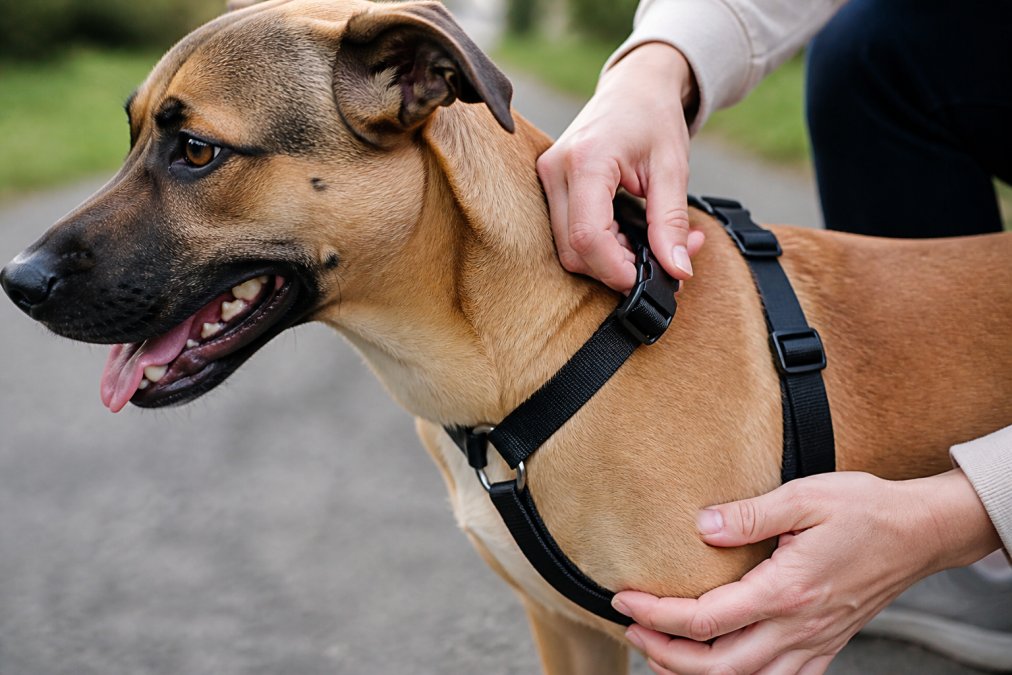
A correctly fitted harness should allow full, natural shoulder mobility and distribute tension across the chest rather than concentrating it on one point. Research from the Royal Veterinary College's canine biomechanics work highlights how important unrestricted movement is for long-term joint health. Look for a padded chest plate and breathable mesh lining that prevents chafing, and check that the front D-ring sits over the sternum, not the throat.
Choosing the Right Alternative for Your Dog's Body Type
Selecting the correct harness shape is only half the battle. The other half is getting the dog to accept wearing it. Many owners buy the perfect Y-shaped harness for their deep-chested Greyhound, only to find the dog freezes, rolls over, or bolts when they try to put it on. This is not stubbornness, it is a sensory and emotional response to a novel, restrictive feeling around the torso.
The Morphology Match
First, let us solidify the fitment rules for the two most common body shapes:
- Deep-Chested Breeds (Greyhounds, Weimaraners, Dobermanns): Their ribcage is narrow from side to side but deep from spine to sternum. Standard harnesses with a single girth strap tend to rotate sideways because there is not enough surface area to grip. A Y-shaped harness with a longer sternum plate and a strap that runs behind the elbows will stay centred. Look for a harness where the front attachment ring sits directly over the manubrium (the bony bump at the front of the chest), not lower down where it can press on the trachea.
- Barrel-Chested Breeds (Bulldogs, Pugs, French Bulldogs): These dogs have a wide, round ribcage and a short neck. The challenge is finding a harness that does not dig into the armpits or slide forward into the throat. A harness with a wide, padded chest plate and generous girth adjustment is essential. Avoid designs with a narrow strap that sits diagonally across the chest, it will chafe and restrict front leg movement.
The Desensitisation Protocol for Harness-Shy Dogs
If your dog already panics at the sight of the harness, do not force the issue. Instead, follow this five-day protocol, spending 5-10 minutes per session:
Day 1: The Look. Place the harness on the floor next to their food bowl. Every time they look at it or sniff it, mark and reward. The goal is to create a positive association with the object itself.
Day 2: The Touch. Hold the harness open and let them sniff it. Gently touch the harness to their shoulder, then immediately reward. If they flinch, pull back and go slower. The threshold is: if they tolerate the touch for two seconds, you are ready to progress.
Day 3: The Wrap. Drape the harness over their back without buckling anything. Reward them for standing still. Then, bring the straps around their chest and hold them in place for three seconds without clipping. Reward and release. Repeat this five times, gradually increasing the hold time.
Day 4: The Buckle. Clip the harness on loosely, loose enough that you can fit your entire flat hand between the strap and the dog's body. Do not attach the lead. Let them walk around the house wearing it for five minutes. Distract them with a game of tug or a treat scatter. The goal is to show that the harness predicts fun, not restraint.
Day 5: The Walk. Attach the lead and walk indoors first. Keep the session short and high-reward. If the dog walks happily, progress to the garden, then the street over the next few days.
Why This Matters More Than the Product
A well-fitted harness on a stressed dog is still a failed walk. The desensitisation protocol is the difference between a tool that works and one that ends up in the drawer.
For small or short-haired dogs that feel the cold, the Waterproof Winter Dog Jacket with Built-In Harness at £19.99 combines warmth with walking practicality via a windproof, water-resistant outer layer and integrated harness. For active or working breeds, the Tactical Dog Harness Set at £59.99 provides military-grade polyester construction, reinforced metal buckles, and a top handle for instant control. Whichever you choose, invest the five days in the introduction, your dog will thank you with a relaxed, happy walk.
Conclusion: Match the Tool to the Dog, Not the Trend
Standard front clip harnesses serve a purpose, but they are not the only option. The best choice depends on your dog's body shape, pulling behaviour, and tolerance for different gear types. Dual-clip harnesses offer the most flexibility for training, head halters provide maximum steering control for strong pullers, and Y-shaped designs protect shoulder mobility for active dogs.
Every purchase from Doggo Shop supports rescue dogs and cats in need worldwide, so you can upgrade your walking gear knowing it makes a difference. Explore our range of no-pull harnesses, winter coats, and tactical sets to find the right fit for your dog. Get started with Doggo Shop and give your pup the walking comfort they deserve.
Frequently Asked Questions
Do front clip dog harnesses actually work?
Yes, they work well for many dogs. The front D-ring redirects your dog's forward momentum back towards you, which discourages pulling. However, they are not the only option. If your dog pulls excessively, has a sensitive throat, or is deep-chested, a standard front clip may cause discomfort or chafing. Alternatives like dual-clip models, head halters, or Y-shaped harnesses often provide better control and comfort without restricting shoulder movement.
What can I use instead of a harness?
For dogs that need more control, a head halter for dogs is a popular alternative. It fits around the muzzle and neck, giving you steering control similar to a horse's halter. This is especially effective for reactive dogs because it works on the dog's natural follow instinct. However, it requires a gradual desensitisation process. Another option is a martingale collar, but it offers less control for strong pullers than a well-fitted harness.
What is the best front clip dog harness in the UK?
Many owners in the UK prefer a dual-clip harness because it offers flexibility. You can attach the lead to the front D-ring for training sessions to discourage pulling, or switch to the back clip for relaxed walks. Look for models with a Y-shaped design to avoid restricting shoulder movement. The No Pull Reflective Dog Harness from Doggo Shop is a solid choice, featuring breathable padding and reflective stitching for UK weather.
What dog harness to avoid?
Avoid harnesses that restrict your dog's natural gait. Look out for designs with a straight chest strap that sits across the shoulder blades, as these can interfere with front leg movement and cause long-term joint issues. Also, avoid any harness that rubs or chafes under the armpits. A well-designed harness should allow full shoulder mobility while distributing pressure evenly across the chest, not concentrating it on the neck or spine.
Are back-clip harnesses better for a dog's posture?
Back-clip harnesses are generally better for a dog's natural posture during relaxed walks because they do not put pressure on the chest. However, they offer little to no control against pulling. A dog can easily lean into a back-clip harness and pull with its full body weight. For this reason, a dual-clip harness is often the best compromise, allowing you to use the back clip for casual strolls and the front clip for training or reactive moments.


Leave a comment