


Why Use a Travel Dog Crate for Car Safety
Table of Contents
- Why a Travel Dog Crate Is the Safest Choice for Car Journeys
- Dog Crate vs Car Harness: Which Restraint Actually Protects Your Dog?
- How to Secure a Dog Crate in a Car the Right Way
- Choosing the Best Dog Crate for Car Travel: What to Look For
- Crate Types Compared: Soft, Plastic, and Metal Options
- Helping Your Dog Adjust to a Travel Dog Crate
- Conclusion
- Frequently Asked Questions
Last Updated: October 8, 2026
Why a Travel Dog Crate Is the Safest Choice for Car Journeys
A travel dog crate is a secure, enclosed carrier designed to hold your dog safely in place during a car journey. It works by limiting movement in a crash, so your dog cannot become a projectile or scramble into the footwell.
The answer is simple: a crate is the safest option for most dogs on most journeys.
Why? Because it does two jobs at once. It protects your dog, and it protects you. An unrestrained dog can injure everyone in the car, including itself.
That is the core of why use a travel dog crate for car safety. It is not about convenience. It is about control.
- Contains your dog during sudden braking or a crash
- Stops distraction while you drive
- Gives your dog a calm space on long trips
The Highway Code states that drivers must secure loads properly, and a dog counts as a load. You can read the full guidance at The Highway Code on securing loads.
Below, we break down how crates compare to harnesses, how to fit one correctly, and how to pick the right one.
Dog Crate vs Car Harness: Which Restraint Actually Protects Your Dog?
A crate offers better overall protection than a car harness for most dogs. A harness straps your dog to a seat belt, but it still leaves the dog loose in the cabin.
That matters. A harnessed dog can still be thrown forward. It can also tangle in the belt during a crash.
A crate, by contrast, keeps your dog in one contained space. The crate itself absorbs some of the force.
Here is the honest trade-off:
| Option | Best For | Main Strength | Main Weakness |
|---|---|---|---|
| Travel dog crate | Dogs who settle in enclosed spaces | Full containment | Takes up boot space |
| Car harness | Dogs who hate crates | Easy to store | Less containment |
| Booster seat | Small dogs only | Good visibility | Limited protection |
Size decides a lot here. A large dog may not fit a crate in a small car. In that case, a good harness is your next best bet.
How to Secure a Dog Crate in a Car the Right Way
Securing a dog crate means strapping it to fixed anchor points so it cannot slide or tip. A loose crate is almost as risky as no crate at all.
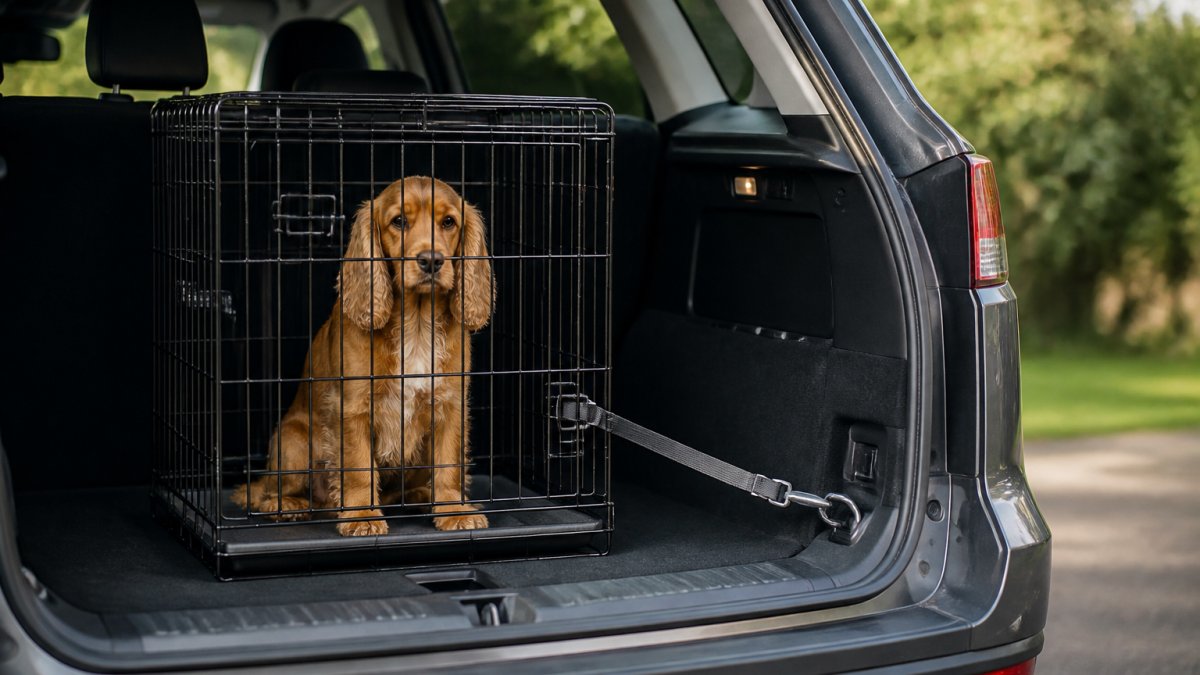
Start with the boot. It is the safest place for a crate in most cars.
Boot Placement and Strapping Methods
Place the crate so it sits flat and cannot shift. Then strap it down.
- Use the car's built-in tie-down points or luggage anchors
- Run straps over the top and around the crate, not just the base
- Pull each strap tight, then check again after a short drive
- Keep the crate away from the rear window where possible
If your car has no anchor points, a boot liner with a non-slip base helps. It is not a full fix, but it reduces sliding.
Mistakes That Weaken Crate Security
A common mistake is trusting the crate's own weight. A heavy crate can still slide in a crash.
Other errors we see often:
- Strapping only the front of the crate
- Leaving slack in the straps
- Placing the crate on a smooth, slippery boot floor
- Using a crate that is too big, so the dog moves around inside it
Choosing the Best Dog Crate for Car Travel: What to Look For
The best dog crate for car travel is one that fits your dog, fits your car, and can take a knock. Get those three right and you are most of the way there.
Look for these features:
- Strong frame that holds its shape under pressure
- Secure door latch your dog cannot nudge open
- Ventilation on more than one side
- Easy-clean base for accidents and muddy paws
Size, Materials, and Crash-Test Standards
Size comes first. Your dog needs room to stand, turn, and lie down, but not so much that it slides around.
Measure your dog from nose to tail, then add a little space. Then measure your boot before you buy.
On crash testing, be careful. There is no single UK law that forces crates to pass a crash test. Some makers test their own products and publish the results. Others do not.
So check the maker's claims, and ask what testing they did. If they cannot tell you, treat it as a warning sign.
Crate Types Compared: Soft, Plastic, and Metal Options
Metal crates are the sturdiest choice for car travel. Soft crates are the lightest. Plastic crates sit in the middle.
Each type suits a different dog and a different car.
- Metal crates: Strong, long-lasting, best for daily car use. Heavier and pricier.
- Plastic crates: Easy to wipe clean, good for travel and vet trips. Less airflow than metal.
- Soft crates: Light and foldable, great for occasional trips. Not built for strong chewers.
For a power chewer, soft crates rarely last. We hear this from owners all the time. A metal crate is the safer buy.
If you travel often, look for a crate that folds flat. It saves space when you are not using it.
Doggo Shop offers a curated selection of premium dog products designed to keep your pup happy, healthy, and comfortable. From interactive toys and smart feeders to durable leashes and cozy beds, we provide high-quality essentials that cater to your dog's daily needs.
Helping Your Dog Adjust to a Travel Dog Crate
Most dogs settle into a crate within a few short trips if you build up slowly. Rushing it is the main reason dogs resist.
Try this routine:
- Leave the crate open at home for a few days
- Feed your dog near it, then inside it
- Close the door for a few seconds, then open it
- Take one short drive around the block
- Build up to longer journeys over a week or two
Add a familiar blanket and a favourite toy. A treat or two helps too.
If your dog drools, pants, or shakes, slow down. Go back a step. Patience beats force every time.
Conclusion
Car journeys with your dog should feel safe for both of you, not stressful. A secured travel dog crate gives you that peace of mind, and it keeps your dog protected when it matters most.
At Doggo Shop, we help owners find gear that lasts. Our premium crates, leads, and travel essentials are made for dogs who go everywhere with you. And with every order, we donate to rescue dogs in need worldwide.
Get started with Doggo Shop and give your dog a safer ride. [SHOP NOW]
Frequently Asked Questions
Why should dogs travel in a crate in the car?
A crate stops your dog from moving around the cabin, which reduces the risk of distraction and injury during sudden braking. It also gives them a familiar, enclosed space that can lower anxiety on longer journeys. In a crash, a properly secured crate keeps your dog contained and away from airbags and loose items. For many dogs, the crate becomes a positive travel cue, making trips calmer for everyone.
Are dog crates safer than harnesses in a car?
It depends on the crate and the harness. A crate that is secured to the car's chassis or tie-down points and has passed a recognised crash test offers excellent protection. A harness must be paired with a seatbelt loop and has to fit correctly to work well. For dogs that settle easily in a crate, it often provides more consistent containment. For very large dogs or small cars, a high-quality harness may be more practical. Always choose equipment that has been tested to a recognised standard.
How do you secure a dog crate in a car?
Place the crate in the boot or on the back seat where it cannot slide. Use ratchet straps or heavy-duty webbing to attach the crate to the car's tie-down anchors or ISOFIX points. Pull the straps tight so the crate cannot shift more than a centimetre in any direction. If your car has a cargo net, use it as a secondary restraint. Avoid bungee cords, which stretch and allow movement. Check the straps before every trip.
What size crate should I use for my dog in the car?
Your dog needs enough room to stand up, turn around, and lie down flat. If the crate is too large, your dog may be thrown around inside it during sudden stops. If it is too small, they will be uncomfortable and may resist getting in. Measure your dog from nose to tail and add a few centimetres, then check the crate's internal dimensions. For car travel, a crate that fills the boot space without blocking your rear view works best.


Leave a comment