


Waterproof Dog Travel Bed vs Standard Car Bed
Table of Contents
- Waterproof Dog Travel Bed vs Standard Car Bed: The Key Differences
- What Counts as a Standard Car Bed
- What Counts as a Waterproof Travel Bed
- Side-by-Side Comparison: Waterproof vs Standard Car Beds
- Safety and Security: Restraint Systems and Seatbelt Integration
- How to Secure a Dog Bed in the Car
- Washable Dog Travel Mats: Cleaning and Maintenance Compared
- Comfort and Support: Orthopedic Cushioning for Long Journeys
- Protecting Your Vehicle: Upholstery, Temperature and Durability
- Sizes, Breed Fit and Portability for Everyday Use
- Frequently Asked Questions
Last Updated: October 3, 2026
Waterproof Dog Travel Bed vs Standard Car Bed: The Key Differences
Choosing between a waterproof dog travel bed and a standard car bed comes down to one question: do you want a bed that survives real life with a dog, or one that looks good until the first muddy paw print?
For most owners, a waterproof dog travel bed vs standard car bed is not a close contest: waterproof wins on cleaning, odour control and vehicle protection.
Below, we compare materials, safety, cleaning, comfort and fit.
What Counts as a Standard Car Bed
A standard car bed is a fabric pet bed with a plush or fleece cover and fibre fill.
Most are machine washable in theory, but the cover soaks up spills and the filling takes hours to dry, so a wet dog means frequent washing.
Standard beds suit dry, short trips with clean dogs: comfortable and often cheaper, but with little protection for your seats.
What Counts as a Waterproof Travel Bed
A waterproof travel bed uses a liquid-repellent outer layer, usually waterproof memory fabric or coated cloth, plus a cushioning fill.
At Doggo Shop, our Waterproof Dog Bed - Washable Non-Slip Pet Mattress uses waterproof memory cloth over soft PP cotton filling, with a detachable, machine-washable cover and a non-slip, moisture-proof base.
The key difference is not just the surface: a waterproof base also stops moisture reaching your seats.
Side-by-Side Comparison: Waterproof vs Standard Car Beds
The table below compares the two bed types across the factors that matter most for car travel.
| Feature | Waterproof Travel Bed | Standard Car Bed |
|---|---|---|
| Surface material | Waterproof memory cloth | Plush or fleece fabric |
| Liquid handling | Repels spills and mud | Absorbs moisture |
| Cleaning | Wipe clean, cover machine washable | Full wash, slow to dry |
| Base | Non-slip, moisture-proof | Often plain fabric |
| Vehicle protection | Shields upholstery | Limited protection |
| Odour control | Low, easy to refresh | Traps smells |
| Best for | Wet, muddy, frequent travel | Dry, short trips |
If your dog travels after walks, swims or rainy days, waterproof saves time every week.
Safety and Security: Restraint Systems and Seatbelt Integration
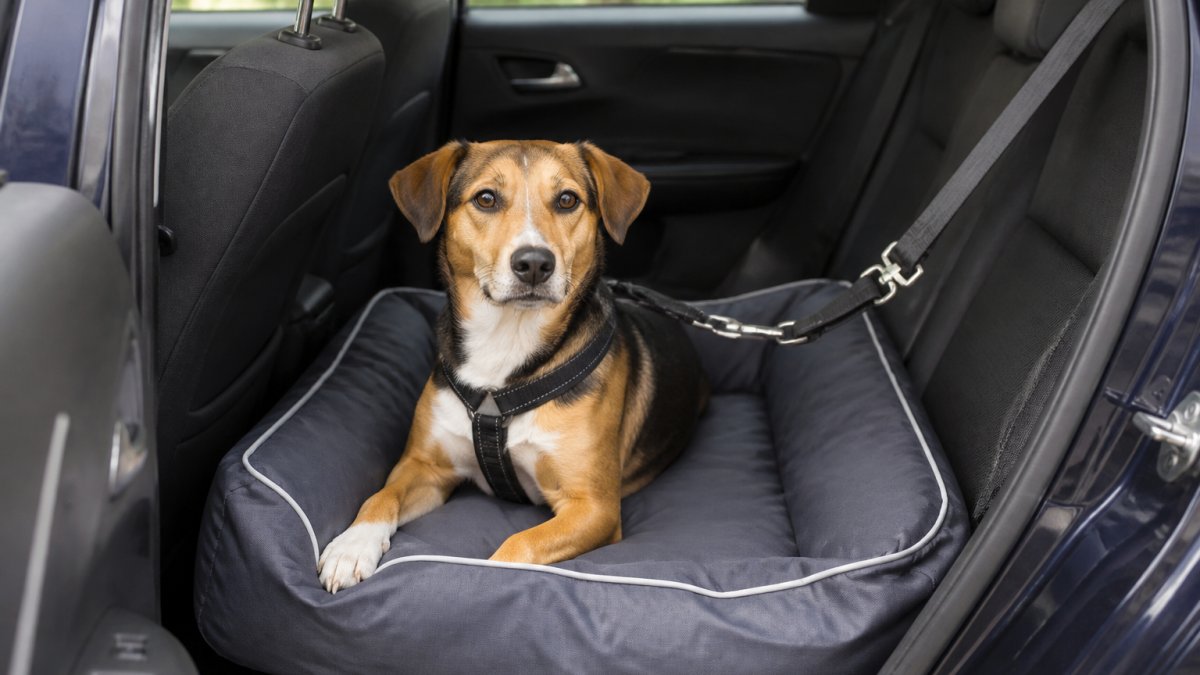
Safety matters more than comfort. A loose bed slides under braking, and an unrestrained dog becomes a projectile in a collision.
What the rules actually require
There is no single UK product standard a pet travel bed must pass to be sold as a "car bed". The Highway Code requires dogs to be suitably restrained so they cannot distract you or injure you or themselves if you stop quickly, and Rule 57 lists three acceptable methods: a seat belt harness, a pet carrier, or a dog cage or guard (The Highway Code - Rules about animals (47 to 58) - Guidance).
How bed designs interact with seatbelt buckles and ISOFIX
Most waterproof travel beds fall into one of three fitting patterns:
- Loose bed on the seat. No physical connection to the vehicle. The non-slip base helps in normal driving, but in a hard stop the bed and dog move together. The weakest configuration, use only with a harness clipped to the seatbelt.
- Bed with seatbelt routing loops or a strap. A webbing loop or strap the seatbelt passes through tethers the bed to the seat, keeping it in place during braking and stopping it tipping. The loop is only as strong as its stitching, check for bar-tacked, load-bearing seams rather than single-stitch trim.
- Bed sized to a crate or boot liner. The bed drops into a crash-tested crate or a boot with a dog guard. The crate or guard provides containment; the bed provides comfort and moisture protection. The most robust arrangement, because the containment device does the safety work.
ISOFIX is a child-seat anchorage system, not designed or rated for pet products. Some pet harnesses and carriers use the lower anchor points, but treat such claims sceptically unless the manufacturer can show test evidence. For most owners, the seatbelt-and-harness route is the practical option.
Crash-testing: what exists and what it tells you
Crash testing for pet restraints in the UK is voluntary. The best-known independent programme is the Center for Pet Safety in the US, which publishes harness and crate test results using a crash-test dog; its findings are widely cited by UK retailers even though it is not a UK regulator.
The practical takeaway: choose a bed with a non-slip base, pair it with a crash-tested harness, and clip the harness to the seatbelt, not the bed itself. The bed provides the stable, dry platform; the harness provides the restraint.
A quick pre-journey check
Before every trip, confirm four things: the bed base grips the seat and does not slide when pushed sideways; the harness is fitted to the manufacturer's sizing guide, not loose; the harness clip is on the seatbelt webbing, not the bed; and nothing in the bed, toys, bowls, chews, can become a projectile. This takes under a minute and covers the failure modes that cause most injuries.
How to Secure a Dog Bed in the Car
Securing a dog bed in the car takes about two minutes and prevents most sliding and tipping:
- Place the bed on a flat seat or boot floor, never on a sloped or folded seat.
- Check the base grips. A non-slip, moisture-proof bottom is the anchor point.
- Route the seatbelt through or over the bed frame if the design allows.
- Clip your dog's harness to the seatbelt, not to the bed.
- Tug-test the bed by hand before every journey.
- Recheck after 10 minutes of driving, since motion shifts fabric.
For a fuller walkthrough, our guide on how to secure a dog bed in the car covers restraint options and safe positioning in more detail. A bed that stays put protects both your dog and your passengers.
Washable Dog Travel Mats: Cleaning and Maintenance Compared
Cleaning is where waterproof beds pull ahead decisively. A waterproof travel bed wipes clean with a damp cloth in under a minute. A standard bed usually needs a full machine wash and a long drying time.
Washable dog travel mats with a detachable cover make this easier: unzip the cover, machine wash it, and the waterproof inner layer stays protected.
Waterproof Dog Bed – Washable Non-Slip Pet Mattress →
Comfort and Support: Orthopedic Cushioning for Long Journeys
Comfort still matters, and waterproof does not mean hard. Orthopedic cushioning comes from the fill, not the surface: dense PP cotton padding supports joints and helps older dogs settle on long drives.
Our Cozy Dog Sofa Bed - Warm Winter Pet Cushion uses high-elastic PP cotton with raised edges for head support, while the waterproof mattress pairs memory fabric with PP cotton filling for gentle cushioning.
A standard bed can be comfortable too, but if it soaks through, your dog lies on damp fabric, neither warm nor supportive.
Protecting Your Vehicle: Upholstery, Temperature and Durability
Vehicle protection is the hidden cost of a standard bed, and it splits sharply by seat material. Moisture, mud, oil from a dog's coat and shed hair all work into the surface over time, and the risk differs for leather and fabric.
Leather versus fabric: two different failure modes
Fabric upholstery absorbs. A wet dog on a standard plush bed soaks the bed, and moisture wicks through to the seat beneath.
Leather upholstery does not absorb, but is more easily damaged. Claws scratch the surface, and repeated moisture followed by heat can dry and crack the finish, particularly on older or lower-grade leather.
In both cases the mechanism is the same: the bed is a sacrificial layer.
Temperature regulation: breathable versus insulated
Temperature is the most neglected factor in car beds, and it cuts both ways. A car interior heats rapidly in summer sun and loses heat quickly in winter, so a single bed is rarely ideal year-round.
- Warm-weather travel. Look for a breathable outer fabric and a fill that does not compact into a dense, heat-retaining slab. A breathable waterproof membrane lets moisture vapour escape rather than trapping it against the dog's skin, reducing overheating and damp coat odour.
- Cold-weather travel. Insulation comes from loft in the fill, not the waterproof layer. A thicker PP cotton fill and raised edges hold warmth around the dog's core. For older dogs or short-coated breeds, a removable warm liner lets you add insulation in winter and strip it back in summer.
The practical approach for most owners: a waterproof bed with a breathable cover for three seasons, plus a warm liner or second insulated bed for winter.
Durability against motion and the real cost of cleaning
Car travel is hard on bedding. The bed is compressed, shifted and rubbed against seat edges on every journey, and a dog turning to settle adds point loads. Two construction details predict how a bed survives this:
- A non-slip, moisture-proof base. This stops the bed migrating and the base fabric abrading against the seat.
- A detachable, machine-washable cover with a protected waterproof inner. The cover takes the wear; the inner layer keeps its integrity. A bed where the waterproof layer is the outer surface will eventually scuff and lose performance.
On cost, the honest comparison is not purchase price but the cleaning cycle. A standard bed needing a full machine wash and long drying time after every wet walk is out of service for a day each time.
The Kennel Club's advice on travelling safely with dogs notes that familiar, comfortable bedding helps reduce travel anxiety. A bed that stays dry, stable and at a comfortable temperature does more for calm travel than most owners realise.
Sizes, Breed Fit and Portability for Everyday Use
Getting the size right prevents most travel problems. A bed that is too large slides and bunches; one that is too small leaves your dog unsupported.
Measure your dog from nose to tail while lying down, then add roughly 15cm of clearance.
Portability is the final check. Lightweight, foldable beds move easily between car, crate and home, making them multi-purpose travel essentials rather than single-use purchases.
Frequently Asked Questions
Are waterproof dog beds better for car travel?
For most car journeys, yes. A waterproof dog bed keeps accidents, wet fur, muddy paws and spilled water from soaking through to your seats, and the wipe-clean or machine-washable surface means you can deal with mess in minutes rather than hours. The non-slip, moisture-proof base also grips upholstery better than a loose standard bed, so it stays put when you brake. If your dog travels regularly, the waterproof option usually pays for itself in avoided valeting bills alone.
Can a standard dog bed be used in the car?
A standard bed can sit in the car, but it was not designed for motion. Without a non-slip base or anchoring points, it slides across the seat on bends and can tip your dog onto the floor during sudden braking. Standard fillings also absorb moisture, so one accident or wet walk means the whole bed needs drying out. If you want to use an existing bed, pair it with a washable travel mat underneath and a seatbelt harness for restraint.
How do I secure a dog bed in the car?
Start with a bed that has a non-slip, moisture-proof base, then add a second layer of security. Thread the vehicle's seatbelt through the bed's anchoring points or the harness loop, or use a crash-tested harness clipped to a seatbelt anchor rather than the collar. Place the bed flat on the seat or boot floor, not stacked on other items. Check the fit by pressing down firmly: if the bed shifts more than a couple of centimetres, tighten the restraint before you set off.
What features should I look for in a dog car bed?
Prioritise four things: a waterproof or liquid-repellent lining, a non-slip base, a removable machine-washable cover, and a secure fit for your dog's size. Breathable fabric helps regulate temperature on longer trips, while orthopedic cushioning matters for older dogs or breeds prone to joint issues. Quick-release buckles make harness attachment easier. Measure your boot or seat space before ordering, and check the bed's dimensions against your dog's length when stretched out, not curled up.
Are there safety regulations for dog car beds?
There is no specific regulation in the UK governing dog car beds themselves. However, Rule 57 of the Highway Code states that dogs and other animals should be suitably restrained so they cannot distract you while driving or injure you or themselves if you stop quickly. A bed combined with a seatbelt harness or a secured crate meets that expectation. Your insurer may also treat an unrestrained dog as contributing to an accident claim, so restraint protects your policy as well as your pet.
Travel with a dog means mud, rain and the occasional accident, and a standard bed simply cannot keep up with that reality. At Doggo Shop, we stock waterproof beds with non-slip, moisture-proof bases, detachable machine-washable covers and supportive PP cotton cushioning, all designed to protect your car and keep your dog comfortable. Every order also supports rescue dogs in need. Get started with Doggo Shop and make every journey cleaner, safer and calmer for both of you.


Leave a comment