


Stop Puppy Biting Clothes: Proven Training Steps
Table of Contents
- Why Puppies Bite Clothes and Pant Legs
- Puppy Teething Timeline: When Biting Peaks
- Immediate Steps to Stop the Biting Behaviour
- Best Toys for Biting Puppies
- Puppy Impulse Control Exercises
- Managing Energy and the Witching Hour
- When to Seek Professional Training Help
- Frequently Asked Questions
Last Updated: September 22, 2026
Why Puppies Bite Clothes and Pant Legs
To stop puppy biting clothes, you first need to understand why puppies bite your clothes and pant legs: movement triggers their prey drive. When fabric moves, it catches their attention. Their instinct is to chase, grab, and shake.
This isn't bad behaviour, it's normal puppy development. Young dogs explore the world with their mouths. They're also teething, which makes their gums sore and sensitive. Chewing helps relieve that discomfort.
Breed-Specific Biting Motivations
Some breeds have stronger biting instincts than others, and understanding your puppy's breed tendency changes how you approach the problem.
Herding breeds (Border Collies, Australian Shepherds, Shetland Sheepdogs, Corgis) nip at moving objects as part of their genetic makeup. Moving fabric, especially pant legs, triggers an automatic herding response. Managing these breeds requires consistency with redirection and channelling that nipping drive into tug toys or herding balls.
Terrier breeds (Jack Russell Terriers, Staffordshire Bull Terriers, West Highland White Terriers) were bred to hunt small prey, so they're drawn to quick movements and bite more intensely. These puppies need robust chew toys and longer redirection sessions.
Retriever and sporting breeds (Labradors, Golden Retrievers, Spaniels) have a "soft mouth" instinct and mouth constantly. They respond well to tug toys and treat-dispensing toys.
Toy breeds (Chihuahuas, Pomeranians, Yorkshire Terriers) often bite out of fear or excitement. Their biting may be sharper and more defensive, triggered by sudden movements.
Knowing your puppy's breed category helps you predict which situations will trigger biting. Your job is to redirect that instinct, not eliminate it.
Most puppy owners think this behaviour will stop on its own. It won't. Without redirecting and teaching better habits, your puppy learns that biting clothes gets attention. The good news: this is one of the easiest puppy problems to fix with the right approach and consistency.
Puppy Teething Timeline: When Biting Peaks
Puppy teething peaks between three and six months, when baby teeth fall out and adult teeth push through. Most puppies stop teething by seven months, though larger breeds may take until nine months. During this window, biting is at its worst because their gums hurt. If your puppy is four months old and biting constantly, you're in the peak teething phase.
After teething ends, many puppies continue biting clothes if they've learned it works. That's why redirection during the teething phase is critical. You're not just managing discomfort, you're teaching your puppy what's acceptable to chew and what isn't.
Immediate Steps to Stop the Biting Behaviour
The fastest way to stop puppy biting clothes is to remove the reward. Stop reacting dramatically when your puppy bites. Don't yell, don't chase, don't pull away sharply. All of these responses are exciting to your puppy. Excitement = reward.
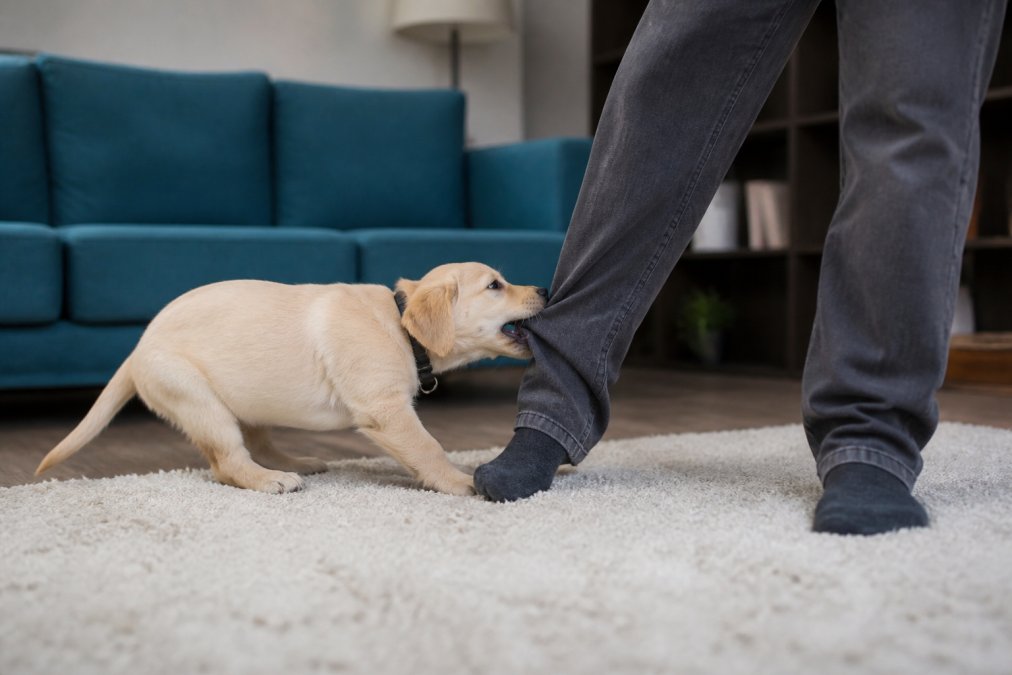
Instead, use calm removal. When your puppy grabs your clothes, stand still and wait. The moment they release, calmly walk away. No talking, no eye contact, no drama. Your puppy learns: biting makes the fun person disappear.
The 'Be a Tree' Method
With the 'be a tree' technique, stand tall, cross your arms, and look away when your puppy bites. Most puppies bite harder at first (an extinction burst), but within 30 seconds to 2 minutes they'll stop. Immediately reward them with a toy, treat, or praise. Consistency is critical, every person in your household must use the same method.
Calm Removal and Redirecting to Toys
Pair calm removal with redirection: offer an appropriate toy when your puppy stops biting. Keep toys nearby during high-energy times and hand them to your puppy before they bite to prevent the behaviour.
Best Toys for Biting Puppies
Textured chew toys massage sore gums and satisfy chewing instinct. The Indestructible Dog Chew Bone Toy for Teeth Cleaning at Doggo Shop is made from durable TPR material that withstands aggressive chewing whilst providing teething relief.

Treat-dispensing toys add mental engagement. The Thick Tire-inspired Durable Dog Chew Toy for Aggressive Chewers lets you stuff treats inside, turning it into an interactive puzzle.

Tug toys satisfy the shaking and pulling instinct. The Interactive Suction Cup Tug Toy sticks to smooth surfaces for solo play. Rotate toys every few days to keep them engaging. Avoid fabric toys that confuse your puppy about what's acceptable to bite.

Puppy Impulse Control Exercises
Teaching impulse control reduces mouthing. Sit and wait before meals and playtime teaches patience. Leave it teaches your puppy to stop pursuing something on command. Drop it teaches them that letting go has rewards. Do these 5-10 minute exercises daily when your puppy is calm, not during high-energy play.
Thick Tire-inspired Durable Dog Chew →
Managing Energy and the Witching Hour
Overtired puppies bite more. When your puppy hasn't had enough sleep or exercise, they become overstimulated. This is often called the "witching hour", a period of wild, uncontrollable energy and constant mouthing. For many owners, this is the single biggest driver of clothes biting, and it's entirely preventable with the right schedule.
Understanding the Witching Hour
The witching hour isn't always one hour. It's a predictable window of overstimulation that typically occurs in late afternoon or early evening (roughly 4-7 p.m. for most puppies), though some puppies have a second peak in the morning. During this window, your puppy becomes a "land shark", biting everything, unable to settle, seemingly possessed by chaotic energy.
This isn't a training failure. It's a sleep debt. Most puppies need 16-18 hours of sleep per day. Without it, their nervous system becomes dysregulated, and biting escalates dramatically. A puppy in the witching hour won't respond to redirection the way they do when calm. They're too overstimulated.
Recognising the Witching Hour
Before the witching hour hits, your puppy will show warning signs:
- Rapid, jerky movements and inability to settle
- Increased mouthing and biting intensity
- Difficulty focusing on toys or commands
- Sudden bursts of zoomies (running in circles)
- Whining or vocalising more than usual
- Dilated pupils and a slightly glazed expression
The moment you see these signs, you've entered the prevention window. If you wait until full witching hour, redirection becomes much harder.
Prevention Timeline and Daily Structure
The most effective approach is enforced rest before the witching hour begins, not after. Here's a sample daily structure for a 3-6 month old puppy:
Morning (7-9 a.m.): Light play and training (10-15 minutes). Puppies wake rested and can focus. Use this window for impulse control exercises like "sit" and "leave it".
Mid-morning (9 a.m.-12 p.m.): Free play, socialisation, or a short walk (10-20 minutes). Mental stimulation is more effective than physical exercise at this age. Use puzzle toys or snuffle mats.
Midday (12-2 p.m.): Enforced nap time.
Why Naps Work Better Than Exercise
Many owners try to "tire out" their puppy with longer walks or more playtime during the witching hour. This backfires. Physical exercise when a puppy is already overstimulated creates more adrenaline, not less. The witching hour gets worse.
Creating the Enforced Rest Space
Your puppy won't nap on command unless you make the space conducive to sleep:
- Use a crate or pen. Puppies naturally settle in confined spaces. A crate signals "this is rest time."
- Keep it dark. Close curtains or cover the crate with a blanket. Darkness triggers sleep hormones.
- Make it comfortable. Add a soft bed or blanket, but avoid toys that encourage play.
- Establish a routine. Take your puppy to the rest space at the same times each day. Consistency helps them anticipate sleep.
- No interaction during rest time. If your puppy whines, don't respond. Responding teaches them that noise gets attention. Wait for silence, then reward with calm praise.
Progress Tracking: When to Expect Improvement
Days 1-3: Biting during the witching hour may actually increase slightly as your puppy adjusts to the new schedule. This is normal. Stay consistent.
Combining Rest with Redirection
Enforced rest prevents the witching hour from becoming severe, but it doesn't eliminate biting entirely. Pair your schedule with the redirection techniques covered earlier (calm removal, the 'be a tree' method, and toy redirection). When your puppy is well-rested, these techniques work far more effectively because your puppy's nervous system is regulated and they can actually learn.
When to Seek Professional Training Help
Most puppy biting stops with consistent redirection and management. But some puppies need professional help.
Seek a trainer if your puppy is:
- Biting hard enough to break skin, even during play
- Showing aggression (growling, stiff body, intense focus) rather than playful nipping
- Not responding to redirection after 4-6 weeks of consistent training
- Biting specific people or situations (like when being groomed or handled)
- Showing fear-based biting (snapping when startled or touched)
Frequently Asked Questions
At what age is puppy biting clothes at its worst?
Puppy biting peaks between 3 and 6 months old, when teething is most intense and mouthing is a natural developmental stage. The behaviour often improves around 6-7 months as adult teeth emerge, but inconsistent training can extend it longer. Breed size matters: larger breeds may continue nipping longer because their play-biting feels more intense. Consistency with redirection and impulse control exercises during this window makes the biggest difference.
What should I do when my puppy bites my clothes right now?
Stop moving immediately and stand still like a tree, making yourself unexciting. Remove your attention by looking away or turning your body. Once your puppy releases or loses interest, calmly redirect them to an appropriate toy like a chew toy or snuffle mat. Reward them heavily when they engage with the toy instead. Never yell or chase, this triggers more mouthing because movement triggers prey drive. Consistency matters more than speed.
Why does my puppy target my pant legs specifically?
Movement triggers mouthing and nipping in puppies. Pant legs move when you walk, which activates their prey drive and herding instinct, especially in herding breeds. Loose fabric is also easier to grab than other clothing. Reduce trigger exposure by wearing fitted trousers during training, moving slowly around your puppy, and keeping play sessions calm. Redirect to movement-based toys like tug toys so they satisfy the urge appropriately.
Can interactive toys and treat dispensers really stop my puppy from biting clothes?
Yes, when paired with training. Toys like treat dispensers and chew toys redirect the mouthing instinct to appropriate objects and provide mental stimulation that reduces boredom-driven biting. However, toys alone won't work without redirection and impulse control exercises. The combination of removing triggers (movement), rewarding calm behaviour, and offering engaging alternatives is what creates lasting change. Puzzle toys and snuffle mats are particularly effective for busy households because they occupy your puppy's focus independently.


Leave a comment