


Slow Feeder Dog Bowls: Benefits & How to Choose
Table of Contents
- What Slow Feeder Dog Bowls Do
- How to Stop a Dog Eating Too Fast
- Preventing Bloat and GDV in Dogs
- Five Key Benefits of Slow Feeder Bowls
- Choosing the Right Slow Feeder for Your Dog
- Transitioning Your Dog to a Slow Feeder
- DIY Alternatives to Commercial Slow Feeders
- Conclusion
Last Updated: August 5, 2026
What Slow Feeder Dog Bowls Do
Slow feeder dog bowls are specially designed feeding dishes that force dogs to eat more deliberately by creating physical barriers within the bowl. Instead of a flat surface where food sits exposed, these bowls feature ridges, mazes, or textured surfaces that require your dog to work around obstacles to reach their meal. This simple design change transforms mealtime from a frantic gulp-fest into a measured, mindful eating experience.

The purpose is straightforward: slow down how fast your dog consumes food. A dog that wolfs down an entire meal in seconds faces genuine health risks that a dog eating at a normal pace does not. By making the bowl itself part of the challenge, you're not restricting your dog's access to food, you're just making them engage with it differently.
At Doggo Shop, we've seen firsthand how the right slow feeder can become one of the most impactful changes a dog owner makes. It's not glamorous. It won't win any awards for design. But the health improvements owners report are substantial enough that once they switch, they rarely go back.
How to Stop a Dog Eating Too Fast
Why Dogs Gulp Their Food
Dogs don't eat slowly because they lack the ability. They eat fast because, evolutionarily, speed was survival. In the wild, a dog that ate slowly risked losing its meal to competitors. That ancestral wiring remains hardwired into your pet's nervous system, even though your kitchen is nowhere near as competitive as a wolf pack's feeding ground.
Some dogs are naturally faster eaters than others. Certain breeds, particularly larger dogs and those with deep chests, seem almost programmed to inhale food. Rescue dogs or dogs with histories of food scarcity sometimes develop urgency around meals that persists long after they've found food security. Anxiety, excitement, or even boredom can accelerate eating speed.
The problem is that gulping isn't just an annoying habit. It's a pathway to serious medical complications that we'll explore in detail below.
How Slow Feeders Reduce Eating Speed
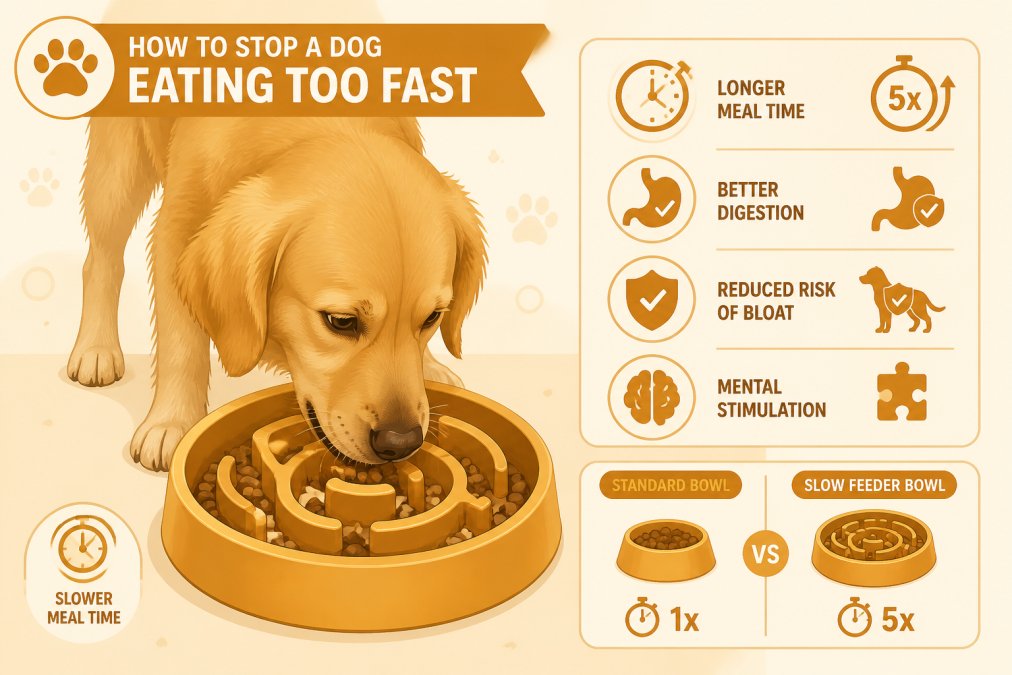
Slow feeders work through pure mechanical intervention. The ridges or maze patterns inside the bowl create physical separation between mouthfuls. Your dog cannot simply open their mouth and inhale the entire contents. Instead, they must use their nose and tongue to navigate around the obstacles, isolating smaller portions of food with each bite.
The result is measurable. A dog that normally finishes a meal in 30 seconds might take 5-10 minutes with a slow feeder. That extended timeframe gives their stomach time to register fullness signals. It allows saliva to begin breaking down food. It transforms eating from a speed competition into an activity that mimics natural foraging behavior.
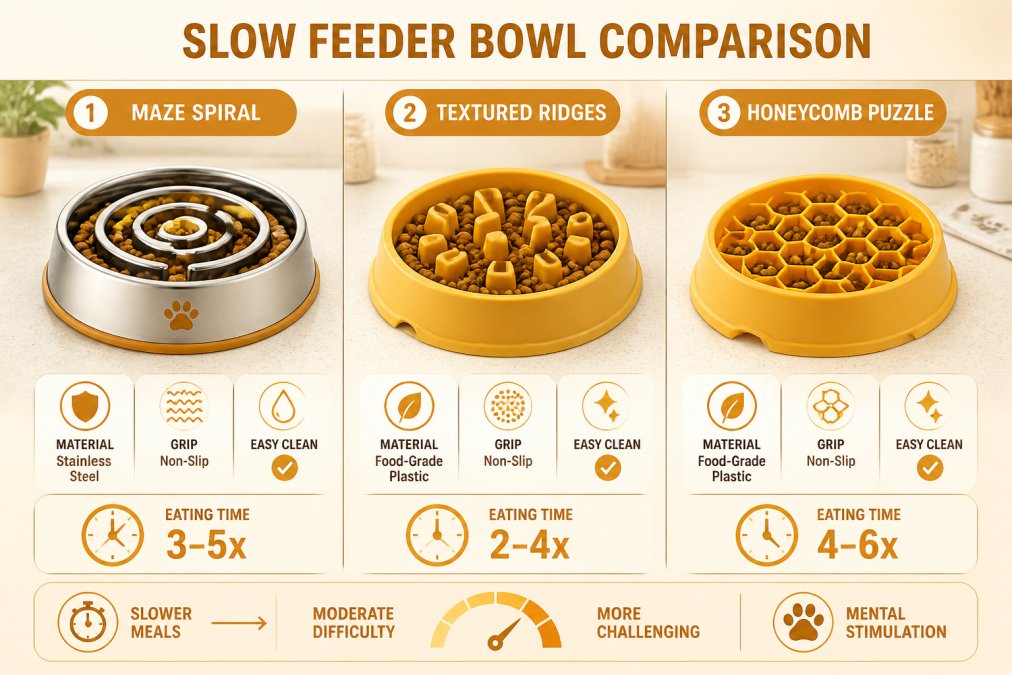
Different slow feeder designs achieve this in different ways. Some use raised ridges that create a maze pattern. Others feature a textured, bumpy surface that slows access. Lick bowls with grooved surfaces work similarly. Each variation slows eating, though some dogs adapt faster to certain designs than others.
Preventing Bloat and GDV in Dogs
Signs of Bloat in Dogs
Bloat, medically known as gastric dilatation-volvulus (GDV), is a life-threatening emergency. The stomach fills with gas and, in severe cases, twists on itself. Without immediate veterinary intervention, GDV is fatal. Early recognition matters because the window for treatment is narrow.
Watch for these warning signs: a visibly distended or hard abdomen, restlessness or pacing, unproductive retching (attempting to vomit without bringing anything up), excessive drooling, or rapid shallow breathing. Some dogs show signs of pain or discomfort when their abdomen is touched. Others simply seem uncomfortable and anxious in ways that don't match their normal behaviour.
GDV can develop rapidly, sometimes within hours. If your dog shows any of these signs, contact your veterinary clinic immediately. Do not wait to see if it resolves on its own.
How Slow Feeders Lower GDV Risk
The mechanism linking rapid eating to bloat is straightforward: dogs that gulp take in large amounts of air along with food. This aerophagia (swallowing air) fills the stomach with gas. A stomach distended with gas is more prone to the twisting that characterizes GDV. Additionally, rapid eating prevents the stomach from processing food efficiently, creating conditions where gas accumulates.
Slow feeders address this directly. By forcing your dog to eat more deliberately, you reduce the volume of air swallowed with each mouthful. The stomach fills more gradually, allowing normal gas to escape. Food moves through the digestive tract more predictably.
Research from veterinary sources consistently identifies rapid eating as a modifiable risk factor for bloat. While breed, chest depth, and genetics play roles in GDV susceptibility, feeding method is one of the few factors entirely within your control. A slow feeder won't eliminate risk entirely, particularly for breeds with high genetic predisposition, but it meaningfully reduces it.
Five Key Benefits of Slow Feeder Bowls
Preventing bloat is the headline benefit, but slow feeders deliver improvements across multiple dimensions of your dog's health and wellbeing.
1. Improved Digestion and Nutrient Absorption
When food enters the stomach more slowly, your dog's digestive system has time to process it properly. Saliva begins breaking down carbohydrates before food reaches the stomach. The stomach can produce adequate gastric juices rather than being overwhelmed by a sudden volume. Food moves through the intestines at a pace that allows nutrient absorption rather than passing through largely undigested. Dogs eating from slow feeders often show improvements in stool quality and consistency, a sign that digestion is working more efficiently.
2. Mental Stimulation and Enrichment
Mealtime becomes a puzzle rather than a reflex. Your dog must think, problem-solve, and engage with their food. This cognitive engagement is particularly valuable for dogs spending long hours alone. An interactive feeding experience provides mental stimulation that helps prevent boredom-related destructive behaviours. The enrichment aspect shouldn't be underestimated, for many dogs, this is the most engaging part of their day.
3. Weight Management and Portion Control
Slower eating gives satiety signals time to reach the brain. A dog eating quickly will consume far more than they actually need before feeling full. The same portion eaten slowly triggers fullness earlier. This means you can maintain or reduce portion sizes without your dog feeling deprived. For dogs prone to weight gain, this is a meaningful advantage without requiring calorie restriction that leaves them perpetually hungry.
4. Reduced Choking and Regurgitation
Large pieces of food swallowed whole can lodge in the oesophagus or cause gagging. Slower eating naturally breaks food into smaller pieces and allows more thorough chewing. Dogs eating from slow feeders experience fewer episodes of regurgitation or coughing after meals. The reduced risk of choking is particularly important for dogs with anatomical features like shortened muzzles (brachycephalic breeds) that already increase choking risk.
5. Reduced Mealtime Anxiety
Some dogs display frantic, anxious behaviour around food, gulping, growling, or showing signs of stress. This often stems from a deep-seated fear of scarcity. Slow feeders can paradoxically reduce this anxiety by making the meal last longer. The extended feeding period seems to signal abundance rather than competition. Dogs that previously showed mealtime anxiety often become calmer and more relaxed when eating from a slow feeder.
Choosing the Right Slow Feeder for Your Dog
Selecting a slow feeder isn't simply a matter of picking one at random. Different dogs have different needs, and the right choice depends on your dog's size, eating style, and specific health concerns.
Material Safety and Durability
Not all slow feeder materials are created equal. Food-grade stainless steel is the most durable option and resists bacterial growth better than plastic. Stainless steel bowls last years without degradation, don't absorb odours, and are dishwasher safe. They're heavier, which means they won't slide around during feeding, but they're also more expensive.
Food-grade plastic bowls are lighter and more affordable, but quality varies dramatically. Cheap plastics can leach chemicals, develop scratches that harbour bacteria, and degrade over time. Look for BPA-free materials that meet relevant UK safety standards for pet products. Even then, plastic bowls typically last 1-2 years before showing signs of wear.
Ceramic bowls occupy a middle ground. They're durable and look attractive, but they can chip or crack if dropped. They're heavier than plastic but not as durable as stainless steel long-term.
Avoid any bowl with non-food-grade materials or unclear sourcing. Your dog's health depends on what touches their food. The Doggo Shop Slow Feeder Dog Bowl uses food-grade materials designed to withstand daily use and maintain structural integrity through hundreds of feedings.
Breed-Specific Design Considerations
Large breed dogs need larger bowls with appropriately sized ridges. A maze pattern designed for a Chihuahua won't effectively slow a Labrador. Similarly, brachycephalic breeds (flat-faced dogs like Bulldogs and Pugs) need bowls with lower edges and wider openings. Their anatomy makes it difficult to navigate deep mazes, so a textured or ridged surface works better than intricate patterns.
Small breeds benefit from smaller bowls with proportional maze patterns. Some tiny dogs find standard slow feeders frustratingly difficult; a bowl designed for their size makes engagement possible rather than frustrating.
Dogs with sensitive mouths or dental issues may need smoother textures rather than sharp ridges. Older dogs sometimes prefer lick bowls (flat bowls with grooved surfaces) over maze-style feeders because they're easier to navigate.
Size and Capacity Matters
A bowl that's too small requires constant refilling during the meal. A bowl that's too large creates wasted space and makes the maze pattern less effective. Match bowl size to your dog's typical portion. Most adult dogs eat between 1-3 cups per meal; your bowl should accommodate your dog's full daily portion without being oversized.
Depth matters as well. Shallow bowls work for dogs that eat by licking (like the Doggo Shop Slow Feeder Dog Lick Bowl), while deeper maze bowls suit dogs that use their noses to navigate. Consider your dog's eating style when selecting depth.
Transitioning Your Dog to a Slow Feeder
Switching from a standard bowl to a slow feeder requires patience. Some dogs adapt instantly; others need a gradual introduction.
Start by placing the slow feeder next to the old bowl for a day or two. Let your dog investigate without pressure. Once they seem comfortable with the new bowl's presence, try feeding a small portion (perhaps a quarter of their normal meal) in the slow feeder while continuing to use the old bowl for the rest.
Gradually increase the proportion fed in the slow feeder over 3-5 days. If your dog shows frustration or refuses to eat, slow the transition further. Some dogs need a week or more to adjust.
If your dog seems genuinely unable to figure out the maze pattern, try a simpler design. Lick bowls or textured surfaces are easier for some dogs than intricate mazes. There's no shame in choosing a less complex option if it means your dog actually eats.
Once fully transitioned, most dogs seem to prefer slow feeders. The extended feeding time becomes part of their routine, and many owners report their dogs appear more satisfied after meals.
DIY Alternatives to Commercial Slow Feeders
If budget is a concern, or if you want to experiment before investing in a commercial bowl, several DIY approaches can slow eating effectively.
Place a clean, food-safe object (like a smooth stone, tennis ball, or stainless steel ball) in the centre of a regular bowl. Your dog must navigate around it to access food. This works reasonably well for some dogs, though objects can shift during eating.
Spread kibble across a muffin tin instead of using a bowl. Each cup holds a small portion, forcing your dog to move from cup to cup. This works particularly well for dogs that enjoy the puzzle-solving aspect.
Use a cupcake tin or ice cube tray with wet food or moistened kibble. The individual compartments create natural portion separation.
Freeze wet food in a Kong or similar toy, then serve it as a slow-feeding puzzle. Your dog must work to extract the food, which dramatically extends mealtime.

These DIY options work reasonably well for experimentation, but commercial slow feeders offer advantages: consistent design, food-safe materials, and durability. They're also easier to clean than improvised solutions.
For dogs requiring genuine health intervention, those with bloat risk or serious eating speed issues, a proper slow feeder from a trusted source like Doggo Shop is worth the investment. The Slow Feeder Dog Bowl (£14.99) or Slow Feeder Dog Lick Bowl (£19.99) are both designed specifically to address these concerns with materials and patterns optimized for different eating styles.
Choosing the right slow feeder requires understanding your dog's individual needs, but the investment pays dividends in digestive health, reduced bloat risk, and improved mealtime behaviour. Doggo Shop's range of slow feeders combines food-grade materials, thoughtful design, and proven effectiveness, all while supporting rescue dogs in need with every purchase. Start with the bowl that matches your dog's size and eating style, transition gradually, and watch as mealtime transforms from a frantic rush into a calm, enriching experience.
Frequently Asked Questions
Do vets recommend slow feeder dog bowls?
Many UK vets recommend slow feeder bowls, particularly for dogs prone to gulping, bloat, or indigestion. Slow feeders reduce the amount of air swallowed during meals (aerophagia), which is a major risk factor for gastric dilatation-volvulus (GDV). Your vet can advise whether a slow feeder is right for your dog's specific health needs and eating habits.
Can slow feeders help prevent bloat in dogs?
Yes. Bloat occurs when dogs swallow large amounts of air while eating quickly. Slow feeder bowls force your dog to eat more deliberately, reducing gulping and aerophagia. This significantly lowers the risk of gastric dilatation-volvulus (GDV), a life-threatening condition. Slow feeders are especially important for deep-chested breeds at higher GDV risk.
How do I know if my dog needs a slow feeder?
Consider a slow feeder if your dog gulps food without chewing, finishes meals in under a minute, regurgitates shortly after eating, or shows signs of bloat like restlessness and abdominal distension. Dogs with a history of indigestion, anxiety around food, or breeds prone to GDV (like German Shepherds and Great Danes) benefit most from slow feeder bowls.
What materials are safest for slow feeder dog bowls?
Look for food-grade, BPA-free materials like non-toxic silicone, stainless steel, or durable ceramic. Avoid plastic bowls that may leach chemicals or splinter. Ensure the bowl has a non-slip base to prevent sliding during meals. Check that all components are dishwasher safe for easy cleaning and bacterial prevention.
This article was written using GrandRanker


Leave a comment