


Teach Puppy Bite Inhibition With Toys
Table of Contents
- Understanding Puppy Mouthing and Bite Inhibition
- What Is Bite Inhibition and Why Toys Matter
- Puppy Bite Inhibition Timeline: What to Expect at Each Stage
- How to Stop Puppy Biting Hands With Redirection
- Selecting the Right Puppy Teething Toys for Biting
- Games and Play Techniques That Teach Impulse Control
- Managing Over-Arousal and Building Consistency
- Frequently Asked Questions
Last Updated: September 23, 2026
Understanding Puppy Mouthing and Bite Inhibition
Puppies explore the world with their mouths through nibbling, chewing, and nipping, a natural behaviour called mouthing.
Bite inhibition, your puppy's ability to moderate bite force, is the key difference between normal mouthing and a problem. Using puppy bite inhibition toys is one of the most effective ways to develop this skill early.
The right approach combines patience, consistency, and the right tools.
Puppies learn through feedback, when a littermate yelps, they learn boundaries. Redirecting biting to toys teaches the same lesson in a structured way.
What Is Bite Inhibition and Why Toys Matter
Bite inhibition is a dog's learned ability to control bite pressure, not eliminating biting, but making it safe and manageable.
Dogs with good bite inhibition rarely cause injury during intense play. Without this skill, even a friendly nip can break skin or cause bruising.
Puppy bite inhibition toys give your puppy something appropriate to bite, creating a clear boundary: "I can bite this. I cannot bite that."
The best toys are textured, durable, and engaging. Interactive toys that reward engagement work especially well because they create positive associations with appropriate biting behaviour.
Puppies who learn bite inhibition early are less likely to develop biting problems as adults, making them safer around children, other pets, and visitors.
Puppy Bite Inhibition Timeline: What to Expect at Each Stage
8 to 12 weeks: Mouthing is intense and constant as your puppy explores. Start redirecting to soft, textured toys and reward interaction with praise and treats.
3 to 4 months: Teething pain increases mouthing behaviour. Use textured surfaces and treat-dispensing toys for chewing relief.
4 to 6 months: Peak mouthing and the critical learning window. Consistency in redirection is essential, reward toy play and discourage hand-biting.
6 months and beyond: Most puppies show significant improvement if training has been consistent. Continue reinforcing good habits.
Individual puppies vary; breed matters too, with larger breeds sometimes needing more intensive redirection.
How to Stop Puppy Biting Hands With Redirection
The most effective strategy is redirection: when your puppy bites your hands, immediately offer a toy. However, when they refuse and continue biting skin, a different approach is needed.
Standard redirection (when your puppy accepts the toy):
- Catch the moment. When your puppy starts mouthing your hands, have a toy within arm's reach.
- Redirect immediately. Place the toy in your puppy's mouth and encourage play with it.
- Praise generously. Use an excited, positive tone. Your puppy should associate toy play with your enthusiasm.
- Repeat consistently. Every single time your puppy chooses to bite hands instead of toys, redirect.
Consistency is non-negotiable. If you redirect sometimes but allow hand-biting other times, your puppy gets confused. They don't understand the rule. Make the boundary crystal clear.
Troubleshooting toy refusal (when your puppy ignores the toy):
Some puppies, especially those in high-arousal states or with strong prey drive, ignore toys and persist in targeting skin. This is frustrating and common, and it requires a different strategy.
Interactive Suction Cup Tug Toy – Dog →
Step 1: Make the toy irresistible. Rub the toy on treats or smear it with peanut butter (xylitol-free) to increase scent appeal. Use treat-dispensing toys with high-value rewards. Animate the toy by moving it erratically, puppies are more attracted to moving objects.
Step 2: Interrupt the cycle before redirection fails. If your puppy refuses the toy three times, stop all interaction: stand up, turn away, cross your arms, and wait 10-15 seconds in silence. Resume only when your puppy has calmed down. This teaches that hand-biting ends engagement without creating fear.
Step 3: Redirect to the toy after the calm reset. Once your puppy has settled, offer the toy again. If they accept it this time, praise enthusiastically and play. If they refuse again, repeat the interruption.
Step 4: Manage the environment to prevent toy refusal. Keep play sessions to 10-15 minutes. Avoid hand-wrestling or hand-chasing. Use toys for interactive play like tug-of-war or fetch. If your puppy refuses toys consistently, they may be over-stimulated, move them to a quiet space for 20 minutes.
Herding and terrier breeds often have higher-intensity biting and may require more frequent toy rotation, stronger tactile feedback, shorter play sessions, and consistent calm-reset interruption. Companion breeds typically accept toy redirection more readily.
Avoid punishment-based approaches like yelling or smacking. Redirection and interruption are more effective because they show the right choice or remove the reward for the wrong one.
If your puppy nips during interactive toy play, pause for 10-15 seconds and resume when they calm down. This mimics how littermates teach each other: hard bites end the fun.
Selecting the Right Puppy Teething Toys for Biting
The right toy choice depends on your puppy's age, size, chewing intensity, and your ability to monitor for wear.
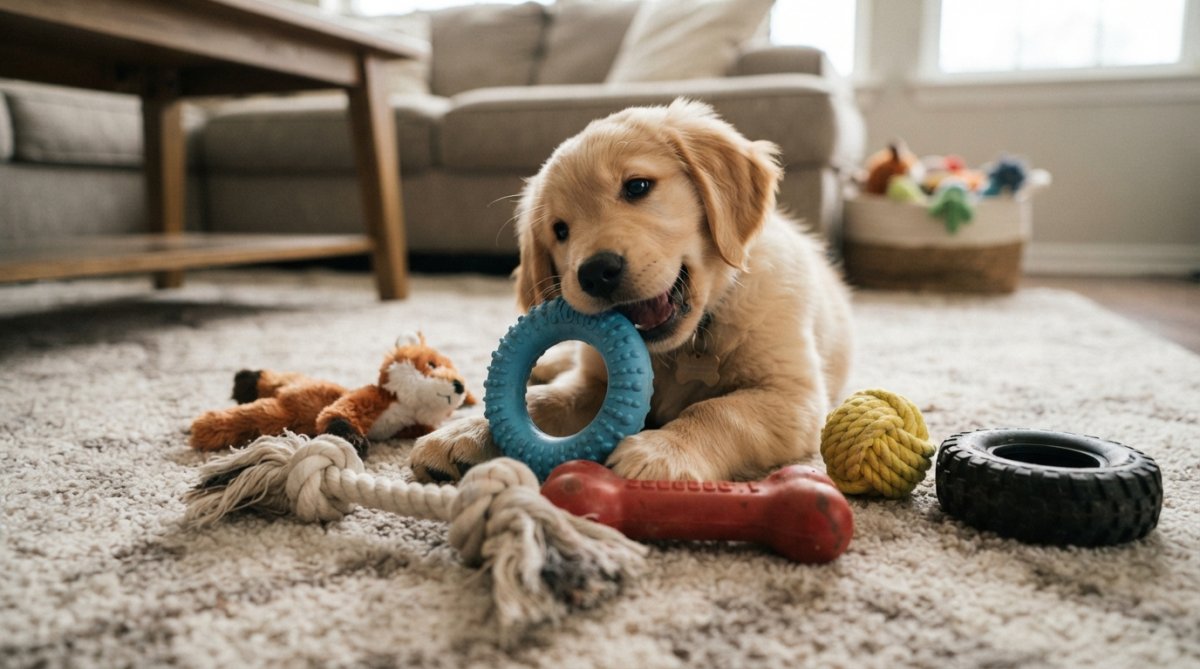
Textured rubber toys provide satisfying resistance and grooves that feel good on sore gums. The Interactive Suction Cup Tug Toy suctions to smooth surfaces for solo play, with a treat-dispensing design that adds engagement.

Rope toys are good for interactive play and tug-of-war games that teach impulse control. Require active supervision, never leave unsupervised with aggressive chewers due to fibre ingestion risk. Inspect weekly for fraying and discard if damaged.
Plush toys with squeakers appeal to puppies who like sound and texture. The Calming Duck Plush Dog Toy provides comfort and play value. Supervise during play and remove toys with damaged squeakers or torn seams immediately.

Durable chew bones are ideal for older puppies (4+ months) and aggressive chewers. The Indestructible Dog Chew Bone Toy is made from tough TPR material that promotes dental health.

| Toy Type | Best For | Key Benefit | Safety Concern |
|---|---|---|---|
| Textured rubber | All puppies, especially teething | Gum relief + dental cleaning | Monitor for cracks; discard if pieces break off |
| Rope toys | Interactive play | Teaches impulse control | Fibre ingestion risk; supervise always |
| Plush with squeaker | Gentle chewers | Comfort + engagement | Squeaker removal = choking hazard |
| Durable chew bones | Aggressive chewers | Long-lasting durability | Check for chips or fractures |
| Treat-dispensing toys | All puppies | Mental stimulation + reward | Ensure treat compartment cannot be forced open |
Games and Play Techniques That Teach Impulse Control
Games are training in disguise. They teach bite inhibition while building your bond with your puppy.
- Hold one end of a rope toy. Let your puppy grip the other end.
- Play actively for 30-60 seconds.
- Say "Drop it" and reward immediately when they release.
- Repeat 3-5 times per session.
Managing Over-Arousal and Building Consistency
Over-arousal is when your puppy's excitement overwhelms their self-control. During these moments, bite inhibition training breaks down. Your puppy bites harder, jumps more, and becomes less responsive to redirection.
Recognising the signs helps. Look for:
- Rapid, intense play movements
- Difficulty focusing on commands
- Increased mouthing and nipping
- Stiff body posture or intense eye contact
Create a simple household agreement:
- No hand play or wrestling
- Always redirect to toys
- Praise toy play enthusiastically
- Use the same command words ("Drop it," "Leave it")
- Take breaks when arousal escalates
Frequently Asked Questions
How long does it take a puppy to learn bite inhibition?
Most puppies begin developing bite inhibition around 3 weeks of age through play with littermates, but it's a gradual process that continues through their first year. Formal training with toys and redirection typically shows noticeable improvement within 2-4 weeks of consistent practice. Every puppy develops at their own pace, so patience and repetition are essential. By 6 months, most puppies demonstrate significantly better mouth control when given proper guidance and appropriate toys for redirecting their biting instincts.
What are the best types of toys for redirecting puppy biting?
The most effective toys combine texture, engagement, and safety. Textured chew toys like the Indestructible Dog Chew Bone or Thick Tire-inspired Durable Dog Chew Toy satisfy the urge to bite whilst promoting dental health. Interactive toys such as the Interactive Suction Cup Tug Toy keep puppies engaged during solo play, whilst softer options like the Calming Duck Plush Toy work well for gentler play sessions. Rotate toys regularly to maintain interest, and always supervise play to ensure your puppy uses them appropriately rather than mouthing your hands.
Should I use time-out when my puppy bites my hands?
Yes, brief time-outs can be effective when combined with redirection. If your puppy bites your hand during play, immediately stop engagement, redirect to an appropriate toy, and reward interaction with that toy instead. If biting continues despite redirection, a short calm time-out (1-2 minutes in a safe space) helps your puppy learn that hand-biting ends playtime. The key is consistency: always follow the same sequence so your puppy understands the connection between their behaviour and the consequence. Never use time-out as punishment; frame it as a natural pause in the fun.
At what age does puppy biting get worse?
Puppy biting typically peaks between 3-6 months of age, when teething is most intense and your puppy's baby teeth are being replaced by adult teeth. During this period, the urge to bite and chew is strongest, making consistent toy redirection and bite inhibition training essential. Around 7-8 months, as adult teeth fully emerge and teething discomfort decreases, biting behaviour often improves naturally. However, without proper training and appropriate toys during the peak months, bad habits can persist. This is why establishing good redirection patterns early makes a significant difference in your puppy's long-term behaviour.


Leave a comment