


Portable Dog Water Bowl Alternatives for Long Hikes
Table of Contents
- Why a Standard Portable Dog Water Bowl Falls Short on Long Hikes
- Portable Dog Water Bottle for Walks vs Dedicated Bowls: What Changes on a Long Hike
- Collapsible Dog Water Bowl for Hiking: When Folding Gear Still Makes Sense
- How Much Water Does a Dog Need on a Hike? Capacity and Weight Planning
- How Often to Give a Dog Water While Hiking: Timing, Trail Conditions and Refill Stops
- Alternatives to a Portable Dog Water Bowl: Three Doggo Shop Options Compared
- Water Safety, Hygiene and Accessibility on the Trail
- Conclusion: Matching the Bowl Alternative to Your Hike
- Frequently Asked Questions
Last Updated: October 6, 2026
Why a Standard Portable Dog Water Bowl Falls Short on Long Hikes
A standard portable dog water bowl is a flat, foldable dish you fill from a bottle or stream, and on a long hike that design creates three problems: you must stop, unpack, pour, and repack every time your dog drinks.
Dogs drink in short bursts, often every 15 to 20 minutes on a warm climb, and a bowl that needs two hands and a flat surface slows the group down. A bottle with a built-in cup solves most of that in one motion.
Portable Dog Water Bottle for Walks vs Dedicated Bowls: What Changes on a Long Hike
A portable dog water bottle for walks is a bottle with an attached cup or trough, so your dog drinks straight from the container while you hold it. On a short walk, a dedicated bowl works fine because you only stop once.
The trade-off is capacity: a bottle holds a fixed amount, while a bowl can be refilled from any source you cross.
Here is how the two approaches compare in practice:
| Factor | Bottle with attached cup | Separate collapsible bowl |
|---|---|---|
| Steps to offer a drink | One-hand squeeze or tilt | Unpack, pour, repack |
| Water wasted | Minimal | Leftovers tipped out |
| Grit and dirt | Covered until use | Open to the trail |
| Best for | Frequent short drinks | Meal and rest stops |
| Weight | Fixed by capacity | Light, but needs a bottle too |
Collapsible Dog Water Bowl for Hiking: When Folding Gear Still Makes Sense
A collapsible dog water bowl for hiking still earns its place in your pack, but for a narrower job than most guides suggest: a full rest stop, sharing water between two dogs, and feeding, not quick top-ups on the move.
We recommend carrying both: the bottle for the walking, the bowl for the break. The Foldable Dog & Cat Bowl folds flat, weighs very little, and clips to a bag or leash with its carabiner.
How Much Water Does a Dog Need on a Hike? Capacity and Weight Planning
Most guides give you one number and stop. That is not enough, because the same dog on the same route can need twice as much water on a hot, exposed climb as on a cool, shaded path. What you need is a method you can run in your head before you leave the car park.
Start with a baseline rate
A widely used working figure is around 30 to 60 ml of water per kilogram of body weight per hour of active walking in mild weather. That is a planning range, not a rule: lower end for a fit, short-coated dog on flat ground, upper end for a heavy-coated, older or less fit dog on steep ground.
So a 20 kg dog on a three-hour hike sits between roughly 1.8 and 3.6 litres, more than many owners carry for themselves.
Adjust for the four things that actually move the number
- Duration and terrain. Time on feet matters more than distance. A slow, steep three-hour climb uses more water than a fast flat walk. Add roughly 10 to 20 per cent for sustained climbing.
- Weather. Warm, humid or windy conditions push requirements up sharply. On a genuinely hot day, treat the upper end of the range as your floor, not your ceiling.
- Dog size, coat and fitness. A double-coated breed, a brachycephalic dog, a puppy, or an older dog with a heart or breathing condition needs more frequent, smaller drinks and closer monitoring. A lean, fit, short-coated dog on a cool day needs less.
- Refill access. A reliable tap or safe refill point halfway lets you carry less and top up. If the route is dry for five hours, you carry the whole day's water from the start.
Turn the number into pack weight
Water is heavy: 1 litre weighs 1 kg. If your dog needs 2.5 litres across a full day with no refill, that is 2.5 kg in your pack before your own water, food or layers. This is why long-hike setups move away from a large bowl towards a bottle with an attached cup plus a modest backup supply.
A practical split for a full day out:
- On-the-move bottle: 500 ml with an attached cup, refilled at any safe source you pass.
- Rest-stop bowl: filled from your own clean supply, not from a stream, unless treated.
- Backup in your pack: 500 ml to 1 litre of clean water you do not touch unless you need it.
- Route note: where the next reliable refill sits, and whether it is a tap, a café, or an untreated source.
A worked example
A 25 kg Labrador, moderately fit, on a four-hour hill walk in mild, overcast weather with one known refill point at the halfway mark:
- Baseline: 25 kg × 40 ml × 4 hours = 4 litres for the full trip.
- With a reliable halfway refill, carry roughly 2 litres and top up.
- Split as 500 ml in the on-the-move bottle, 500 ml for the rest stop, and 1 litre as backup.
On a warm, sunny day you would push that carried volume up, not down, even with the refill point.
RSPCA advice on keeping dogs safe in hot weather is clear that dogs struggle to cool down and can overheat quickly, which is why water planning matters more on a warm day than the distance alone suggests.
How Often to Give a Dog Water While Hiking: Timing, Trail Conditions and Refill Stops
Offer water every 15 to 20 minutes on the move, and let your dog drink freely at every proper rest. Thirst is a late signal in dogs, so waiting for them to ask usually means waiting too long.
Trail conditions change the rhythm. On a shaded path in cool air, your dog may barely touch the bottle; on an exposed climb in direct sun, they may want a drink every few minutes. Watch the pace, the panting, and the ground underfoot rather than the clock alone.
Alternatives to a Portable Dog Water Bowl: Three Doggo Shop Options Compared
Before you buy anything, it is worth knowing the real alternatives to a portable dog water bowl, because a dedicated bowl is only one of several ways to get water into a dog on a long hike. Each has a trade-off, and the right one depends on how long you are out, how much you will carry, and how your dog drinks.
Foldable Dog & Cat Bowl – Portable Travel Feeding Dish →
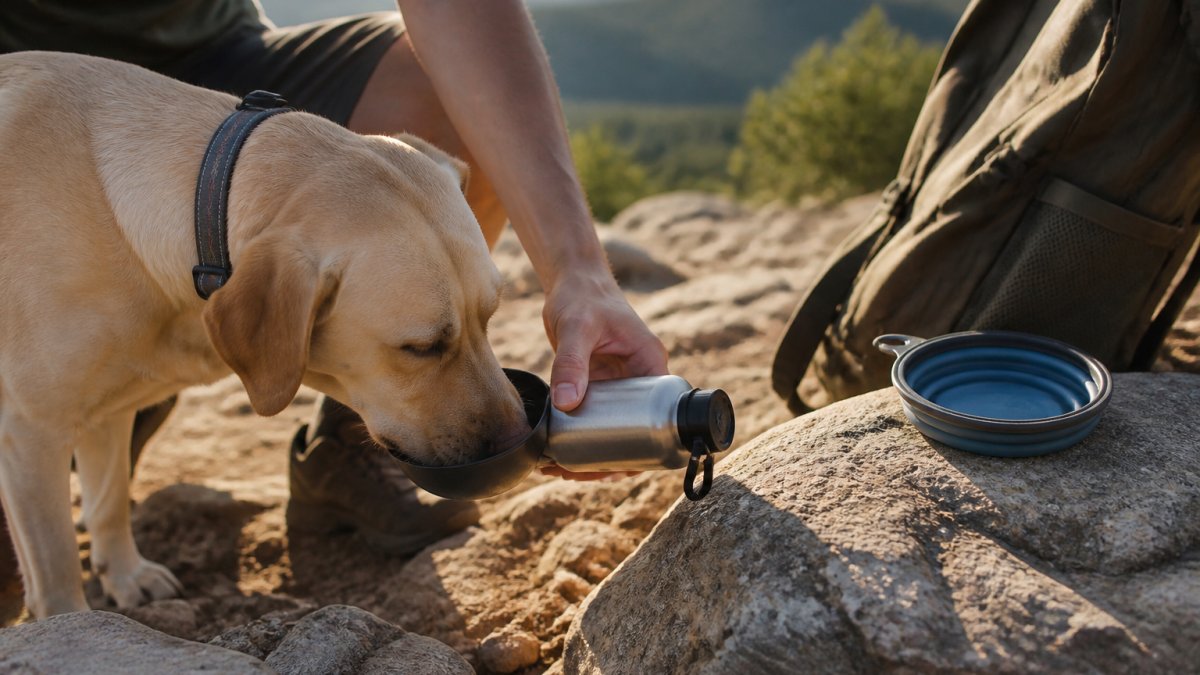
The genuine alternatives, and what each costs you
A lightweight cup or mug. A plain plastic or silicone cup from your kitchen weighs almost nothing and costs nothing.
Natural water sources. Streams, puddles and standing water are a last resort, not a plan.
A bottle with a built-in cup. This removes the pour-and-repack step entirely: your dog drinks from a clean surface you control, in one motion, while you keep walking.
How the alternatives compare in practice
| Option | Weight and bulk | Cleanliness | Hands needed | Best for |
|---|---|---|---|---|
| Lightweight cup | Very low | Open to grit | Two | Short walks, backup |
| Lidded food container | Moderate | Good until opened | Two | Rest stops, food too |
| Hydration bladder + cup | Low if already carried | Good if valve avoided | Two | Owners already carrying a bladder |
| Natural source | None | Poor, untreated | One | Emergency only |
| Bottle with attached cup | Low, fixed by capacity | Good, covered until use | One | Frequent drinks on the move |
Where our three options fit
The best alternative to a portable dog water bowl for most long hikes is a bottle with a built-in cup, because it removes the pour-and-repack step entirely.
The 2-in-1 Pet Water Bottle (£24.99) is our pick for most long hikes.
The 3-in-1 Portable Pet Water Bottle with Bowl & Waste Bag (£21.99) is the one for a full day out.
The Foldable Dog & Cat Bowl (£14.99) is the budget-friendly companion piece. It is food-grade silicone, BPA-free, dishwasher-safe, and folds flat with a carabiner for clipping on.
| Product | Price | Capacity | Best for |
|---|---|---|---|
| 2-in-1 Pet Water Bottle | £24.99 | Bottle with cup | Most long hikes |
| 3-in-1 Portable Bottle | £21.99 | 300 ml or 500 ml | Full days out |
| Foldable Dog & Cat Bowl | £14.99 | Double bowl | Rest stops and feeding |
Water Safety, Hygiene and Accessibility on the Trail
Trail water is not always safe to drink.
guidance from the Blue Cross on what dogs should and should not drink supports carrying your own clean water rather than relying on what you find.
Hygiene matters too. Rinse and dry your bottle and bowl after every trip, and wash the collapsible bowl with warm soapy water or in the dishwasher. Leftover water sitting in a warm bottle for days breeds bacteria.
Accessibility is the angle most guides skip.
Conclusion: Matching the Bowl Alternative to Your Hike
The longer the hike, the less a plain travel bowl earns its space. For a quick loop, it is fine. For a full day on the trail, a bottle with an attached cup does the heavy lifting, and a collapsible bowl covers the rest stops.
At Doggo Shop, we stock the gear that makes those long walks easier, and every order supports rescue dogs in need.
Frequently Asked Questions
What can I use instead of a portable dog water bowl on a long hike?
A 2-in-1 water bottle with an attached cup lets you pour and offer water without a separate bowl. A 3-in-1 bottle adds a food box and waste bag holder. A foldable silicone bowl still works well if you carry your own water supply. The best choice depends on how long you're walking, how much your dog drinks, and whether you want one item or two in your pack.
How much water should I carry for my dog on a hike?
A rough guide is 50-100ml per 5kg of body weight per hour of activity, adjusted for heat and terrain. Carry more than you estimate and plan refill points. The 3-in-1 Portable Pet Water Bottle holds 300ml or 500ml, so for longer routes you may need to carry a backup supply alongside it.
Can dogs drink directly from a hiking water bottle?
Most dogs can't drink efficiently from a standard bottle opening. A 2-in-1 bottle with a silicone cup solves this by converting the cover into a drinking vessel. The 2-in-1 Pet Water Bottle uses a stainless steel body and a silicone cover that becomes a cup, so your dog drinks from a proper vessel rather than the bottle mouth. This also reduces backwash and keeps the remaining water cleaner.
How often should I offer my dog water on a long hike?
Offer water every 20-30 minutes during active walking, and always at the top of a climb or after a steep descent. On hot days, shorten that to every 15-20 minutes. Watch for heavy panting, lagging, or a dry nose and offer water immediately. Small, frequent drinks are better than one large serving at the end.
Are collapsible dog water bowls still worth taking on a hike?
Yes, if you're carrying your own water in a separate bottle or bladder. The Foldable Dog & Cat Bowl folds flat, weighs very little, and attaches to a bag or leash with its carabiner. It's also useful at rest stops where you want to leave water out while you eat. Pair it with a separate water supply, or use a 2-in-1 bottle and leave the bowl at home for shorter trips.


Leave a comment