


How to Stop Puppy Biting During Play
Table of Contents
- Why Puppies Bite and Mouth During Play
- How to Teach a Puppy Bite Inhibition
- How to Redirect Puppy Biting to Toys
- What to Do When a Puppy Bites
- When Do Puppies Stop Biting
-
Common Mistakes That Increase Puppy Biting
- Mistake 1: Playing too roughly
- Mistake 2: Rewarding biting with attention
- Mistake 3: Inconsistent responses
- Mistake 4: Not providing appropriate outlets
- Mistake 5: Confusing the four reasons a puppy bites
- Mistake 6: Expecting instant results
- Mistake 7: Ignoring the warning signs of escalation
- Mistake 8: Leaving children to manage it alone
- Preventing Play from Becoming Too Rough
- Frequently Asked Questions
Last Updated: October 6, 2026
Why Puppies Bite and Mouth During Play
Puppies explore the world with their mouths, so nipping during play is completely normal.
Mouthing serves important purposes: puppies use their teeth to test boundaries, build confidence, and release energy, just like human toddlers grabbing everything.
Teething also drives biting behaviour. Puppy teeth start coming in around 3-4 weeks old.
Understanding why your puppy bites makes it easier to stop puppy biting effectively. You're not punishing bad behaviour.
How to Teach a Puppy Bite Inhibition
Bite inhibition is your puppy's ability to control the force of their bite. A puppy with good bite inhibition mouths gently instead of chomping hard, essential, because even gentle play biting can hurt you or damage furniture.
Teaching bite inhibition takes time and consistency. Most puppies start learning between 3-12 weeks old. The goal isn't to stop all mouthing immediately.
The Yelp and Pause Method
This method mimics how puppies learn from each other: when one bites too hard, the other yelps and stops playing, teaching that hard bites make the fun stop.
Here's how to do it:
- Let your puppy mouth your hand gently during play
- When they bite too hard, yelp loudly, make a high-pitched "Ow!" sound
- Stop playing immediately and turn away
- Wait 10-15 seconds before resuming play
- Repeat consistently every time they bite hard
The yelp must sound genuine. A quiet "ow" won't register. Your puppy needs to understand that hard bites have immediate consequences.
If your puppy gets more excited by the yelp or doesn't seem to understand the connection, try the next approach instead.
Rewarding Calm and Gentle Behaviour
Positive reinforcement works faster than punishment for most puppies. When your puppy mouths gently or chooses a toy over your hand, reward that choice immediately.
Use high-value rewards:
- Small pieces of chicken or cheese
- Enthusiastic praise and petting
- Access to their favourite toy
Timing matters: reward within 1-2 seconds so your puppy connects the reward directly to what they just did.
Praise calmly when they're being gentle. Excited praise can overstimulate them and restart rough play.
How to Redirect Puppy Biting to Toys
Redirection teaches your puppy that toys are for biting, not hands or furniture, one of the most effective long-term strategies for stopping play biting.
When your puppy starts to mouth your hand, immediately offer a toy instead and make it more interesting than your hand.
Choosing the Right Toys for Your Puppy
Not all toys work equally well for teaching bite inhibition. The best toys for this phase are:
- Textured chew toys that feel good on sore gums
- Rope toys for tug-of-war and interactive play
- Treat-dispensing toys that reward engagement
Avoid small toys your puppy could swallow. Avoid toys that look like forbidden items (like socks or shoes).
The Thick Tire-inspired Durable Dog Chew Toy works well for puppies learning bite inhibition. The textured surface massages sore gums during teething.
For puppies who need mental stimulation alongside physical play, the Interactive Suction Cup Tug Toy attaches to smooth surfaces, letting your puppy play solo tug-of-war.
The Play Session Protocol
A structured play session prevents biting from escalating. Here's a simple framework you can use every day:
- Start calm, Begin with gentle petting and quiet interaction
- Introduce the toy, Offer an appropriate chew toy
- Play for 5-10 minutes, Let your puppy engage with the toy actively
- Watch for signs of overstimulation, Heavy panting, jumping, or increased nipping means it's time to pause
- Take a break, Stop play, offer water, let your puppy settle
- Resume if calm, Only continue if your puppy has calmed down
- End on a positive note, Stop before your puppy gets frustrated or tired
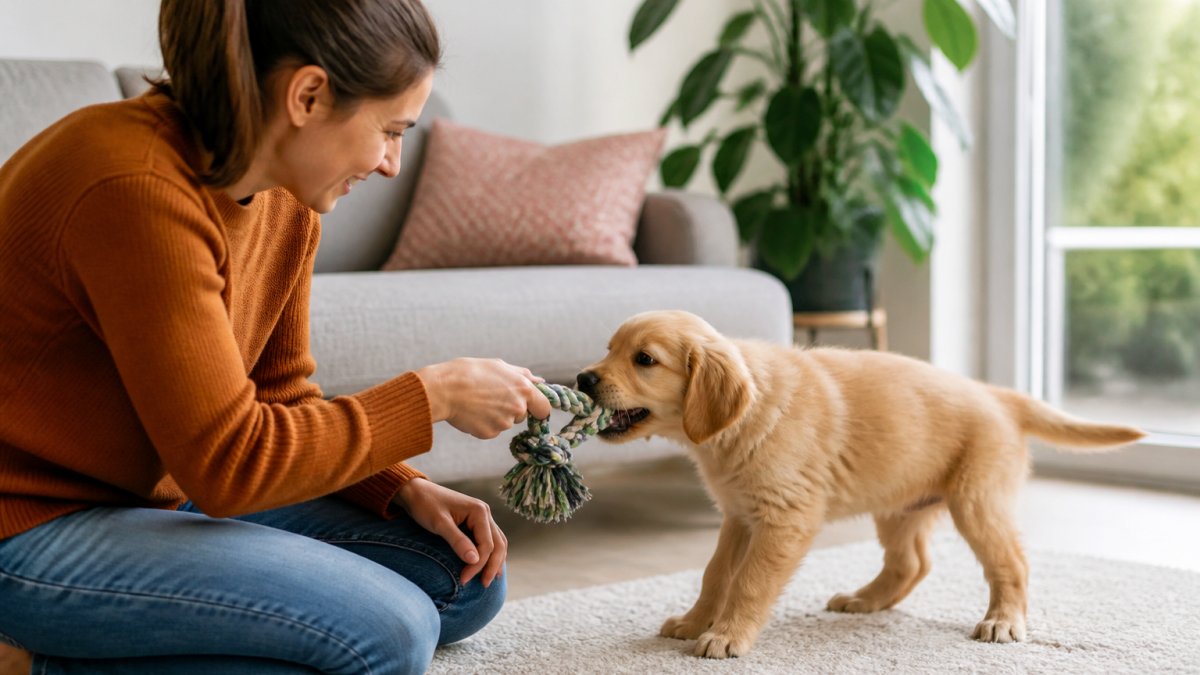
This protocol prevents play from becoming too rough and teaches your puppy that playtime has boundaries. Puppies with structured sessions bite less because their energy is channelled appropriately.
Everyone in your household should follow the same protocol, if one person allows rough play and another stops it, your puppy gets confused.
What to Do When a Puppy Bites
Even with training, your puppy will bite sometimes. How you respond in the moment shapes their behaviour long-term.
Stopping Play Immediately
The moment your puppy bites too hard, stop all interaction. No talking, no eye contact, no attention of any kind.
Your puppy doesn't understand words like "no" or "stop" during excited play. But they understand that biting makes everything stop.
Don't grab or scold them harshly, this can escalate the situation or make them fear you.
Thick Tire-inspired Durable Dog Chew Toy for Aggressive Chewers – Treat →
Brief Time-Outs and Consistency
A time-out doesn't mean punishment. It means removing your puppy from the fun. A 30-60 second pause is usually enough.
Here's the sequence:
- Puppy bites hard
- You stop playing immediately
- Turn away or leave the room
- Wait 30-60 seconds
- Return and offer calm interaction or a toy
Never use the crate as punishment, it should feel safe and positive, not like a penalty box.
Everyone in your household must respond the same way. Inconsistency is one of the biggest reasons puppies keep biting longer than necessary.
When Do Puppies Stop Biting
Most puppies naturally reduce biting as they mature. The timeline varies, but here's what to expect:
- 8-12 weeks: Puppy biting peaks during this phase
- 3-6 months: Biting should decrease significantly with training
- 6 months onward: Most puppies have learned bite inhibition
Some puppies stop mouthing by 4-5 months; others take longer, especially high-energy breeds. Consistent training speeds up the process dramatically.
Puppies that don't learn bite inhibition early often continue biting into adulthood. Even "soft" adult bites can cause injury. Teaching this skill now prevents problems later.
Common Mistakes That Increase Puppy Biting
Many well-meaning owners accidentally make biting worse. The list below goes beyond the usual warnings by explaining why each mistake backfires, and by separating the different reasons a puppy bites, because the fix for a teething bite is not the same as the fix for an attention-seeking bite.
Mistake 1: Playing too roughly
Rough wrestling and hand-chasing teach your puppy that hard biting is part of the game: every time your hand moves fast and your puppy catches it, the behaviour is rewarded. Keep play controlled, keep your hands still, and let the toy do the moving.
Mistake 2: Rewarding biting with attention
Any attention, scolding, shouting, or pushing the puppy away, can reinforce biting. To a puppy, being pushed is contact, and contact is what they wanted. The reliable response is to remove yourself, not react.
Mistake 3: Inconsistent responses
If biting sometimes ends play and sometimes doesn't, your puppy learns it's worth trying. Everyone in the household must respond the same way, every time.
Mistake 4: Not providing appropriate outlets
Puppies have a genuine need to chew. Without suitable toys, they will chew hands, furniture and clothing instead. Provide a rotating selection of textured chews, long tugs, and food-dispensing toys so there is always something legal to bite.
Mistake 5: Confusing the four reasons a puppy bites
The single biggest mistake is treating all biting as one behaviour. In practice, biting during play usually falls into one of four categories, and each needs a different adjustment:
- Teething. Peaks roughly between 12 and 20 weeks as baby teeth loosen and adult teeth push through. The bite is often rhythmic and directed at hard edges. Adjustment: offer chilled chew toys before and after play, and keep sessions short.
- Tiredness. A puppy who has missed a nap bites harder and recovers more slowly. The bite often comes with yawning, slowing down, or losing interest in the toy. Adjustment: end the session and put your puppy down for a rest, no amount of training will work on a tired puppy.
- Overstimulation. The bite is fast, frantic and accompanied by zooming, jumping and a glazed look. Adjustment: stop play, reduce noise and movement, and give your puppy a quiet space to settle.
If you cannot tell which category you are dealing with, note the time of day, what happened just before the bite, and how your puppy behaved afterwards. Patterns usually emerge within a week.
Mistake 6: Expecting instant results
Bite inhibition takes weeks or months, not days. Most puppies show clear improvement between four and six months, but the timeline depends on breed, temperament and how consistent the household has been. Patience and consistency matter more than intensity.
Mistake 7: Ignoring the warning signs of escalation
Ordinary play mouthing is loose, bouncy and easy to interrupt. Behaviour that warrants professional advice looks different. Seek help from your vet or a qualified behaviourist if you notice any of the following:
- Biting that continues after your puppy has been separated and given time to settle.
- Bites that break skin or are accompanied by a hard, fixed stare.
- Growling, snapping or guarding over food, toys or resting places.
Mistake 8: Leaving children to manage it alone
Children are the most common target of puppy biting, and they are also the least able to respond consistently. An adult should supervise all play between a puppy and a child under roughly ten years old. Teach children three rules: keep hands still, stand up and turn away if the puppy bites, and call an adult rather than shouting or running.
Preventing Play from Becoming Too Rough
The best approach is prevention.
Watch for these signs that play is escalating:
- Increased jumping and running
- Faster, harder bites
- Growling or high-pitched play sounds
When you see these signs, pause play immediately.
Provide calm alternatives during high-energy times.
Supervision is essential. You can't teach bite inhibition if you're not watching.
To stop puppy biting during play requires patience, consistency, and the right approach.
At Doggo Shop, we provide toys specifically designed to support this training phase.
Frequently Asked Questions
Is it normal for puppies to bite while playing?
Yes, play biting is completely normal puppy behaviour. Puppies explore their world with their mouths and use play biting to learn boundaries and develop bite inhibition. Most puppies mouth, nip, and play bite as part of their social development. The goal is not to eliminate biting entirely, but to teach your puppy to bite gently and redirect that energy to appropriate toys. With consistent training, puppies learn to control the intensity and frequency of their bites.
How do I teach bite inhibition during play?
Bite inhibition is taught through consistent feedback. When your puppy bites too hard, give a high-pitched yelp or squeal to signal that play has hurt you, then stop play immediately. This mimics how puppies learn from littermates. Pause for 10-20 seconds, then resume play. Repeat this each time biting becomes too intense. Reward calm, gentle behaviour with praise and treats. Over weeks of repetition, your puppy learns that soft mouths keep play going, while hard bites end it. Consistency across all household members is essential.
When do puppies stop biting and mouthing?
Most puppies begin to outgrow frequent play biting between 16 and 20 weeks of age, as their adult teeth come in and they mature socially. However, some puppies continue play biting into 4-6 months old, especially high-energy breeds. Full bite inhibition typically develops by 6 months, though some dogs retain mild mouthing habits into adulthood. The timeline depends on breed, individual temperament, and how consistently you reinforce boundaries. Teething (which peaks around 3-5 months) can temporarily increase biting, so appropriate chew toys become even more important during this phase.
What should I do if my puppy's biting is getting worse despite training?
If biting intensity or frequency increases, evaluate whether your puppy is overstimulated, overtired, or not getting enough appropriate outlets for chewing. Tired puppies often bite more; ensure your pup gets regular naps and exercise appropriate for their age. Check that all household members are using the same training method and stopping play consistently. Introduce dedicated chew toys like the Thick Tire-inspired Durable Dog Chew Toy or Interactive Suction Cup Tug Toy to redirect biting energy. If aggression escalates or includes growling and snapping, consult a professional dog trainer or behaviourist to rule out developing behaviour problems.


Leave a comment