


How to Stop Dog Barking Inside: 7 Proven Methods
Table of Contents
- Understanding Why Your Dog Barks Inside
- Dog Barking at Windows Solutions
- Managing Dog Anxiety Barking Solutions
- Training Dog Not to Bark: Teaching the Quiet Command
- Positive Reinforcement Dog Training Barking Techniques
- Environmental Management and Prevention
- Exercise, Mental Stimulation, and Breed-Specific Solutions
- Common Mistakes to Avoid When Training
Last Updated: July 17, 2026
Understanding Why Your Dog Barks Inside
Dogs bark to alert, claim territory, seek attention, or express anxiety. The key to solving indoor barking is identifying the root cause, treating all barking the same way doesn't work. A dog barking at the window needs a different approach than one barking for attention.
Common Triggers and Causes
Most dogs have multiple triggers layered on top of each other. Attention-seeking barking occurs when your dog learns that barking gets results, even negative attention. Alarm barking triggers at doorbells, footsteps, or unfamiliar sounds, instinctive protective behavior. Territorial barking erupts at window movement or unfamiliar sounds as your dog defends their space. Separation anxiety barking happens when you leave; it's panic, not defiance, often accompanied by pacing or destructive behavior. Frustration barking occurs when your dog wants something unreachable: a toy under the couch or access to the backyard.
Understanding which type you're dealing with changes everything. A training method that works for attention-seeking can actually worsen separation anxiety.
Dog Barking at Windows Solutions
Window barking is one of the most common indoor problems. Your dog sees movement, hears sounds, and feels compelled to alert you. The solution combines environmental management with desensitization.
Block the view first. Use curtains, blinds, or frosted film on windows. This removes the stimulus entirely and stops window barking in 40-60% of cases within days.
Add white noise or background sound. A fan, soft music, or white noise machine masks the sounds that trigger barking, doorbells, car horns, voices outside.
Redirect to an alternative behavior. When your dog approaches a window, redirect them to a puzzle toy or a designated spot away from the glass. Reward heavily when they choose that spot instead.
Desensitization takes time. Gradually expose your dog to triggering sights and sounds at a volume or distance where they don't react. Reward calm behavior and slowly increase intensity. This rewires their automatic response from "alert and bark" to "notice and stay calm."
Many dogs improve dramatically within 2-3 weeks using these methods together. Consistency is key, one person blocking the window while another yells at the dog creates confusion and slows progress.
Managing Dog Anxiety Barking Solutions
Anxiety-driven barking is fundamentally different from other types. Your dog isn't making a choice; they're in a stress response. This requires patience and often professional help.
Separation anxiety barking happens when your dog panics about being alone. Start by desensitizing your dog to your departure routine. Practice grabbing keys, putting on shoes, or walking toward the door 50 times without leaving. Your dog's nervous system learns these actions don't always predict departure.
Leave for short periods. Start with 30 seconds, returning before your dog barks. Gradually extend to 1, 2, then 5 minutes. Each successful experience builds confidence that you always return.
Create a safe space. A crate, specific room, or bed can become your dog's secure zone. Make it attractive with treats and toys. Many anxious dogs find confinement reduces anxiety, it's a defined, manageable space.
Use calming tools. Anxiety wraps, calming supplements, or pheromone diffusers can take the edge off enough that training works better. Consult your veterinarian about options specific to your dog.
Severe separation anxiety often requires professional help from a veterinary behaviorist or certified dog trainer.
Training Dog Not to Bark: Teaching the Quiet Command
Teaching "quiet" is one of the most effective tools for managing barking. You're not teaching your dog to never bark, you're teaching them when barking is and isn't appropriate. The process takes 2-4 weeks of consistent practice.
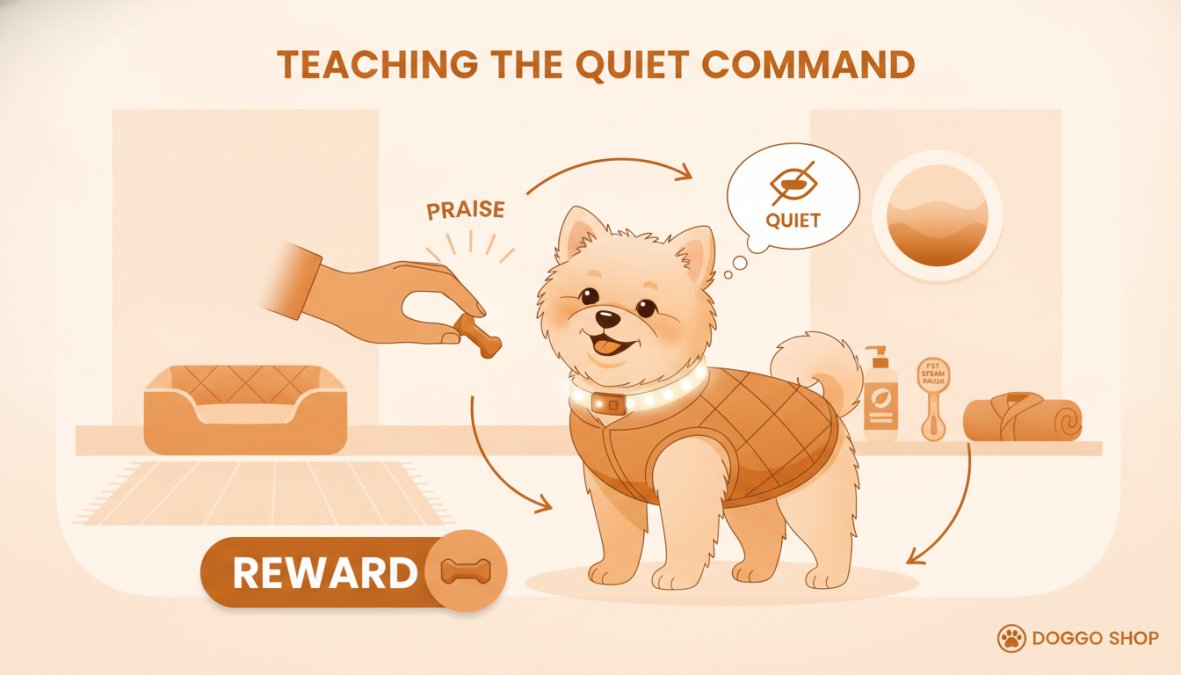
Step-by-Step Quiet Command Training
Step 1: Wait for natural quiet (Days 1-3). The instant your dog is quiet, mark it with "quiet," then immediately reward with a high-value treat. Repeat 10-15 times daily. You're labeling the moment and making it rewarding.
Step 2: Add the cue (Days 4-7). Say "quiet" right before your dog naturally stops barking. Wait 2-3 seconds of silence, then treat. Gradually increase the duration of quiet required: 3 seconds, then 5, then 10.
Step 3: Use real-world triggers (Days 8-14). Ring a doorbell softly or have someone knock gently. Let your dog bark 2-3 times, then say "quiet." When they pause, treat immediately. Over days, your dog learns: barking is okay, but when I say "quiet," stopping gets the reward.
Step 4: Increase duration and difficulty (Days 15-28). Extend the quiet time required before the treat. Introduce stronger triggers: louder doorbells, more realistic knocking. Practice in different rooms. The goal is your dog responding to "quiet" across contexts.
Timing is everything. The treat must come within 1-2 seconds of the quiet behavior. Use high-value treats: small pieces of chicken, cheese, or special training treats your dog doesn't get otherwise.
| Training Phase | Duration | Daily Practice | Expected Progress |
|---|---|---|---|
| Marking quiet moments | 3 days | 10-15 reps | Dog learns "quiet" = reward |
| Adding the cue | 4 days | 15-20 reps | Dog responds to word 50% of time |
| Real-world triggers | 7 days | 10-15 reps per trigger | Dog pauses on command with mild triggers |
| Building reliability | 14 days | 5-10 reps daily | Dog responds consistently across contexts |
Around day 10-12, many owners hit a plateau. Their dog knows the command in training but ignores it when actually triggered. This is normal. You need to practice with actual triggers more, not just quiet moments. Gradually increase trigger intensity while your dog is still succeeding.
Positive Reinforcement Dog Training Barking Techniques
Positive reinforcement is the only approach that works long-term for barking problems. Punishment fails because yelling teaches your dog that barking brings attention. Spraying with water creates confusion and fear. Shock collars suppress barking without addressing why your dog barks. The underlying drive remains, and barking often returns or shifts to different behaviors.
Positive reinforcement works because it changes your dog's emotional response to the trigger. Instead of "I see movement at the window, I must bark," your dog learns "I see movement at the window, I look at my owner for a treat."
Reward the behavior you want, not the absence of barking. Catch your dog being calm near a trigger and reward that calm. Repeat hundreds of times. Your dog learns that calmness around triggers is profitable.
Use high-value rewards. Training treats work better than praise alone. For food-motivated dogs, use chicken or cheese. For toy-motivated dogs, a quick tug or fetch works. For attention-seekers, enthusiastic praise can be enough.
Build the behavior in stages. Start in low-distraction environments. Your living room is easier than a busy street. Master each stage before moving to the next.
Consistency matters more than intensity. Five minutes of training every day beats one 30-minute session per week. Your dog's brain needs repeated exposure to the new pattern.
Many owners see meaningful improvement within 2-3 weeks. Complete reliability often takes 8-12 weeks, but progress is steady and builds on itself.
Environmental Management and Prevention
The fastest way to stop dog barking inside is often removing the trigger entirely.
Control what your dog can see and hear. Close curtains on windows where your dog barks. Use white noise machines to mask external sounds. Move your dog's sleeping area away from high-traffic windows or doors.
Manage your own behavior. Dogs learn quickly that certain actions predict exciting things. If you react to the doorbell, your dog learns the doorbell matters. Stay calm when triggers happen.
Create a routine. A consistent schedule for meals, walks, playtime, and alone time reduces anxiety-driven barking. Your dog knows what to expect, so fewer surprises trigger alarm barking.
Provide appropriate outlets. A dog with pent-up energy barks more. Daily walks, playtime, and mental stimulation reduce barking significantly. A tired dog is a quieter dog.
Use physical barriers strategically. Baby gates prevent your dog from accessing trigger zones. A crate in a quiet room creates a safe space away from stimulation.
These strategies work best combined with training. You're removing opportunities for barking while teaching your dog what you do want.
Exercise, Mental Stimulation, and Breed-Specific Solutions
An under-stimulated dog barks more. This is one of the most overlooked causes of indoor barking. Daily exercise reduces barking significantly. A 30-minute walk or 20-minute play session releases endorphins that naturally calm the nervous system. Dogs that get adequate exercise are less reactive to triggers and more responsive to training.
Mental stimulation matters equally. Puzzle toys, sniff games, training sessions, and interactive play all provide mental work. A dog solving a puzzle toy is not barking at the window.
Breed Tendencies and Tailored Approaches
Some breeds bark more than others. Terriers, hounds, and herding breeds have strong instincts to bark and chase. Training these breeds requires more consistency and more outlets for their natural drives. Companion breeds (Cavaliers, Bichons, toy breeds) often bark for attention and need independence training. Guard and protection breeds (German Shepherds, Rottweilers, Dobermans) have territorial instincts and need clear boundaries about when barking is acceptable. Low-barking breeds (Basenjis, Greyhounds) naturally bark less; if they do, it often signals anxiety, pain, or a genuine concern.
Tailor your approach to your breed. A Terrier needs more outlets for their drive. A companion breed needs more attention and reassurance. A guard breed needs clearer boundaries.
Common Mistakes to Avoid When Training
Inconsistency is the biggest killer. Everyone in the household must follow the same approach. Inconsistent responses teach your dog that the rule changes randomly.
Rewarding the wrong behavior. You think you're ignoring barking, but you're actually rewarding it. Your dog barks, you yell "quiet," your dog stops for a second, you treat. You've rewarded barking followed by a brief pause.
Punishing barking. Yelling, spraying, or corrections don't teach your dog to stop. They teach them to hide it or bark in different situations and increase anxiety.
Starting with triggers that are too strong. If you begin training with a loud doorbell, your dog will bark before you can teach them anything. Start in quiet conditions where your dog can succeed.
Giving up too early. Most barking problems improve within 2-3 weeks, but complete reliability takes 8-12 weeks. Training needs to continue until the behavior is automatic.
Not addressing the underlying cause. A dog barking from anxiety needs anxiety management. A dog barking from boredom needs more exercise. Identify the cause first.
Expecting instant results. Your dog's barking habit took weeks or months to develop. Expect 2-3 weeks for noticeable improvement, not instant silence.
The dogs that improve fastest are those with owners who stay consistent, address the root cause, and practice daily.
Indoor dog barking is one of the most solvable behavior problems. Start by identifying why your dog barks, then choose the strategy that matches that cause. Environmental management, positive reinforcement training, and adequate exercise address most barking problems within weeks. Consistency, patience, and the right approach for your specific dog make all the difference.
Frequently Asked Questions
Why does my dog bark so much inside the house?
Indoor barking stems from several causes: attention-seeking, alarm responses to sounds or movement, territorial behavior, separation anxiety, or frustration. Dogs may bark at windows when they see activity outside, due to boredom from insufficient exercise, or as a learned behavior when previous barking got them what they wanted. Understanding your dog's specific trigger is the first step to addressing the behavior effectively.
How do I teach my dog the quiet command for indoor barking?
Start by waiting for a natural pause in barking, immediately say 'quiet,' and reward with treats and praise. Practice during calm moments first, then gradually introduce the command during mild barking. Consistency is essential, use the same word and reward every time. Avoid yelling, which can excite dogs further. Most dogs respond better to a calm, firm tone paired with high-value rewards.
Can positive reinforcement dog training for barking work as well as punishment?
Yes, positive reinforcement is more effective long-term. Rewarding quiet behavior, alternative actions (like sitting), and calm states creates lasting change without fear or stress. Punishment, yelling, or bark collars often increase anxiety and can worsen barking. Dogs trained with treats, praise, and consistency develop better impulse control and are more responsive to cues.
What should I do if my dog has separation anxiety barking?
Separation anxiety requires gradual desensitization: practice short departures, create a safe space, use white noise or calming music, and consider interactive toys or puzzle feeders to redirect focus. Some dogs benefit from calming supplements or professional behaviorist guidance. Never punish anxiety-driven barking; instead, build confidence through patience and consistency. In severe cases, consult your veterinarian about additional support options.
This article was written using GrandRanker


Leave a comment