


How to Socialize a Fearful Rescue Dog: A Step-by-Step Guide
Last Updated: October 22, 2026
Quick Summary
Socializing a fearful rescue dog starts with a decompression period: follow the 3-3-3 rule and ask nothing of your dog for the first 72 hours, then build trust over the first 3 weeks and 3 months before structured socialisation begins. Set up a quiet room, crate and baby gate, keep a predictable routine, and work below your dog's stress threshold with gradual, treat-paired exposure.
- The 3-3-3 rule covers the first 72 hours, first 3 weeks and first 3 months of settling in.
- Keep training sessions to 10-15 minutes and no more than two trigger sessions per day.
- If a stage shows no progress signal after two weeks, drop back one stage.
- For visitors, start at the distance where your dog still takes food and relaxes within 10 seconds.
- Try parallel walking 10 to 20 metres apart for dog introductions, with no face-to-face greeting.
Table of Contents
- Start with the Rescue Dog Decompression Period
- How to Help a Scared Rescue Dog Feel Safe at Home
- Read Your Fearful Rescue Dog's Body Language and Set a Stress Threshold
- Identify Triggers and Build a Staged, Measurable Socialization Plan
- Socialising a Rescue Dog with Strangers and Visitors
- Socialising a Fearful Dog with Other Dogs
- Use Distance, Calm Exposure and Positive Reinforcement to Build Confidence
- When to Involve a Vet or Behaviour Professional
- Frequently Asked Questions
Start with the Rescue Dog Decompression Period
You cannot rush socializing a fearful rescue dog. A decompression period lets your new dog settle before you ask anything of them.
Rescue dogs arrive with an invisible history: many have never lived in a home, had little positive contact with people, or been moved between kennels, foster homes and vets.
The 3-3-3 rule is a useful guide.
The First 72 Hours, First 3 Weeks and First 3 Months
Think of settling in as three stages, not one event.
- First 72 hours: Your dog may shut down, hide, or refuse food. Keep everything quiet and ask nothing of them.
- First 3 weeks: Routine starts to take hold. You may see the real personality emerge, along with the fears.
- First 3 months: Trust builds. This is when structured socialisation can begin in earnest.
Many owners invite friends round in week one to "get the dog used to people". That usually backfires: a dog with no safe base cannot learn.
How to Help a Scared Rescue Dog Feel Safe at Home
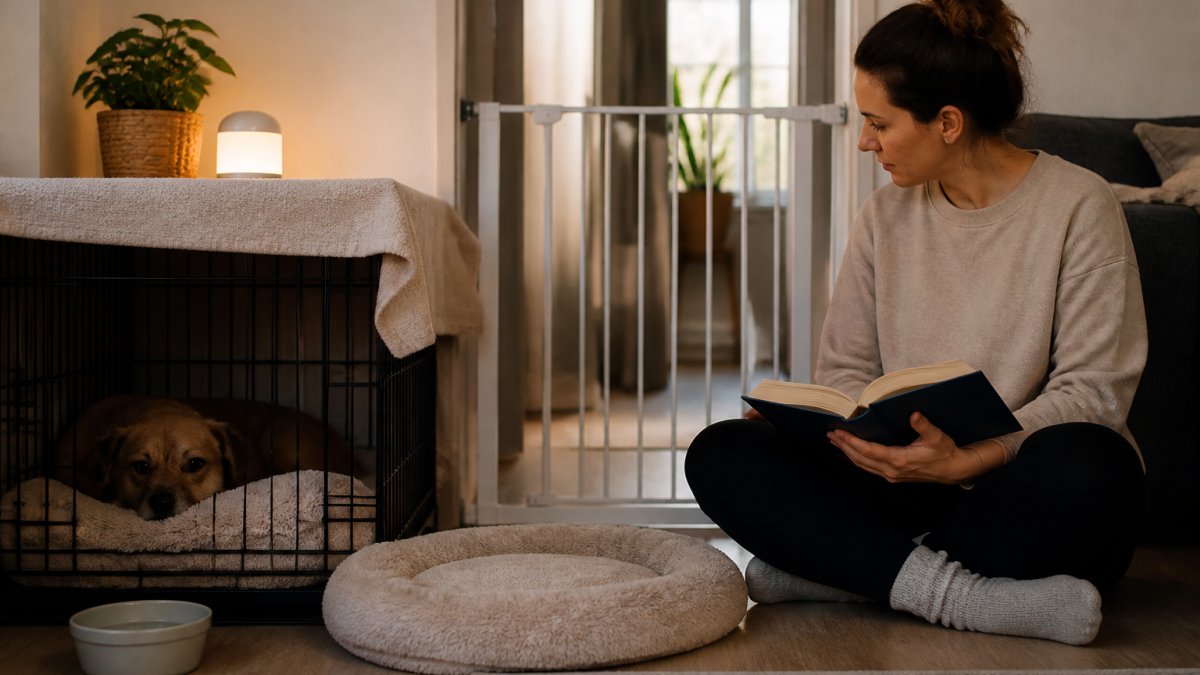
Safety comes before socialising. A scared rescue dog needs a secure base before exploring the world, so set up the house first.
Set Up a Quiet Room, Crate and Baby Gate
Give your dog one room or corner that is theirs. Add:
- A crate with a blanket over the top, leaving the door open
- A baby gate so they can watch the household without joining in
- A few quiet enrichment toys to fill idle time
Never drag a dog out of their crate. Let them come to you.
Build a Predictable Daily Routine
Dogs relax when they know what happens next. Keep meals, walks and rest at the same times daily; a predictable routine lowers stress and makes training easier.
Read Your Fearful Rescue Dog's Body Language and Set a Stress Threshold
You cannot socialise a dog you cannot read. Body language tells you when your dog is coping and when they are not.
A stress threshold is the point where a dog stops coping and starts reacting.
Watch for these stress signals:
- Yawning, lip licking or turning away
- Ears pinned back, tail tucked
- Stiff body, frozen posture
Growling is information, not defiance. It says "I am uncomfortable". Punishing it removes the warning, not the fear.
Identify Triggers and Build a Staged, Measurable Socialization Plan
A trigger is anything that sparks fear: strangers, other dogs, traffic, doorbells, vacuum cleaners, handling, the vet. Before you socialise, know what you are working with and how far you can push before your dog stops coping.
Step 1: Build a Trigger Inventory
Spend a week noting every situation where your dog changes: the trigger, the distance or intensity, and the first signal you see. A notebook or phone note is enough:
| Date | Trigger | Distance / intensity | First signal | Recovery time |
|---|---|---|---|---|
| Mon | Stranger at front door | 10 m, door closed | Lip lick, turn away | 2 minutes |
| Tue | Passing dog on walk | 15 m, both on lead | Stiff body, stare | 5 minutes |
| Wed | Doorbell | Volume 3 of 10 | Ear flick, no bark | Under 1 minute |
This log is your baseline: it shows which triggers are mild, which are severe, and which are improving.
Step 2: Rank Each Trigger from Mild to Severe
Score each trigger from 1 (barely notices) to 5 (panics, cannot eat, cannot recover) and work on the lowest first. A dog who tolerates a quiet doorbell is ready for a louder one; a dog who panics at strangers is not ready for a hallway visitor.
Step 3: Set a Measurable Plan for Each Trigger
Use the same four-column structure for every trigger, but make the criteria observable and specific. Here is a worked example for strangers:
| Stage | What you do | Progress signal (move on when) | Step back if |
|---|---|---|---|
| 1 | Stranger stands 20 m away, dog on lead | Dog glances, then takes a treat within 3 seconds | Dog refuses food or freezes for more than 5 seconds |
| 2 | Stranger stands 10 m away | Dog looks, then relaxes jaw and turns away | Dog stares, stiffens or barks |
| 3 | Stranger walks past at 10 m | Dog can sniff ground or take a treat as they pass | Dog lunges or tries to bolt |
| 4 | Stranger stands 5 m away, side-on, silent | Dog approaches within 2 m, sniffs, then disengages | Dog retreats or hides |
| 5 | Stranger tosses a treat sideways from 2 m | Dog takes treat and returns to handler | Dog snaps or avoids treat |
Repeat this structure for other dogs, places, sounds and handling. Distances vary by dog; every stage needs a visible pass criterion and a clear reason to step back.
Step 4: Apply the Two-Week Rule
If a stage produces no progress signal after two weeks of short, calm sessions, drop back one stage. A stall usually means the step is too big, the environment too busy, or the dog tired or unwell.
Step 5: Separate Plans for People, Dogs, Places, Sounds and Handling
Fear is rarely one thing: a dog might be fine with people but terrified of traffic, or relaxed at home but panicked at the vet. Build a separate plan per category and work on one at a time to stay under threshold.
Snuffle Mat for Dogs – Interactive Sunflower Treat Puzzle →
What Progress Actually Looks Like
Do not expect a fearful rescue dog to become outgoing. Realistic progress is recovering faster, taking food sooner, and choosing to disengage rather than react.
Track three things each session: whether your dog took food, seconds until they relaxed, and whether they chose to move away. Those measures beat a subjective sense of how it went.
Socialising a Rescue Dog with Strangers and Visitors
Letting the dog approach in their own time is correct but incomplete: you also need a clear threshold, how close is close enough, how long an interaction lasts, and when to stop. Without those answers, owners accidentally flood their dog while believing they are being gentle.
Voluntary Exposure Versus Forced Greeting
Voluntary exposure means the dog chooses whether to approach, how close to get, and when to leave. Forced greeting means the dog is carried, led, held or cornered into contact. They look similar but teach opposite lessons.
A fearful dog allowed to approach a seated visitor, sniff their shoe and walk away learns strangers are predictable and escapable.
Set a Safe Exposure Threshold
Before any visitor arrives, decide three numbers:
- Distance: the closest your dog can be to the visitor while still taking food and relaxing within 10 seconds. Start there, not at the visitor's feet.
- Duration: 30-60 seconds of exposure at first, then a break in the quiet room.
- Recovery time: how long your dog needs to return to normal after the visitor leaves. If recovery takes more than an hour, the session was too intense.
A Visitor Protocol with Exit Points
- Put the dog in their quiet room with a long-lasting chew and close the baby gate.
- Let the visitor arrive, sit down quietly and ignore the dog completely. No eye contact, no reaching out, no baby talk.
- Open the gate. Stay seated. Let the dog choose whether to come out.
- If the dog approaches, the visitor tosses a treat sideways, away from their body, and continues to ignore the dog.
- If the dog retreats, close the gate and end the session. That is a successful session, not a failed one.
- Keep the visit to 15-20 minutes for the first three or four occasions.
Early Stress Signals That Mean Stop
End the interaction immediately if you see:
- Lip licking, yawning or turning the head away
- Ears pinned back, tail tucked or body lowered
- Freezing, stiffening or refusing food
Growling is information, not defiance. It says the dog is uncomfortable. Punishing it removes the warning, not the fear, and leaves you with a dog who bites without warning.
Common Mistakes That Set Dogs Back
- Inviting a group round in the first month to "get it over with"
- Letting visitors stare at, loom over or reach for the dog
- Allowing a visitor to hold the dog while it struggles
When to Bring in Help
If your dog cannot tolerate a visitor at 10 m after several weeks of calm, structured sessions, or panics for over an hour after a visit, stop and speak to your vet. Pain, thyroid problems and sudden sensory changes can all sit behind new fear. For serious cases, ask for a referral to a clinical animal behaviourist.
Socialising a Fearful Dog with Other Dogs
Dog introductions need space and calm. A fearful dog on a tight lead meeting a bouncy dog is a recipe for a setback.
Try parallel walking first. Two dogs walk on loose leads, 10 to 20 metres apart, moving in the same direction. No face-to-face greeting.
Over several sessions, close the gap. Watch for sniffing, loose movement and the ability to disengage. Those are green lights.
Use Distance, Calm Exposure and Positive Reinforcement to Build Confidence
Gradual exposure means small, repeatable steps at a distance your dog can handle.
This is the core of positive reinforcement.
Reward with treats, toys and sniffing time. Sniffing is calming for dogs, so let them stop and explore.
Our Snuffle Mat for Dogs is a simple way to add calm enrichment at home.

Track Progress and Handle Setbacks Safely
Keep a simple log after each session: what you did, how your dog reacted, what you would change. Progress is rarely a straight line, a bad day does not erase weeks of work. Drop back a step, keep sessions short, and rebuild.
When to Involve a Vet or Behaviour Professional
Some fears need more than a training plan. Contact your vet if your dog shows panic that does not settle at home, loss of appetite or disturbed sleep, sudden behaviour changes, or worsening reactivity.
Socialising a fearful rescue dog takes patience, structure and the right kit. If your dog needs calm enrichment between sessions, Doggo Shop stocks interactive toys and puzzle feeders built for exactly that, including our Smart Duck Feeder and Pet Casino Puzzle Toy.


Frequently Asked Questions
How long does it take for a fearful rescue dog to become more confident?
Every dog moves at its own pace, but the widely used 3-3-3 rule gives a useful rough timeline. The first three days are about decompression, the first three weeks about settling into routine, and the first three months about building trust and starting gentle socialization. Some fearful rescue dogs need six months or longer before they are comfortable with visitors or other dogs. Track small wins, such as taking food from your hand or approaching a stranger at a distance, rather than comparing your dog to others.
Should I use treats and toys during socialization sessions with my fearful rescue dog?
Yes. Positive reinforcement with high-value treats, sniffing games and puzzle feeders helps a fearful rescue dog link new people and places with good things. Keep sessions short, reward calm behaviour and stop before your dog becomes overwhelmed. Interactive toys such as a snuffle mat or treat-dispenser can also provide calm enrichment between sessions, giving your dog a safe way to burn mental energy without facing a trigger.
What should I do if my rescue dog is afraid of other dogs?
Start with distance. Walk your dog at a distance from other dogs where they can still eat treats and respond to you, then gradually reduce that gap over several weeks. Use a calm handler, loose leash and positive reinforcement, and avoid nose-to-nose greetings or busy dog parks. A one-to-one introduction with a steady, confident dog in a neutral space is safer than a group. If your dog freezes, lunges or tries to flee, increase distance and seek help from a qualified behaviourist.
When should I see a vet or behaviour professional about my fearful rescue dog?
Speak to your vet first if your dog shows fear of everyday sounds, handling or new places, or if anxiety is affecting eating and sleep. Your vet can rule out pain or medical causes and discuss whether a referral to a clinical animal behaviourist is appropriate. Seek professional help sooner if your dog shows aggression, self-harm, or has not improved after several weeks of gradual exposure at home. In the meantime, keep a simple diary of triggers and reactions to share with them.


Leave a comment