


How to Keep Dogs Entertained Indoors: 10 Activities That Work
Table of Contents
- Why Indoor Entertainment Matters for Your Dog
- Mental Stimulation vs. Physical Exercise: Finding the Balance
- Interactive Indoor Dog Games to Keep Dogs Entertained Indoors
- Mental Stimulation for Dogs Indoors: Puzzle Toys and Brain Games
- DIY Dog Toys for Indoor Entertainment: Budget-Friendly Solutions
- How to Tire Out a Dog Indoors: Energy Management by Age and Breed
- Toy Rotation and Commercial Products: Keeping Novelty Alive
- Common Mistakes to Avoid When Keeping Dogs Entertained Indoors
How to Keep Dogs Entertained Indoors: 10 Activities That Work
Last Updated: July 22, 2026
Why Indoor Entertainment Matters for Your Dog
Boredom leads to destructive behaviors: chewed furniture, excessive barking, separation anxiety, and aggression. Indoor enrichment isn't just about preventing mischief; it's essential for your dog's emotional health. Research shows that adequate mental stimulation reduces stress hormones, improves sleep, decreases anxious behaviors, and develops stronger impulse control.
At Doggo Shop, we've observed that owners who actively engage their dogs indoors report fewer behavioral issues and happier companions. The difference comes down to appropriate stimulation matched to your dog's age, energy level, and breed.
Mental Stimulation vs. Physical Exercise: Finding the Balance
These aren't interchangeable. Physical exercise burns energy; mental stimulation engages the brain. A physically exhausted but mentally bored dog will still find destructive outlets.
Mental stimulation involves problem-solving and cognitive engagement through puzzle toys, scent work, and training. Physical exercise is straightforward: running, jumping, and moving their body.
The ideal approach combines both daily. A 20-minute obedience session followed by 15 minutes of fetch hits both needs. Different dogs require different ratios, a Border Collie needs significantly more mental stimulation than a Bulldog. The mistake most owners make is assuming a long walk equals complete fulfillment. Indoors, you control the entire environment.
Interactive Indoor Dog Games to Keep Dogs Entertained Indoors
Games are the foundation of indoor entertainment. They're interactive, build your relationship, and are free or nearly free.
Hide and Seek
Hide and seek taps into your dog's natural hunting instincts. Start by hiding treats in obvious spots while your dog watches, then say "Find it!" Gradually increase difficulty by hiding treats under blankets, inside boxes, or behind furniture. Advanced version: hide yourself in different rooms. Most dogs become obsessed with this game because it combines search, discovery, and reunion with their favorite person.
Scavenger Hunts and Scent Work
Scent work is deeply satisfying for dogs. Hide small treats around your living space, under cushions, in boxes, inside paper bags, behind doors. Release your dog with "Search!" and let them work. Start with obvious hides in a single room, then advance to multiple rooms and harder-to-find locations.
This activity is particularly effective for anxious dogs because it channels nervous energy productively. A 15-minute scent work session can produce the same mental fatigue as an hour of physical exercise.
Tug-of-War and Fetch Variations
Controlled tug-of-war with clear rules teaches impulse control and strengthens your bond. Use a dedicated tug toy, establish that your dog releases on command, and keep play balanced and playful.
For indoor fetch, use soft toys in confined spaces like hallways. The Doggo Shop's [Adjustable Tennis Ball Thrower for Dogs](https://70135e-74.myshopify.com/products/pet-intelligence-ball-dispenser-adjustable-tennis-pitching-machine) ($97.00) eliminates repetitive throwing, while the Automatic Ball Throwing Machine for Dogs ($69.99) provides self-launching fetch for apartments.
Mental Stimulation for Dogs Indoors: Puzzle Toys and Brain Games
Puzzle toys require your dog to solve a problem to access rewards, creating genuine mental fatigue and satisfaction.
Food-Dispensing Toys and Puzzle Feeders
A Kong stuffed with wet food and frozen provides 20-30 minutes of engagement. Upgrade to actual puzzle feeders that require sliding, flipping, or manipulating pieces to reveal treats. The sweet spot is 10-20 minutes of engaged problem-solving, too easy and it's solved in 2 minutes, too hard and your dog gives up.
Rotate puzzle toys weekly so they feel novel. A toy ignored for two weeks becomes fascinating again when reintroduced.
Snuffle Mats for Nose Work
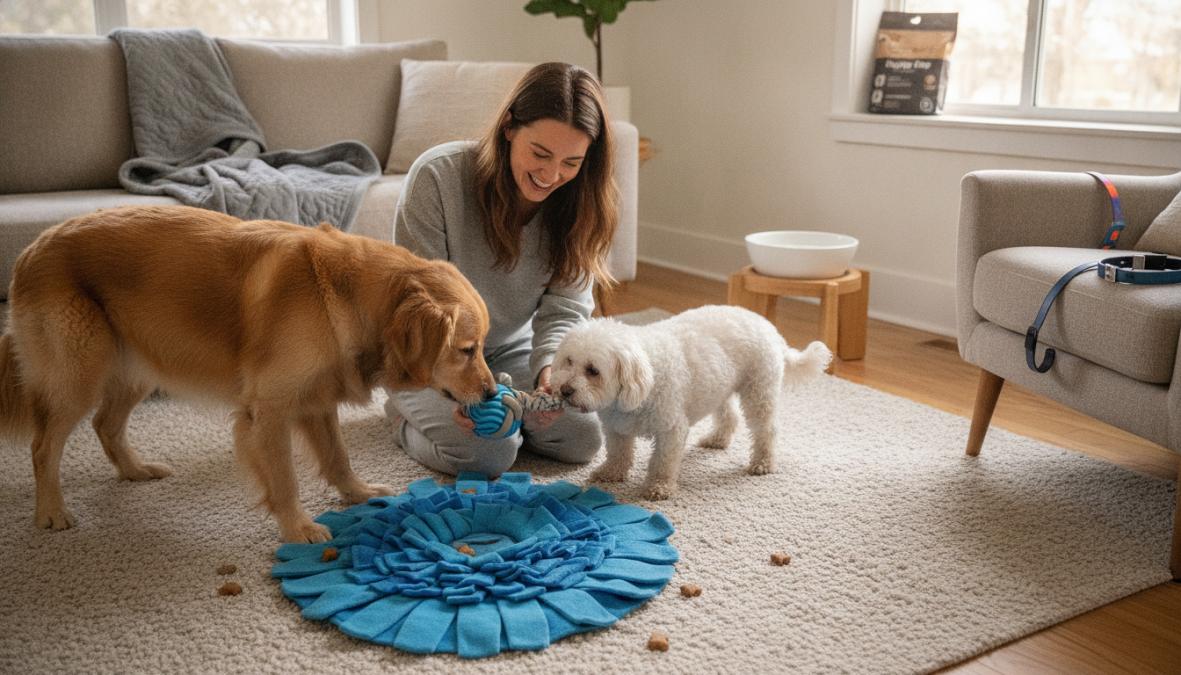
A snuffle mat has multiple layers and pockets for hiding treats. Your dog uses their nose to search through fabric, mimicking natural foraging behavior. The Doggo Shop's [Snuffle Mat for Dogs - Interactive Sunflower Treat Puzzle](https://70135e-74.myshopify.com/products/pet-snuffle-mat-for-your-doggo) ($19.99) provides 15-20 minutes of engagement. DIY alternative: use a muffin tin with tennis balls in each cup, or hide treats in a rolled towel.
Obedience Training and Trick Practice
A 10-minute training session creates more mental fatigue than 30 minutes of fetch. Use positive reinforcement exclusively, teach one new trick per week, and keep sessions short (5-10 minutes). Clicker training accelerates learning by marking the exact moment your dog does the right thing.
DIY Dog Toys for Indoor Entertainment: Budget-Friendly Solutions
Frozen Kong alternatives: stuff a toilet paper roll with treats, fold the ends closed, and freeze it. Your dog tears it apart to access treats, free, biodegradable, and highly engaging.
Puzzle from household items: use a muffin tin, hide treats in each cup, and cover with tennis balls. Your dog removes the balls to find treats.
Scent toy: place treats inside a sock, tie it closed, and hide it around your home.
Tug toy: tie two old t-shirts together in a knot for tug-of-war.
Fetch toy: crumple newspaper into a ball, free, durable, and your dog loves the crinkle sound.
DIY toys feel genuinely novel to your dog. Rotate between commercial and DIY toys to maximize engagement.
How to Tire Out a Dog Indoors: Energy Management by Age and Breed
Not all dogs have the same needs. Understanding your dog's specific requirements prevents both under-stimulation and over-stimulation.
High-Energy and Working Breeds
Border Collies, Australian Shepherds, and Huskies need 1-2 hours of combined mental and physical activity daily. Mental stimulation is non-negotiable, a 2-hour walk without cognitive engagement leaves them bored, while a 30-minute training session leaves them satisfied.
Structure your day: 20 minutes of training, 15 minutes of fetch or tug-of-war, 15 minutes of scent work or puzzle toys. Rotate activities frequently for novelty.
Senior Dogs: Gentle Indoor Modifications
Senior dogs need low-impact activities: snuffle mats, slow scent work, gentle training, and puzzle feeders. A 10-minute snuffle mat session is perfect. Elevated puzzle feeders reduce joint strain. Senior dogs often appreciate routine more than novelty, and teaching new tricks keeps an aging brain sharp.
Apartment-Friendly Options with Noise Management
Apartments require silent entertainment: puzzle toys, snuffle mats, training, and scent work. The Doggo Shop's [Smart Rolling Interactive Ball for Dogs & Cats - 360° Play](https://70135e-74.myshopify.com/products/smart-rolling-interactive-ball-for-dogs-cats-360-play) ($14.99) engages your dog without noise.
| Activity | Noise Level | Duration | Best For |
|---|---|---|---|
| Snuffle Mat | Silent | 15-20 min | All ages, apartments |
| Puzzle Toys | Silent | 10-30 min | All ages, apartments |
| Scent Work | Silent | 15-20 min | All ages, apartments |
| Clicker Training | Minimal | 5-10 min | All ages, apartments |
| Fetch | Loud | 10-15 min | High-energy, houses |
| Tug-of-War | Moderate | 5-10 min | High-energy, houses |
| Hide and Seek | Quiet | 10-15 min | All ages, apartments |
Toy Rotation and Commercial Products: Keeping Novelty Alive
A dog's interest in a toy declines predictably: intense engagement for 3-7 days, then sharp decline. By day 14, it's usually ignored.
Toy rotation solves this. Keep 5-6 toys in rotation, put 2-3 out at a time, and rotate every 7-10 days. A toy your dog ignored for two weeks becomes fascinating when it reappears. This extends your toy collection's life without constant purchases.
Commercial puzzle toys worth the investment: Kongs (durable, versatile, affordable), snuffle mats (silent, effective, long-lasting), and treat-dispensing balls (engaging, reusable). The Doggo Shop's products are tested for safety and durability. The brand donates 100% of profits per order to rescue dogs in need.
Common Mistakes to Avoid When Keeping Dogs Entertained Indoors
Mistake 1: Assuming physical exercise equals complete stimulation. Dogs need both mental and physical engagement.
Mistake 2: Leaving the same toys out permanently. Novelty matters enormously.
Mistake 3: Choosing toys based on what you think is fun rather than what your dog finds engaging.
Mistake 4: Over-complicating puzzle toys. A toy that's too easy is better than one that's too hard.
Mistake 5: Inconsistent engagement. Consistent daily activities beat sporadic engagement.
Mistake 6: Ignoring breed-specific needs. Match activities to your dog's breeding and temperament.
Mistake 7: Using entertainment as punishment. Keep all engagement positive.
Keeping your dog entertained indoors is foundational to a happy, well-behaved dog. Whether you have a high-energy breed, a senior dog, or live in an apartment, there's a solution that fits your situation. Start with one or two activities, observe what your dog loves, and build from there. Your dog will reward you with better behavior, deeper calm, and a stronger bond.
Frequently Asked Questions
What's the difference between mental stimulation and physical exercise for keeping dogs entertained indoors?
Mental stimulation engages your dog's brain through puzzle toys, training, and scent work, while physical exercise burns energy through movement. Both are essential to keep dogs entertained indoors and prevent boredom-related destructive behavior. Mental stimulation can actually tire dogs out faster than physical activity alone, making it ideal for apartment living or bad weather days. Combining both approaches creates a balanced routine that addresses your dog's cognitive and physical needs.
How often should I rotate toys to keep my dog interested in indoor entertainment?
Rotate toys every 1-2 weeks to maintain novelty and prevent boredom. Store half your dog's toys away and bring out fresh ones, then swap them back. This simple strategy keeps mental stimulation high without buying constantly. For dogs with separation anxiety or high energy, rotate more frequently, even every few days. Interactive toys like puzzle feeders and treat-dispensing toys can stay out longer since they require active engagement, while passive toys benefit most from rotation.
What are the best DIY dog toys for indoor entertainment on a budget?
Create snuffle mats by tying strips of fabric through a rubber mat, fill muffin tins with treats and tennis balls for puzzle play, or make treat-dispensing toys from toilet paper tubes filled with kibble and sealed at the ends. Frozen water bottles, cardboard boxes filled with crumpled paper, and old socks knotted together also provide free enrichment. These DIY solutions offer excellent mental stimulation for dogs indoors without expensive purchases, though commercial options like Doggo Shop's Snuffle Mat ($19.99) provide durability if budget allows.
How can I keep a high-energy dog entertained indoors without excessive noise?
Focus on mental stimulation rather than high-impact physical games in apartments. Use puzzle toys, scent work, obedience training, and treat-dispensing toys to tire your dog mentally while keeping noise low. Indoor agility using cushions or low obstacles, tug-of-war games, and clicker training all burn energy quietly. Rotate activities to prevent boredom, and establish a consistent routine. For apartments, avoid repetitive fetch games or jumping activities; instead, invest in interactive toys like automatic ball launchers that provide controlled exercise without disturbing neighbors.
This article was written using GrandRanker


Leave a comment