


How to Introduce New Dog Toys: A Step-by-Step Guide
Table of Contents
- How to Introduce New Dog Toys: Getting Started
- Step-by-Step Process for How to Introduce New Dog Toys
- Introducing Toys to Resident Dogs vs. New Puppies
- Managing Dog Toy Rotation for Long-Term Engagement
- Helping Dogs Not Interested in Toys Develop Play Drive
- How to Teach Dog Toy Names and Interactive Play
- Environmental Enrichment and Multi-Dog Household Strategies
- Common Mistakes to Avoid When Introducing New Toys
Last Updated: July 23, 2026
How to Introduce New Dog Toys: Getting Started
Learning how to introduce new dog toys properly sets the foundation for a happy, well-adjusted pup. At Doggo Shop, we understand that the way you present a toy shapes whether your dog will engage with it or ignore it entirely. Dogs respond well to structure, positive reinforcement, and gradual exposure. Thoughtful toy introduction teaches your dog about play styles, builds confidence, and strengthens your bond through interactive engagement.
What You'll Need Before Starting
Gather high-value treats your dog loves, existing toys for reference, and a quiet, familiar space where your dog feels safe. If you have multiple dogs, plan for separation during initial playtime using a crate, separate room, or pen. A clicker is optional but helpful for marking desired behaviours. Set aside 10-15 minutes of focused, distraction-free time when you're calm and patient.
Step-by-Step Process for How to Introduce New Dog Toys
Step 1: Choose the Right Toy for Your Dog's Play Style
Not all toys suit every dog. Think about how your individual dog plays. Some dogs are natural fetchers, while others prefer to carry and shake toys. Prey drive plays a role, a dog with high prey drive might obsess over squeaky toys, while a low-drive dog might ignore them entirely.
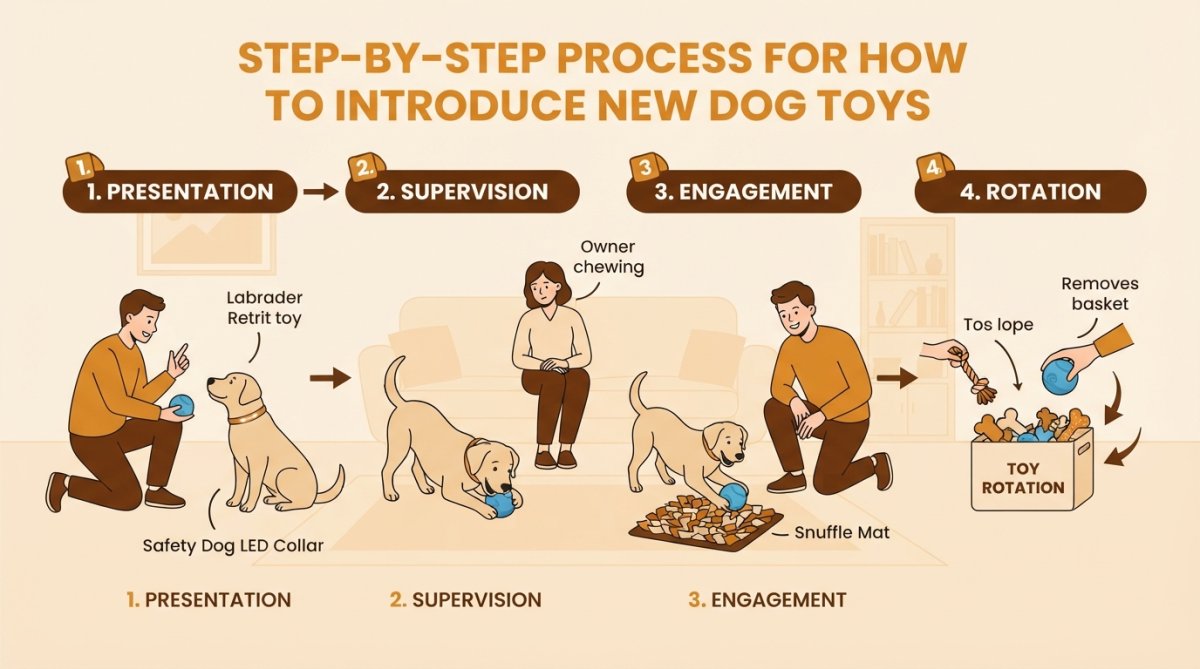
Consider your dog's size, age, and chewing intensity. Puzzle toys and snuffle mats work well for dogs who enjoy mental enrichment, while interactive fetch machines suit high-energy dogs. The Doggo Shop range includes options for every play style, from the Automatic Ball Throwing Machine for fetch enthusiasts to the Interactive Sunflower Snuffle Mat for dogs who love foraging games.
Step 2: Start in a Calm, Familiar Environment
Introduce the new toy in a space where your dog already feels confident and safe. Avoid introducing toys during high-energy times. Instead, choose a moment when they're naturally relaxed, perhaps after a walk or meal. Simply place the toy nearby without pressure for your dog to interact with it. Let them investigate at their own pace. Keep the first session short: five to ten minutes is plenty.
Step 3: Use Positive Reinforcement and Reward-Based Training
Once your dog shows even mild interest in the toy, reward that behaviour immediately. The moment they sniff it, touch it, or pick it up, deliver a high-value treat and enthusiastic praise. This creates a clear mental link: interacting with this toy = good things happen.
Escalate the reward structure as your dog engages more deeply. If they pick up the toy, reward. If they carry it, reward. If they bring it back to you, reward generously. Clicker training pairs beautifully with toy introduction. Click the moment your dog engages with the toy, then immediately follow with a treat.
Step 4: Supervise Play and Watch for Resource Guarding Signs
Supervision during early toy play is non-negotiable. Watch for signs of resource guarding: stiffening when you approach, eating or chewing more intensely when you're near, turning away from you, growling, or snapping. If you notice any of these signs, don't punish. Instead, step back and give space.
Establish that your presence near the toy is positive, not threatening. Toss treats toward your dog while they play with the toy. This teaches them that you approaching = good things, not toy removal.
Step 5: Teach the Drop It Command for Safety
Teaching your dog to release toys on command is one of the most valuable safety skills you can build. Hold a toy your dog already knows and loves. When they pick it up, immediately show them a high-value treat held very close to their nose. Most dogs will drop the toy to take the treat. The moment they release it, say "drop it" enthusiastically, give the treat, and praise heavily.
Repeat this 5-10 times per training session, several times per week. Once your dog understands the association, start saying "drop it" just before you show the treat. Never punish your dog for not dropping a toy. The drop it command works best when it predicts something positive.
Introducing Toys to Resident Dogs vs. New Puppies
For Resident Dogs
Adult dogs living in your home already have established play preferences and habits. Start by observing what toys your resident dog currently engages with. New toys that align with these preferences have a much higher adoption rate.
The introduction timeline for adult dogs is often longer than for puppies. A resident dog might ignore a new toy for days before suddenly deciding it's worth investigating. Continue leaving the toy accessible, reward any interaction, and resist the urge to force engagement.
Resident dogs also benefit from toy rotation. Rather than leaving all toys available at once, rotate them weekly. This keeps novelty high and prevents toys from becoming boring background objects.
For New Puppies
Puppies are naturally curious and typically engage with toys enthusiastically, but they still benefit from structured introduction. Young puppies are also more vulnerable to toy-related injuries. Choose age-appropriate toys: soft plushies and rubber toys for very young puppies (8-12 weeks), gradually introducing harder chew toys as their adult teeth come in.
Puppies learn socialization and play styles through toy interaction. Spend 10-15 minutes several times daily playing with your puppy using toys. This builds their confidence and teaches them that toys are vehicles for connection with you.
Puppies also need to learn toy boundaries early. If a puppy growls over a toy, address it immediately with redirection and reward-based training.
Managing Dog Toy Rotation for Long-Term Engagement
Toy rotation keeps your dog engaged without purchasing new toys constantly. Divide your dog's toys into groups of 3-4. Keep one group available while storing the others out of sight. Every 7-10 days, swap groups. Your dog encounters "new" toys without you spending additional money. Store rotated toys in a closed container where your dog can't see them.
Helping Dogs Not Interested in Toys Develop Play Drive
Troubleshooting Toy-Shy Dogs
Some dogs show little interest in toys despite your best efforts. Understanding why your dog isn't interested is the first step toward changing their engagement.
Start by making toys more rewarding than they currently are. Instead of leaving toys available, use them as special, high-value items that only appear during specific times. Play fetch for two minutes, then put the toy away. This scarcity makes toys feel more valuable.
Try different toy types. A toy-shy dog might ignore balls but engage with toys that squeak, move on their own, or contain treats. The Automatic Ball Throwing Machine works for dogs who love fetch but don't care about static toys. The Smart Rolling Interactive Ball provides autonomous movement that can trigger prey drive.
Make toys interactive and unpredictable. Drag a toy across the floor to trigger chase instinct. Hide treats inside toys so your dog has to interact with them to access rewards. A snuffle mat engages your dog's natural rooting and searching behaviours. Puzzle toys that dispense treats provide both mental stimulation and food reward.
If your dog remains uninterested despite consistent effort, accept that they may simply be a low-toy-drive dog. This is normal and doesn't indicate a problem. Focus instead on enrichment activities they do enjoy: walks, sniffing games, training sessions, or social interaction.
How to Teach Dog Toy Names and Interactive Play
Teaching your dog the names of specific toys is a fun party trick and a genuinely useful skill. Dogs with a strong vocabulary around toys can fetch specific ones on command. Start with one toy your dog already engages with regularly. Hold it, say its name clearly, and play with them using it. Repeat the name frequently during play.
After several sessions, hold the toy, say its name, and see if your dog shows interest or moves toward it. Reward any response. Once your dog consistently responds to one toy name, introduce a second toy using the same method.
Interactive play strengthens the human-dog bond while providing physical and mental exercise. Fetch games, tug-of-war with appropriate toys, and chase games all count as interactive play. Dogs who engage in regular interactive play with their owners show fewer behavioural problems, better impulse control, and stronger attachment.
Environmental Enrichment and Multi-Dog Household Strategies
Managing Toy Access in Multi-Dog Homes
Multi-dog households require careful toy management. When multiple dogs share toys, resource guarding often emerges. The simplest solution is providing multiple identical toys. If you have two dogs, buy two balls, two snuffle mats, two interactive toys. This removes the scarcity that triggers guarding behaviour.
Store high-value toys out of sight when you're not supervising. Only bring toys out during supervised, structured play sessions.
When to Separate Dogs During Playtime
Not all dogs should play together with toys. Watch your dogs' play interactions carefully. Healthy multi-dog play involves mutual engagement, role-switching, and breaks. If one dog consistently dominates, if either dog shows signs of stress, or if play escalates toward aggression, separate them.
Separate dogs during toy play if one dog guards toys while the other wants to play with them, play becomes too intense or rough, one dog is significantly larger or more aggressive, or dogs have different energy levels or play styles.
Provide separate spaces for individual toy play using crates, separate rooms, or a baby gate. Many multi-dog households find that separate toy time actually increases overall happiness, as each dog gets to play according to their own style without compromise.
Common Mistakes to Avoid When Introducing New Toys
The most frequent mistake owners make is introducing toys without any structure or planning. Structured introductions work across all temperaments and play styles.
Another common error is moving too quickly through the introduction process. Owners become impatient when their dog doesn't immediately love a toy, so they abandon it and buy something else. Slow, patient introductions yield better long-term engagement.
Many owners also fail to supervise early toy interactions closely enough. Without supervision, you miss early signs of resource guarding, toy damage, or toy-related injuries.
Punishing toy-related behaviours is a major mistake. If your dog growls over a toy or refuses to drop it, punishment makes guarding worse, not better. Reward-based approaches work far more effectively.
Introducing too many toys at once overwhelms dogs and prevents them from bonding with any single toy. Stick to one new toy at a time. Finally, ignoring your dog's individual play style and preferences wastes money and frustration. Match toys to your dog's actual preferences, and you'll see engagement immediately.
Introducing new toys successfully comes down to understanding your individual dog, moving at their pace, and using reward-based approaches that make toys genuinely rewarding. At Doggo Shop, we've seen dogs transform from toy-indifferent to toy-obsessed when their owners take time with introductions. The Automatic Ball Throwing Machine, Smart Rolling Interactive Ball, and Snuffle Mat are designed to suit different play styles. Find what matches your dog's natural preferences, introduce it thoughtfully, and watch your dog's engagement flourish. Every purchase at Doggo Shop supports rescue dogs and cats in need worldwide, so you're building your dog's toy collection while making a genuine difference. Shop now and give your pup the very best.
Frequently Asked Questions
How do I get my dog interested in new toys if they ignore them?
Start by pairing the new toy with high-value rewards like treats or praise. Use interactive play with the toy rather than leaving it alone, toss it, move it around, or play fetch to trigger your dog's prey drive. If your dog is toy-shy, try softer materials first and introduce toys during positive moments like feeding time. Clicker training can help associate the toy with rewards. Some dogs need time and patience; consistent, reward-based introduction works better than forcing interaction.
Should I introduce dog toys one at a time or all together?
Introduce new toys one at a time to prevent overwhelming your dog and to monitor their reaction clearly. This approach also helps you identify which toys your dog prefers and makes it easier to spot resource guarding or toy aggression early. Once your dog is comfortable with one toy, you can introduce another. Dog toy rotation, swapping toys weekly, keeps engagement high without cluttering your home and maintains your dog's interest over time.
What should I do if my dog shows signs of resource guarding with new toys?
Watch for resource guarding signs like stiffening, growling, or blocking access to the toy. If you notice these behaviours, separate the toy and start teaching the 'Drop It' command using treat-based reinforcement. Never punish resource guarding, instead, use reward-based training to teach your dog that giving up toys leads to better rewards. Consider working with a dog behaviorist if guarding is severe. Supervised play and separation protocols during initial introduction help prevent territorial behaviour from developing.
How do I teach my dog toy names and make interactive play more engaging?
Use clicker training and treat-based reinforcement to associate toy names with specific toys. Say the toy name, show it, play with it, then reward. Repeat consistently. Interactive play, where you actively engage with your dog using the toy, builds stronger human-dog bonding than solo play and increases play drive. Rotate between interactive toys (fetch machines, puzzle toys) and solo toys (chew toys) for balanced enrichment. This approach keeps your dog mentally stimulated and more interested in play.
This article was written using GrandRanker


Leave a comment