


How to Handle Puppy Biting When Overexcited
Table of Contents
- Why Overexcited Puppies Bite: Arousal Biting Explained
- Puppy Bite Inhibition Training: The Foundation of Calm Bite Control
- How to Calm an Overexcited Puppy Before Biting Escalates
- Redirecting Puppy Biting to Appropriate Chew Toys and Activities
- The Puppy Time-Out Method: When and How to Use It
- Preventing Overexcited Biting: Environment, Routine and Impulse Control
- Frequently Asked Questions
Last Updated: September 12, 2026
Why Overexcited Puppies Bite: Arousal Biting Explained
Puppy biting is the mouthing and nipping a puppy does when excitement, play or fatigue pushes their arousal past the point where they can think straight. It is normal puppy behaviour, not aggression, and peaks during teething and early social development.
The distinction matters: an overexcited puppy needs help coming down from a high, while an aggressive puppy needs a professional approach. Confusing the two is a common mistake owners make.
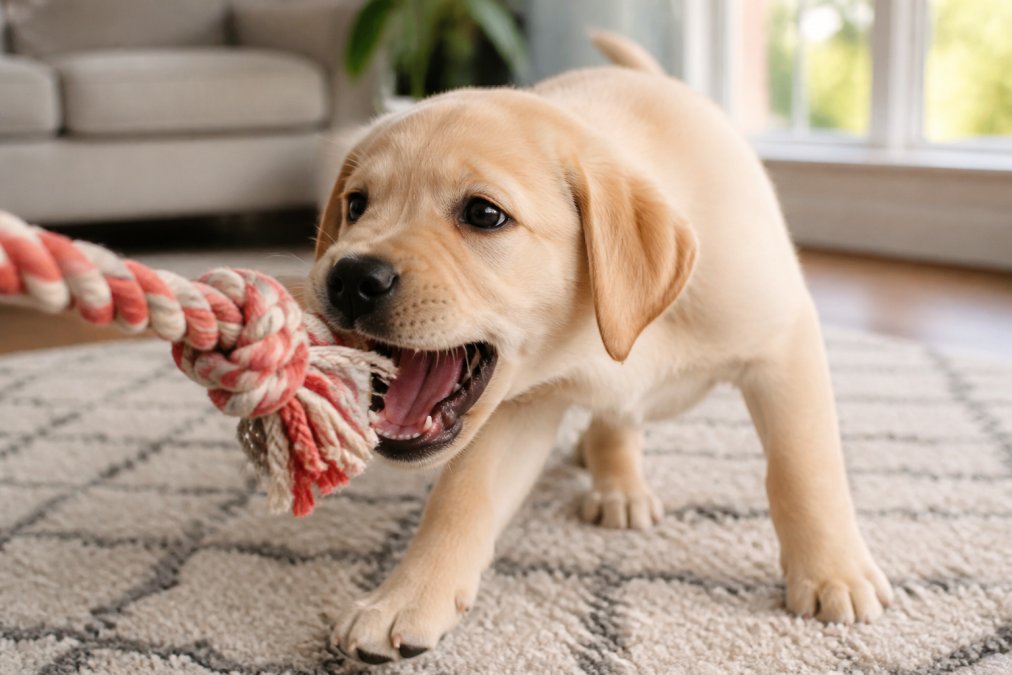
The Overtired Connection
Here is what most guides miss: biting often gets worse the more tired your puppy is. A puppy who has been zooming around for forty minutes is not "full of energy" any more, they are overstimulated, and their self-control has gone offline.
Think of a toddler at bedtime: the wilder they get, the closer to collapse they are. If your puppy's nipping escalates in the evening, sleep is often the real fix, not more training.
How to Spot the Warning Signs Before Biting Starts
Puppies broadcast rising arousal through body language long before teeth make contact. Learning these signals lets you intervene early instead of reacting after a nip.
Watch for:
- Flattened ears and a stiff, still body
- Wide, darting eyes and a "zoomies" glint
- Faster, shallower panting
- Losing interest in the toy and turning toward hands
- Repeated lip-licking or yawning in a play context
When you see two or more of these, de-escalate now. A short pause, a scatter of treats or a calm break is far easier than stopping a full biting episode.
Puppy Bite Inhibition Training: The Foundation of Calm Bite Control
Puppy bite inhibition training teaches your dog to control the force of their mouth, and it is the single most valuable skill you can build in the first few months. A dog who learned bite inhibition as a puppy is far less likely to cause injury later, even if provoked.
The mechanics are simple. When teeth touch skin, play stops immediately. Not with a shout, just a calm "ouch" and a two-second pause. If the biting continues, you leave the room for ten to twenty seconds.
That short withdrawal is the lesson: mouths on skin end the fun, mouths on toys keep it going. Consistency matters more than intensity, and every family member must follow the same rule.
The Kennel Club's puppy training guidance
How to Calm an Overexcited Puppy Before Biting Escalates
Calming an overexcited puppy means reducing stimulation, not adding more. The goal is to bring arousal down a level or two before the biting tips over, in the right order, because the wrong intervention at the wrong moment makes things worse.
Why stillness works: the arousal curve
Arousal in puppies behaves like a curve, not a switch. As excitement climbs, they pass a threshold where the thinking brain goes offline and the reactive brain takes over. Past that threshold, no cue, treat or toy will reliably reach them, they are physically unable to process it.
This is why timing matters more than technique. Intervene before the threshold, while you still have a thinking puppy. Once they are in full shark mode, your only job is to reduce input and wait for the curve to come back down.
The de-escalation ladder
Work down this ladder in order. Move to the next step only if the previous one has not worked within about ten to fifteen seconds.
- Go still and quiet. Stop all movement, fold your arms, turn slightly away and drop your gaze. Movement, high-pitched voices and eye contact read as play and push arousal higher. Stillness removes the fuel.
- Create a physical gap. Step behind a baby gate, over a pen panel, or onto a sofa the puppy cannot reach. Distance alone lowers arousal because the trigger is out of range.
- Redirect the nose downward. Scatter a handful of treats or kibble across the floor. Sniffing is naturally calming, it engages the parasympathetic system and gives the puppy a job incompatible with biting.
- Give the mouth a settling job. Offer a stuffed chew toy, a frozen carrot or a snuffle mat. Licking and chewing are self-soothing behaviours, not just distractions.
- Change the environment. Move to a dim, quiet room and sit on the floor with your puppy. Lower light, less noise and a smaller space all reduce the input that is driving the arousal.
- End the session with a calm break. If the puppy is still escalating, lead them to a pen or crate for a genuine rest. This is not a time-out for biting, it is a recognition that the puppy needs to come down.
What not to do
A few common reactions reliably make overexcited biting worse:
- Squealing or yelping. For some puppies this is exciting, not aversive, and it turns hands into squeaky toys.
- Pushing the puppy away with your hands. Hands moving toward the puppy read as play and raise arousal.
- Grabbing the muzzle or scruffing. This is a physical punishment, it damages trust, and it does nothing to teach the puppy what to do instead.
- Chasing the puppy to retrieve them. Chase games are the highest-arousal activity there is. Walk away instead and let the puppy follow.
A worked example
Say your puppy has been playing tug for fifteen minutes. They start panting faster, their ears go back and they glance at your hands instead of the toy. That is two warning signs, intervene now.
You drop the tug, stand still and look away. The puppy pauses, then lunges at your trouser leg. You step behind the baby gate and scatter kibble on their side. They sniff and eat. After thirty seconds you offer a stuffed chew toy through the gate; they take it and settle. Session over, you caught it before the threshold.
Redirecting Puppy Biting to Appropriate Chew Toys and Activities
Redirection swaps the target, not the behaviour. Your puppy still gets to bite, just something appropriate instead of your sleeve.
Keep a toy within arm's reach and offer it the moment teeth touch skin. A durable chew toy, tug toy or treat-dispensing puzzle gives the mouth a satisfying job. Rotate toys so they stay novel.
At Doggo Shop, we offer a range of interactive toys, including a durable chew toy for aggressive chewers and an interactive suction cup tug toy that lets a puppy tug solo while you keep your hands free.
The Puppy Time-Out Method: When and How to Use It
The puppy time-out method is a brief, calm removal from play when biting continues past redirection. It is not punishment but a reset, and it works best when short, boring and consistent.
Use it like this:
- Give one warning. Teeth on skin, say "ouch", pause, offer a toy.
- If biting repeats within seconds, calmly lead your puppy to a pen or crate.
- Leave them for ten to twenty seconds. No talking, no eye contact.
- Release them and resume calm play. Repeat as needed.
Preventing Overexcited Biting: Environment, Routine and Impulse Control
Prevention beats reaction every time. A well rested, mentally stimulated and physically exercised puppy is far less likely to tip into arousal biting, but those terms mean specific things at specific ages. Here is what the routine actually looks like.
Sleep: the pillar most owners get wrong
Young puppies need far more sleep than most people realise. Many trainers suggest around eighteen to twenty hours a day for puppies under twelve weeks, dropping to roughly sixteen hours by four to six months (thekennelclub.org.uk). That is when the brain consolidates learning and the nervous system resets.
An overtired puppy looks exactly like an overexcited one: zooming, nipping, unable to settle. The fix is a nap, not more training. Build the day around roughly one hour awake to two hours asleep, and protect those naps like appointments.
Signs your puppy is past their sleep window:
- Nipping escalates in the late afternoon or early evening
- They cannot settle even with a chew toy
- They startle easily at normal household noise
- They bite harder and recover more slowly from redirection
If you see these, the next step is a darkened crate or pen, not a training drill.
Exercise: quality over quantity
A common mistake is trying to tire a biting puppy out with more exercise. This backfires: an already over-aroused puppy needs less input, not more physical output.
A better guide is age-appropriate, sniff-led exercise. Many trainers suggest around five minutes of structured walking per month of age, twice a day, plus free sniffing in the garden (thekennelclub.org.uk). A four-month-old might get two twenty-minute walks, not one forty-minute march.
Sniffing is the key. A fifteen-minute sniffy walk tires a puppy more than a thirty-minute brisk march, because scent work engages the brain and lowers arousal rather than raising it.
Mental stimulation: tiring the brain
Mental work is the most under-used tool in puppy rearing. Ten minutes of puzzle feeding does more for settling than half an hour of fetch, without pushing arousal up.
Practical options:
- Snuffle mats for scatter feeding
- Puzzle feeders for one or two meals a day
- Stuffed chew toys frozen for teething puppies
- Short training games, five minutes, three times a day, teaching sit, wait, settle and leave it
- Cardboard boxes with treats hidden inside for shredding
Impulse control: the skills that prevent biting
The commands that matter most for overexcited biting teach a puppy to pause. Build them in short daily sessions, never when the puppy is already over-aroused:
- "Leave it", teaches the puppy to disengage from something they want
- "Wait", teaches them to hold position before a reward
- "Settle", teaches them to lie down calmly on a mat while life happens around them
- Hand-feeding, feeding part of the daily ration by hand, one piece at a time, teaches gentle mouthing as a default
A useful rule: train these when the puppy is calm and slightly hungry, not after a play session. You are building a habit, not testing willpower.
Environmental management: setting the puppy up to succeed
You cannot train your way out of a poorly designed environment. Modify the space so the biting cycle cannot start.
- Puppy pens and baby gates create a safe zone where the puppy can be left with a chew toy while you cook, work or take a call. This prevents the boredom-biting cycle entirely.
- Tethers attached to a fixed point near your desk or sofa let the puppy be with you without being able to reach your hands, shoes or trouser legs.
- A calm zone, a crate or covered pen in a quiet corner, gives the puppy a place to self-settle when the household gets busy.
- Remove tempting items from floor level: shoes, socks, cables, children's toys. Every item you remove is one fewer thing to redirect from.
- Rotate toys so the available chew options stay novel. A puppy with three toys on rotation is more interested than one with twenty on the floor.
Breed tendencies: adjust the balance
A generic schedule will not fit every puppy. High-drive breeds, collies, spaniels, terriers, working lines, often need more mental work and structured settling practice, because their default is to escalate quickly. Low-drive or brachycephalic breeds may tire faster and need shorter sessions with more rest.
This is about matching the routine to the puppy in front of you. A working or herding line means leaning harder on mental work, mat training and enforced naps; a lap breed means shorter sessions and even more carefully protected rest.
Frequently Asked Questions
How do I stop my puppy from biting when it gets overexcited?
Start by removing attention the moment teeth touch skin. Stand still, fold your arms and look away. Once your puppy pauses, redirect to a chew toy like a durable rubber bone. If biting continues, use a brief time-out in a puppy-proofed space for 10-20 seconds. Consistency across all family members matters more than any single technique. Most puppies improve between 4 and 7 months as bite inhibition develops.
What is the puppy time-out method and how long should it last?
The puppy time-out method involves calmly removing your puppy from the exciting situation for a short break. It should last 10-20 seconds, just enough to interrupt the arousal without causing distress. Use a puppy-proofed area, not a crate if your puppy is still learning to love it. Pair time-outs with redirection to appropriate chew toys so your puppy learns what to do instead of biting.
At what age is puppy biting at its worst?
Puppy biting typically peaks between 3 and 5 months, when teething discomfort and excitement collide. During this period, puppies explore the world with their mouths and haven't yet developed full bite inhibition. By 6 to 7 months, with consistent training and redirection, most puppies show significant improvement. Breed and individual temperament can shift this timeline slightly.
Should I say 'no' when my puppy bites?
A sharp 'no' can startle some puppies, but it often adds excitement or anxiety rather than teaching calm behaviour. Instead, use a calm marker like 'ouch' followed by a brief pause in play. Then redirect to a chew toy. This approach teaches your puppy that biting ends the fun, while appropriate chewing earns praise and continued interaction.


Leave a comment