


How to Exercise a High Energy Dog Indoors: 7 Calming Games
Table of Contents
- Why Indoor Exercise Matters for High Energy Dogs
- How Much Indoor Exercise Does a Dog Need?
- Indoor Dog Exercise Games That Burn Real Energy
- Enrichment Activities for Dogs: Scent Work and Puzzle Toys
- Safety Precautions for Indoor Play in Flats and Houses
- How to Calm a High Energy Dog After Play
- Breed-Specific Energy Management and Training Tricks
- Frequently Asked Questions
Last Updated: October 21, 2026
Why Indoor Exercise Matters for High Energy Dogs
A tired dog is a good dog, but you already know that. The problem is the weather, the dark evenings, or a flat with no garden.
Indoor exercise is not a compromise. It is a skill. Done well, it tires your dog out faster than a walk, because it works the brain as well as the body.
High-energy breeds need both physical exertion and cognitive exercise. Skip either one and you get boredom.
So how do you exercise a high energy dog indoors without wrecking your home or annoying the neighbours? Below, we break down the games, the safety rules, and the wind-down routine that actually works.
How Much Indoor Exercise Does a Dog Need?
Most high-energy dogs need roughly 30 to 60 minutes of active indoor play split across two or three sessions a day. Short, frequent bursts beat one long marathon.
The exact amount depends on age, breed, and the weather outside. A young collie needs more than a middle-aged terrier.
Watch your dog, not the clock. Signs they have had enough:
- Slowing down or losing interest in the toy
- Heavy panting that does not ease after a minute
- Lying down mid-game
- Turning away from you
If your dog flops down and sighs, you have hit the sweet spot.
Indoor Dog Exercise Games That Burn Real Energy
The best indoor dog exercise games mix movement with thinking. Fetch, tug, and hide and seek all work in a small space if you set them up properly.
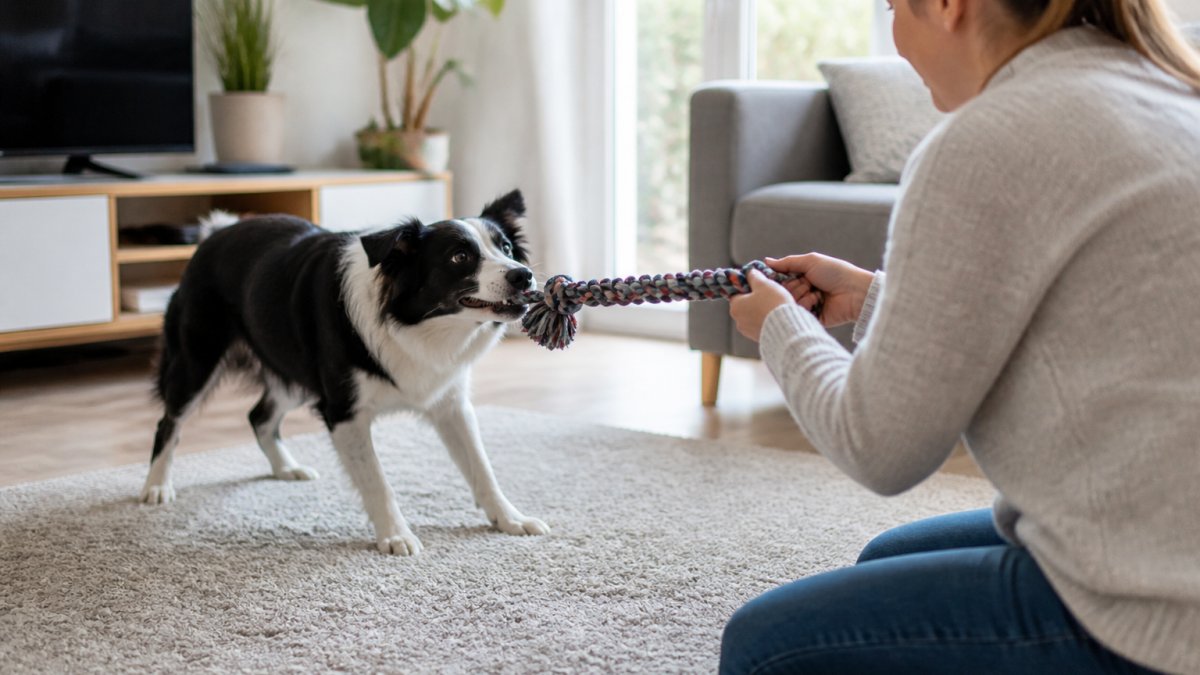
Fetch and Tug-of-War in Small Spaces
Fetch indoors needs rules. Throw a soft toy down a hallway rather than across a room full of furniture.
Tug-of-war is brilliant for high-energy dogs because it is a full-body workout. Use a long rope toy and let your dog win sometimes.
A common mistake is yanking the rope hard. That can hurt your dog's neck. Keep the tension steady and let your dog do the pulling.
Hide and Seek and Stair Climbing
Hide and seek works your dog's brain and body at once. Ask your dog to stay, hide behind a door, then call them. Reward with a treat when they find you.
Stair climbing is a simple way to add physical exertion. Walk your dog up and down a flight of stairs a few times, or toss a toy gently up two or three steps.
Enrichment Activities for Dogs: Scent Work and Puzzle Toys
Enrichment activities for dogs are the fastest route to a calm, tired pup.
Nose games are simple. Scatter kibble across a snuffle mat and let your dog forage. Hiding treats around a room turns your living room into a scent puzzle.

Our Snuffle Mat for Dogs is built for exactly this. Sprinkle treats between the soft fabric petals and watch your dog sniff, snuffle, and search.
For dogs that need movement with their thinking, a smart ball adds another layer. The Smart Rolling Interactive Ball rolls and dodges obstacles on its own, so your dog chases and pounces while you get on with your day.

Safety Precautions for Indoor Play in Flats and Houses
Safety comes first, especially in a flat. Hard floors, sharp corners, and thin walls all create risks that a garden does not. Most guides stop at "clear the room"; the detail below is what actually prevents injuries and neighbour complaints.
Floor grip and slip prevention
Laminate, tile, and polished wood offer almost no traction. A dog sprinting after a ball on a smooth floor can splay their legs, strain a cruciate ligament, or skid into furniture.
Check the rug itself. A loose rug that rucks up is worse than bare floor. Use a non-slip underlay or double-sided tape at the corners. If your dog is a hard Brake-and-turn player, keep the play area to one rug rather than letting them cross from carpet to tile mid-sprint.
Noise control for flats and terraces
Sound travels through floors and shared walls. Bouncing balls, scrabbling claws, and dropped toys are the main culprits. Practical mitigations:
Snuffle Mat for Dogs – Interactive Sunflower Treat Puzzle →
- Play on a thick rug or foam mat rather than bare floor, this absorbs impact noise as well as giving grip.
- Choose soft, fabric-covered, or plush toys for fetch; hard plastic balls and squeakers carry through floors.
- Keep high-impact games (fetch, stair work, tug) to daytime hours, typically before 8pm, and switch to scent work or puzzle feeders in the evening.
- Put a blanket or towel under the play area if you are on an upper floor, it dulls the thud of landings.
If you live in a leasehold flat, check your lease or building rules on pets and noise, many specify quiet hours. A quick word with neighbours before a new routine starts prevents most complaints.
Furniture, collisions, and breakables
Clear a runway rather than a whole room. Move coffee tables, floor lamps, and anything with a sharp edge out of the fetch line. Close doors to rooms you do not want your dog in, and block stairs if you are not using them for exercise. A dog chasing a toy does not watch where it is going.
Toy safety and supervision
Rope toys, plush toys, and snuffle mats are not chew toys. A determined chewer can swallow fabric strands, which can cause a serious intestinal blockage. Supervise every session and put toys away afterwards. Check rope toys for fraying after each use and retire them once strands start to pull loose.
A quick safety checklist before you start:
- Clear breakable items from the play area
- Put a non-slip mat or runner down on hard floors
- Choose soft toys for indoor fetch
- Close doors to rooms you do not want your dog in
- Check lease or building rules on noise and quiet hours
How to Calm a High Energy Dog After Play
The wind-down matters as much as the workout. Without it, your dog stays wired and struggles to settle. Learning how to calm a high-energy dog is a skill you build, not a switch you flip. The aim is to bring arousal down gradually over 10 to 20 minutes, not to stop play abruptly.
Step 1: Lower the pace before you stop
Do not go from full-speed tug to "lie down" in one move. Spend the last two or three minutes of the session slowing the game: shorter throws, gentler tug, longer pauses between turns. This gives your dog's nervous system time to come down. A common pattern is to end with a simple, low-arousal command they already know well, a sit, a down, or a hand touch, and reward calmly.
Step 2: Move to a quiet space and change the signal
Swap the tug toy for a chew or a long-lasting treat, and move to a quieter room. Dim the lights and speak softly. Dogs read these cues: the same room, the same low voice, and the same chew every time becomes a predictable signal that playtime is over. Keep the transition boring, excitement in your voice undoes the work.
Step 3: Give a slow, scent-based job
Sniffing lowers arousal. A snuffle mat with a few treats, or a scatter of kibble on a rug, gives your dog a job that uses their nose at a slow pace. This is the single most effective step for most high-energy dogs. Five to ten minutes of slow foraging does more to settle a dog than telling them to lie down.
Step 4: Reward the calm, not the excitement
Watch for calming signals: a slow blink, a sigh, a stretch, a shake-off, or a turn away. These tell you your dog is winding down. Reward that calm behaviour with quiet praise or a small treat placed on the floor, not a excited "good boy" that winds them back up. If your dog offers a settle on their own, mark it quietly and leave them alone.
Step 5: Build a predictable routine
Same order every time: play, toilet break, chew, settle. Dogs relax faster when they know what comes next. A predictable sequence is more powerful than any single trick because it lets your dog anticipate the end of play.
If your dog is still pacing 30 minutes after play, they likely need more mental work rather than more running, add a puzzle feeder or a scent game to the next session.
Breed-Specific Energy Management and Training Tricks
Different breeds need different approaches. A border collie needs a job. A husky needs distance.
Herding breeds love trick training and obstacle courses.
Scent hounds and terriers thrive on nose games. Hide treats around the room and let them hunt.
Working breeds need impulse control work.
Training sessions should be short: five to ten minutes, two or three times a day.
If your dog destroys toys in minutes, choose durable options and always supervise. Our Automatic Rolling Ball is made from chew-resistant silicone and ABS, with two play modes for gentle or energetic dogs. For fetch fans, the Adjustable Tennis Ball Thrower keeps the game going even when your arm is tired.

Frequently Asked Questions
How much indoor exercise does a high-energy dog need each day?
Most high-energy dogs need 60 to 120 minutes of combined physical and mental activity daily. When outdoor walks are limited, split this into three or four short sessions of 15 to 30 minutes. Mix vigorous play like fetch or tug-of-war with calmer enrichment such as scent work or puzzle feeders. Watch for signs your dog is settling, like slower breathing or a relaxed tail, rather than pushing for a fixed time. Puppies and senior dogs need shorter, gentler sessions.
Can mental stimulation tire a dog out as much as physical exercise?
Yes, in many cases it can. Scent work, puzzle feeders and training sessions make dogs use their brain, which can be just as tiring as a run. Ten minutes of focused nose games often leaves a high-energy dog calmer than a rushed walk. Combine both types of activity for the best results: physical exertion releases energy, while cognitive exercise builds impulse control and helps your dog settle afterwards.
What are safe indoor dog exercise games for a small flat?
Choose low-impact games that do not need much space. Hide treats around the room for nose games, roll a smart interactive ball along the hallway, or practise trick training and impulse control commands. Avoid full-speed fetch and stair climbing if space is tight. Put non-slip mats down on hard floors and keep play away from stairs and furniture edges. Short, frequent sessions work better than one long one in a flat.
How do I calm a high-energy dog after indoor play?
Wind down gradually rather than stopping abruptly. Swap active play for a snuffle mat or a chew toy, dim the lights and speak in a low, calm voice. Practise a settle command on a mat so your dog learns that playtime has a clear end. Offer water and a quiet space away from busy areas. A consistent routine after every session helps your dog learn to switch off, which is especially useful for high-energy breeds in flats.
A high-energy dog indoors does not have to mean chaos. With the right mix of games, enrichment, and a proper wind-down, you can tire your dog out without leaving the house. At Doggo Shop, we stock premium interactive toys and enrichment tools designed to keep active dogs happy and settled. Every order also supports rescue dogs in need, so your purchase does double good. Explore our range and find the toy that finally wears your dog out.


Leave a comment