


How to Choose Safe Dog Toys: A Complete Guide
Table of Contents
- How to Choose Safe Dog Toys: Key Safety Principles
- Non-Toxic Dog Toy Materials: What's Safe for Your Pup
- Durable Dog Toys for Aggressive Chewers
- Best Dog Toys for Different Play Styles
- Signs of Unsafe Dog Toys and Wear and Tear
- Supervised vs. Unsupervised Play: Safety Guidelines
- Emergency First Aid: What to Do if Your Dog Ingests Toy Material
- Conclusion: Making Safe Toy Choices for Your Dog
How to Choose Safe Dog Toys: A Complete Guide
Last Updated: July 19, 2026
Choosing safe dog toys is one of the most important decisions you'll make as a dog owner. The wrong toy can lead to choking, intestinal blockages, or toxic chemical exposure. This guide walks you through the specific criteria that separate safe toys from dangerous ones, so your dog can play without putting their health at risk.
How to Choose Safe Dog Toys: Key Safety Principles
Safe toy selection starts with understanding choking hazards and matching toys to your specific dog. Most toy-related injuries happen because owners don't know what warning signs to look for. The difference between a safe toy and a dangerous one comes down to size, material durability, construction quality, and supervision.
Your dog's size matters significantly. A toy safe for a Golden Retriever could be a choking hazard for a Chihuahua. Similarly, a toy designed for a gentle player might shred instantly in an aggressive chewer's mouth, creating small pieces that can be swallowed. Matching the toy to your individual dog's chewing style is essential.
Understanding Choking Hazards and Small Parts
Choking hazards fall into two categories: toys small enough to lodge in your dog's throat, and toys with detachable parts that can be swallowed. A good rule of thumb is the tennis ball test, if a toy can fit entirely inside your dog's mouth with room to spare, it poses a swallowing risk for larger breeds.
Watch for toys with buttons, eyes, or other embellishments that can be chewed off. Even a small plastic eye can become lodged in the esophagus or intestinal tract, requiring emergency surgery. Rope toys deserve special attention; the individual strands can unravel and tangle in your dog's digestive system, a condition called a linear foreign body that often requires surgical intervention.
Toys with holes or openings should be either too small for your dog's tongue or large enough that the tongue can't get trapped.
Size-Appropriate Toy Selection
A toy that's appropriately sized should require effort to pick up and hold, but shouldn't be so large that your dog loses interest. For puppies, remember that they grow; a toy appropriate for an 8-week-old puppy may be too small at 6 months.
If your dog can close their mouth completely around a toy, it's too small. If they can't grab it comfortably, it's too large. For aggressive chewers, slightly oversized toys work better because the dog expends energy trying to destroy something they can't fully demolish.
Consider your dog's play style when sizing toys. A dog that likes to carry toys needs something they can grip safely. A dog that likes to shake toys needs something sturdy enough to withstand that motion without tearing.
Non-Toxic Dog Toy Materials: What's Safe for Your Pup
The material determines whether your dog is chewing on something inert and safe or something that can break down into harmful particles. Understanding what's actually in the toy matters because your dog will ingest small amounts through saliva and wear.
Natural Rubber and Synthetic Alternatives
Natural rubber toys offer durability and safety. Natural rubber is non-toxic, doesn't splinter like wood or some plastics, and breaks down predictably if ingested in small amounts. Kong built their reputation on natural rubber for good reason.
Synthetic rubber and thermoplastic elastomer (TPE) are also generally safe when manufactured without harmful plasticizers. Look for toys labeled as BPA-free, phthalate-free, and made without PVC. These certifications indicate the manufacturer has tested for common toxic compounds.
Fleece and fabric toys are soft and appealing but prone to tearing. If your dog is an aggressive chewer, fabric toys will disintegrate and your dog will ingest fibers. For gentle players, fleece can work with constant supervision.
Chemical Safety and Material Science
The manufacturing process matters as much as the base material. Toys manufactured to safety standards are tested for lead, cadmium, and other heavy metals. Budget toys sometimes skip this step, creating unnecessary risk.
Dyes and colorants can also be problematic. Some toys use non-food-grade dyes that transfer to your dog's mouth and are ingested. Food-grade dyes are the standard for toys that will be chewed extensively.
The smell test is worth doing. If a toy has a strong chemical odor, that's a sign of off-gassing. A new toy should have minimal smell or a smell consistent with the base material.
Durable Dog Toys for Aggressive Chewers
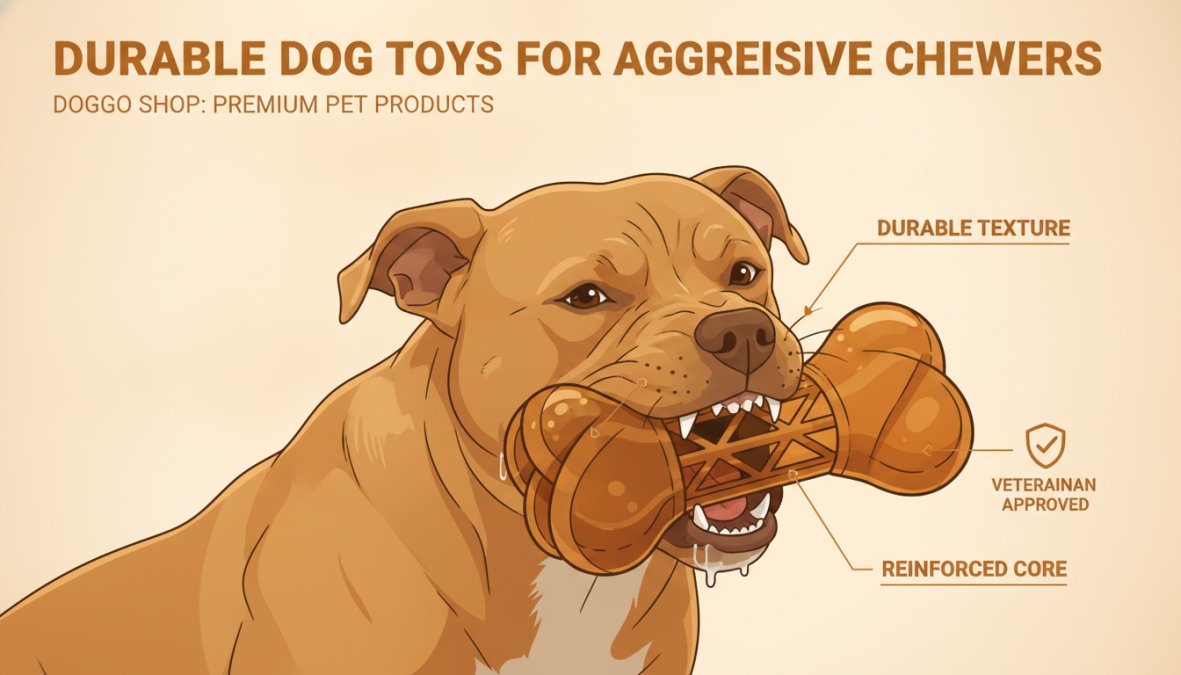
Heavy chewers destroy toys quickly, and a toy that falls apart becomes a choking hazard. Matching durability to your dog's chewing style is essential for both safety and value.
Tear-Resistant Materials and Construction
Tear-resistant materials are typically thicker, denser, and made from compounds that don't shred easily. Natural rubber and high-quality thermoplastic elastomers are the gold standard. Nylon and similar polymers can work but sometimes splinter.
Construction quality matters as much as material. Look for toys with reinforced seams or toys molded as a single piece rather than glued together. Glued seams will eventually fail under sustained chewing pressure. The Kong Extreme line (black rubber) is specifically designed for heavy chewers, with significantly thicker rubber and minimal small parts that could be chewed off.
Matching Durability to Your Dog's Chew Style
Not all aggressive chewers chew the same way. Some gnaw methodically, others shake toys violently, and some focus on puncturing toys.
For methodical gnawers, a dense rubber toy with a textured surface gives them something to work on without falling apart. These dogs appreciate toys they can spend hours with.
For violent shakers, you need toys with exceptional structural integrity. Rope toys are genuinely dangerous for these dogs because shaking causes the rope to fray and unravel. A solid rubber toy is much safer.
For puncturers, the goal is a toy that can't be torn open. A solid toy with no seams and no fill is your best option.
Best Dog Toys for Different Play Styles
Dogs play differently based on personality, breed instinct, and individual preference. Matching toys to play style increases engagement and safety simultaneously.
Interactive Play vs. Solo Play Safety
Interactive toys are toys you play with your dog, fetch toys, tug toys, balls. Solo toys are toys your dog plays with alone, chew toys, puzzle toys, treat-stuffed toys. The safety considerations differ significantly.
Interactive toys should be monitored constantly. You control the game and can remove the toy if it starts to fail. This means you can use toys that might not be suitable for unsupervised play.
Solo toys need to be substantially more durable and safer because you won't be watching. A toy your dog plays with alone needs to withstand hours of chewing without breaking apart, be sized so it can't be swallowed, and be made from materials safe if ingested in small amounts.
Age-Appropriate Toys: Puppies vs. Adult Dogs
Puppies have different needs than adult dogs. They're teething, which means they need toys that provide relief and are soft enough not to damage emerging teeth. Puppy teething toys should be soft but durable. Some toys can be refrigerated or frozen to provide additional relief.
Adult dogs generally prefer toys that match their chewing intensity. A dog that was a gentle player as a puppy might become an aggressive chewer as an adult.
Senior dogs often have dental issues or tooth sensitivity that affects toy choice. Toys that are too hard can crack or damage aging teeth. Softer toys designed for senior dogs take this into account.
Signs of Unsafe Dog Toys and Wear and Tear
A toy doesn't become dangerous only when purchased, it becomes dangerous as it deteriorates. Regular inspection is essential.
Inspecting for Splintering, Detachable Parts, and Damage
Check toys weekly for signs of wear. Splintering is a clear warning sign; if a toy is starting to splinter, it's time to throw it away. Splintered pieces are small enough to be swallowed but large enough to cause intestinal blockages.
Detachable parts are another obvious red flag. If a button, eye, or embellishment can be pulled off, it will be eventually. Loose stitching is a precursor to detachable parts; if you see threads coming loose, the toy is heading toward failure.
Tears in seams are particularly problematic because they're where toys tend to fail catastrophically.
When to Replace Toys and Toy Rotation Strategy
Replace toys when they show clear signs of wear. Don't wait until they're falling apart. The moment you see splintering, major tears, or detachable parts starting to loosen, the toy should go.
A toy rotation strategy extends the life of your toy collection while keeping your dog engaged. Instead of leaving all toys available all the time, rotate them. Your dog plays with toys A, B, and C for a week, then you swap in toys D, E, and F. The toys that were put away get a break, and when they come back out, they feel new to your dog.
This approach keeps your dog engaged, gives you more time to inspect toys, extends toy life, and reduces the risk of destructive behavior.
Supervised vs. Unsupervised Play: Safety Guidelines
You can't watch your dog 24 hours a day, and your dog shouldn't be restricted to only supervised play. The key is understanding which toys are safe for unsupervised play and which require your presence.
Toys safe for unsupervised play must be sized so they cannot be swallowed, made from materials safe if ingested in small amounts, constructed so they don't break apart into small pieces, have no detachable parts, and have no fill that can be accessed. Most durable rubber toys meet these criteria.
Toys that require supervision include most plush toys, rope toys, toys with fill, and toys with small parts. These toys are fine for 15-30 minutes of supervised play but shouldn't be left with your dog when you're not watching.
Create a routine: when you leave the house, your dog gets access only to toys safe for unsupervised play. When you're home and can watch, you can offer more engaging but less safe toys. This balances your dog's need for enrichment with their safety.
Emergency First Aid: What to Do if Your Dog Ingests Toy Material
If you see your dog swallow a toy piece, note the time and size. Small pieces often pass through the digestive system without issue. Larger pieces warrant a call to your veterinarian.
Don't induce vomiting without veterinary guidance. Some materials cause more damage coming back up than going down.
Watch for signs of blockage over the next 48-72 hours: vomiting, loss of appetite, lethargy, abdominal pain, constipation, or diarrhea. Any of these symptoms warrant an immediate vet visit. Gastrointestinal obstructions can be life-threatening if not treated quickly.
Take photos of the toy and the missing piece if possible. This information helps your vet assess the risk.
Choosing safe dog toys requires attention but isn't complicated. Your dog deserves toys that are engaging and fun while also being safe. The criteria are straightforward: appropriate size, durable construction, non-toxic materials, and regular inspection.
Doggo Shop curates premium dog toys specifically with safety as the foundation. Every toy is selected for durability, material safety, and appropriateness for different play styles and chewing intensities. Beyond toys, Doggo Shop donates 100% of profits per order to support rescue dogs in need worldwide, so every toy you choose helps another dog get a second chance. Shop now to give your pup the very best while supporting rescue dogs globally.
Frequently Asked Questions
What materials are safest for dog toys?
The safest dog toy materials include natural rubber, food-grade silicone, and untreated rope fibers. Avoid rawhide (choking risk), foam that shreds easily, and toys with synthetic fibers that can cause gastrointestinal obstruction if ingested. Always verify toys meet non-toxic material standards and are free from harmful chemicals. Check product labels for safety certifications and test reports.
How do I choose safe dog toys for aggressive chewers?
For heavy chewers, select tear-resistant, durable toys made from natural rubber or reinforced materials that won't splinter. Avoid plush toys and rope toys that can be easily destroyed. Match toy size to your dog's mouth, too small risks choking, too large may cause jaw strain. Inspect frequently for wear and tear, and replace immediately if you see splintering or detachable parts forming.
What are common choking hazards in dog toys?
Common choking hazards include toys with small detachable parts (bells, eyes, squeakers), toys smaller than your dog's mouth diameter, rawhide chews, and toys that splinter easily. Avoid rope toys with loose fibers that can cause tongue entrapment. Always supervise play with toys that could pose ingestion risks, and remove any toy showing signs of damage that could lead to swallowing of material.
How often should I inspect and replace dog toys?
Inspect toys weekly for signs of wear and tear, including splintering, tears, or detachable parts. Replace toys immediately if damage is found, don't wait for complete failure. For heavy chewers, rotate toys every 2-4 weeks to prevent destructive behavior and reduce ingestion risk. A toy rotation strategy helps extend toy life while keeping your dog engaged with fresh options during supervised and unsupervised play.
This article was written using GrandRanker


Leave a comment