


Durable Leashes for Hiking Dogs: 5 Trail-Tested Picks
Table of Contents
- Why Durable Leashes for Hiking Dogs Matter on the Trail
- Quick Comparison: Durable Leashes for Hiking Dogs
- 1. Hands-Free Dog Leash for Hiking with Belt and Bottle Holder
- 2. Heavy Duty Dog Leash with Double Bungee: Bungee Dog Lead for Trail Walking
- 3. Durable 4.5M Dog Leash for Daily Walks and Training
- 4. Tactical Dog Harness Set: Complete Hiking Dog Gear
- Safety Tips for Hiking with Dogs: Etiquette, Terrain and Emergency Repairs
- Which Durable Leash for Hiking Dogs Should You Choose?
- Frequently Asked Questions
Last Updated: September 16, 2026
Why Durable Leashes for Hiking Dogs Matter on the Trail
A leash that snaps halfway up a fell path means a dog loose near livestock, a dangerous scramble, and a recall that may not hold. Durable leashes for hiking dogs keep the whole walk under control, and the difference between good and bad comes down to materials, hardware and shock handling.
Quick Comparison: Durable Leashes for Hiking Dogs
| Product | Price | Length | Best For |
|---|---|---|---|
| Hands-Free Dog Leash with Belt, Pocket & Bottle Holder | £24.99 | 1-1.37 m bungee | Hands-free hiking and running |
| Heavy Duty Dog Leash with Double Bungee | £19.99 | 0.5-0.89 m stretch | Strong pullers and scrambling |
| Durable 4.5M Dog Leash for Daily Walks | £19.99 | 4.5 m | Training and long-line work |
| Tactical Dog Harness Set - K9 Training 5-in-1 Gear | £59.99 | Complete set | Full hiking kit in one buy |
1. Hands-Free Dog Leash for Hiking with Belt and Bottle Holder
The pick for anyone wanting hands free on technical ground. The adjustable waist belt fits 71 to 122 cm and carries a waterproof zippered pocket for keys, cards and most smartphones, plus a treat pouch and elastic water bottle holder. The shock-absorbing bungee leash runs 1 to 1.37 metres and reduces strain when your dog pulls.
2. Heavy Duty Dog Leash with Double Bungee: Bungee Dog Lead for Trail Walking
Built from climbing rope and tightly woven nylon, this is the bungee dog lead for trail walking when your dog is a committed puller. The double bungee stretches from 0.5 to 0.89 metres, absorbing jerks and sparing your arms on long descents. A 360° swivel metal clasp prevents tangling, and the padded foam handle protects against rope burns.
3. Durable 4.5M Dog Leash for Daily Walks and Training
Length is the point. At 4.5 m and 1.2 cm wide, this long leash gives your dog room to explore while you keep control, suiting small to large dogs. The cloth construction is lightweight but sturdy, comfortable to hold, and available in five colours: blue, black, red, orange and green.
4. Tactical Dog Harness Set: Complete Hiking Dog Gear
If kitting out from scratch, this 5-in-1 set bundles the essentials: a military-grade polyester harness, traction rope leash, waist bag, dog pouch and water cup holder. The harness has reinforced metal buckles, adjustable straps, breathable mesh lining and a reinforced top handle for instant control and lifting aid. Hook-and-loop panels take name tags or patches.
Safety Tips for Hiking with Dogs: Etiquette, Terrain and Emergency Repairs
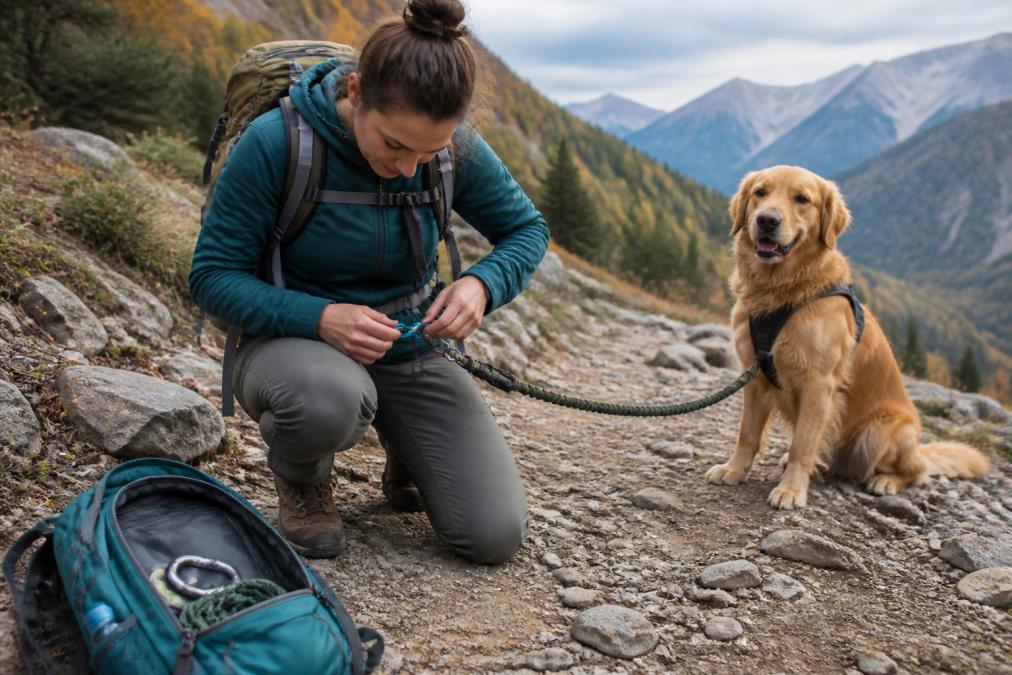
Leash etiquette and access rules differ by land type
In England and Wales, the Countryside Code sets out the basics for dogs on public paths and access land: keep dogs under effective control, keep them on a lead around farm animals, and keep them on a lead on open access land between 1 March and 31 July to protect ground-nesting birds. That seasonal restriction catches out a lot of hikers who only think about livestock.
Terrain handling: when to shorten, when to switch
On technical terrain, shorten the lead and keep your dog close on descents and scrambles. A long line is for open, safe ground only. Two habits matter:
- Descending steep ground: keep the dog uphill of you or level with you, never below you on loose scree. A bungee lead will stretch under a falling dog and can add momentum rather than arrest it, so switch to a fixed-length lead for the descent.
- Scrambles and stiles: a harness with a reinforced top handle lets you lift and steady your dog directly. This is the single most useful piece of kit on graded ground, and it is why many hikers pair a harness with their lead rather than relying on a collar.
- Low-light visibility: reflective stitching and stripes are the difference between being seen and being missed on a country lane at dusk. Reflective thread on its own is not enough on an unlit lane, pair it with a light on the dog's harness or collar.
Emergency repair kit for a broken leash or carabiner
Leash hardware fails at the worst moments, and a jammed clip or snapped clasp can leave you improvising on a hillside. A small kit weighs almost nothing and covers the failures that actually happen:
- A spare locking carabiner rated for climbing or via ferrata use, not a decorative keyring clip. This is the single most useful item, it lets you clip the lead to a harness D-ring and walk out safely.
- A short length of 5-6 mm accessory cord (around 1.5-2 m). It can replace a snapped bungee section, act as a temporary collar, or secure a dog to a tree while you sort out a problem.
- A spare trigger clip or two, matched to the width of your lead's webbing.
- A small roll of duct tape or a couple of cable ties for a torn handle or a frayed stitch line.
Which Durable Leash for Hiking Dogs Should You Choose?
Match the lead to the job, not the dog's size alone. The two deciding questions are how much your dog pulls and how much you need your hands free.
A decision framework
- Strong puller on rough ground: the Heavy Duty Dog Leash with Double Bungee at £19.99. The double bungee absorbs shock and the padded handle saves your hands on long descents. The trade-off is weight and a springy feel for a dog that does not pull.
- Hands-free walking and running: the Hands-Free Dog Leash with Belt at £24.99. Both hands stay available for balance, and the belt carries keys, phone and water. Not the right choice on exposed scrambling, where you want a hand-held lead for instant correction.
- Recall training and open-ground freedom: the Durable 4.5M Leash at £19.99. Length is the point, but it needs active hand-over-hand handling and is not a walking lead.
- Everything in one purchase: the Tactical Dog Harness Set at £59.99. The reinforced top handle is the standout feature on technical ground. Only worth it if you do not already own a harness you like.
Breed-specific considerations
Most guides treat all dogs the same. They should not, because the physics of a lead change with the dog on the end of it.
- High-energy pulling breeds (huskies, malamutes, German shepherds, boxers): prioritise shock absorption and a padded handle. A double bungee is close to essential, a fixed lead transfers every lunge straight into your shoulder and lower back. A waist belt can work well here because it moves the load to your hips, but only on ground where you are not relying on a hand-held lead for balance.
- Scent hounds and beagles: these dogs work with their nose down and change direction without warning. A 360° swivel clasp matters more than bungee here, because the lead tangles constantly. A long line on open ground suits them, but expect to handle it actively.
- Small breeds and older dogs: a heavy climbing-rope lead is overkill and uncomfortable to carry. A lightweight webbing or cloth lead in the 1.2 cm width range is plenty, and a fixed length is easier to manage than a bungee that springs when a small dog stops suddenly.
- Giant breeds: check the weight rating on the hardware, not just the lead. A 180 lb rating on the hands-free option covers most giant breeds, but the carabiner and D-rings are the parts that fail, so inspect them.
Ergonomics for the human hiker
This is the part almost no gear guide covers, and it matters on a long day out.
- Waist-attached leads move the load to your hips and pelvis, which is stronger and more stable than your shoulder. On steep ascents this keeps your centre of gravity lower and your posture more upright. The downside is that a sudden lunge can pull you off balance sideways, so a waist belt is best on ground where a stumble is recoverable.
- Hand-held leads give you instant, fine control and let you shorten the lead in a second. On steep or exposed ground this is worth the trade-off in comfort, because you can feel what your dog is doing through the lead and react before a problem develops.
- Shoulder or cross-body attachments are the worst of both worlds on technical ground: they load one shoulder, twist your torso, and make it hard to shorten the lead quickly. They are fine on flat, open paths and not much else.
- Lead length changes your posture. A long line held loosely encourages you to look down at the line rather than at the ground ahead. On uneven terrain, keep the slack gathered in loose loops in one hand and keep your eyes up.
Frequently Asked Questions
What is the best leash to use for hiking with my dog?
The best choice depends on your dog's size and the terrain. A hands-free leash with a bungee section works well for most trails because it absorbs sudden pulls and keeps your hands free for balance. Look for reflective stitching, a padded handle and a secure clip-in point. For strong pullers, a heavy-duty double bungee leash offers extra shock absorption and a tangle-free swivel clasp.
Are bungee leashes better for hiking with dogs?
Bungee leashes reduce strain on your arms and shoulders when your dog pulls or lunges, which makes them a good fit for trail walking. The stretch absorbs sudden jerks, so both you and your dog stay more comfortable on uneven ground. They are less suited to tight heel training, where a fixed-length lead gives clearer feedback. For most hiking, a bungee dog lead for trail walking is the practical choice.
Is a hands-free leash better for long-distance hiking?
A hands-free dog leash for hiking frees both hands for map reading, trekking poles or scrambling over rocks. The belt distributes pull across your hips rather than your wrist, which reduces fatigue on longer routes. Look for an adjustable waist belt, a waterproof pocket for essentials and a shock-absorbing bungee section. It suits dogs up to 180 lbs, making it a versatile option for most breeds.
How long should a dog leash be for hiking?
A 1.2 to 1.5 metre lead gives close control on narrow or technical terrain, while a 4.5 metre training lead offers more freedom on open ground. Many hiking leashes use a bungee section that stretches from around 1 to 1.4 metres, balancing freedom with control. Always check local leash laws and trail regulations before choosing a length, as some areas require dogs to stay on a fixed lead.
What features should I look for in a durable hiking dog lead?
Prioritise durable webbing or climbing rope construction, reflective stitching for low-light visibility and a padded handle for comfort. A 360° swivel clasp prevents tangling, and a shock-absorbing bungee section reduces strain. Check the weight rating matches your dog, and look for weatherproof, washable materials that handle mud and water. A quick-release clip-in point adds convenience at rest stops.
Choosing the right lead is the difference between a relaxed trail day and a stressful one, and the wrong hardware can undermine even the best-trained dog. At Doggo Shop, we stock trail-ready leads built to hold up, from the shock-absorbing Hands-Free Dog Leash with Belt to the Heavy Duty Double Bungee and the complete Tactical Harness Set, and every order supports rescue dogs in need. Get started with Doggo Shop and gear up for the trail with kit you can trust.


Leave a comment