


Durable Leash Options for Reactive Dogs: UK Guide
Table of Contents
- Understanding Reactive Dogs and Leash Requirements
- No-Pull Harness for Reactive Dogs UK: Front-Clip Control
- Double Ended Dog Lead UK: Dual-Point Control Systems
- Biothane Leash UK: Waterproof and Durable Materials
- Heavy-Duty Leashes for Reactive Dogs: Shock Absorption and Tensile Strength
- Long Line for Reactive Dogs UK: Extended Control at Distance
- Warning Leashes and Colour-Coded Systems for Anxious Dogs
- Head Collars vs. Body Harnesses: Control Without Restraint
Durable Leash Options for Reactive Dogs: UK Guide
Last Updated: July 29, 2026
When your dog lunges at every passing cyclist or freezes in fear at unfamiliar sounds, a standard lead becomes a liability rather than a tool. Reactive dogs demand equipment engineered for control, durability, and safety. At Doggo Shop, we understand that choosing the right durable leash means balancing your dog's wellbeing with your own confidence on walks. This guide covers the most effective solutions tested by owners managing everything from fear-based pulling to aggression-triggered lunging.
Understanding Reactive Dogs and Leash Requirements
Reactivity stems from two distinct emotional drivers: fear-based reactivity appears as avoidance, freezing, or defensive aggression, while frustration-based reactivity looks like explosive excitement, barking, and lunging toward stimuli. Both create tension on the lead but require different management strategies.
Standard leads fail reactive dogs because they're designed for cooperative animals. A 4-foot fabric lead with a basic clip offers zero shock absorption when a 30kg dog hits the end of the line at full speed. The sudden jolt transmits directly through your arm, destabilizing you and frightening your dog further.
Durable leash options for reactive dogs prioritize reinforced stitching, high-tensile materials, and multiple attachment points. A quality reactive dog lead should handle sudden, violent force without failing and reduce the physical shock transmitted to your body.
No-Pull Harness for Reactive Dogs UK: Front-Clip Control
Front-clip harnesses redirect your dog's forward momentum across their chest rather than allowing them to pull straight ahead. When your dog lunges, the harness naturally turns their body sideways, disrupting the pulling motion and making forward progress impossible without your cooperation.
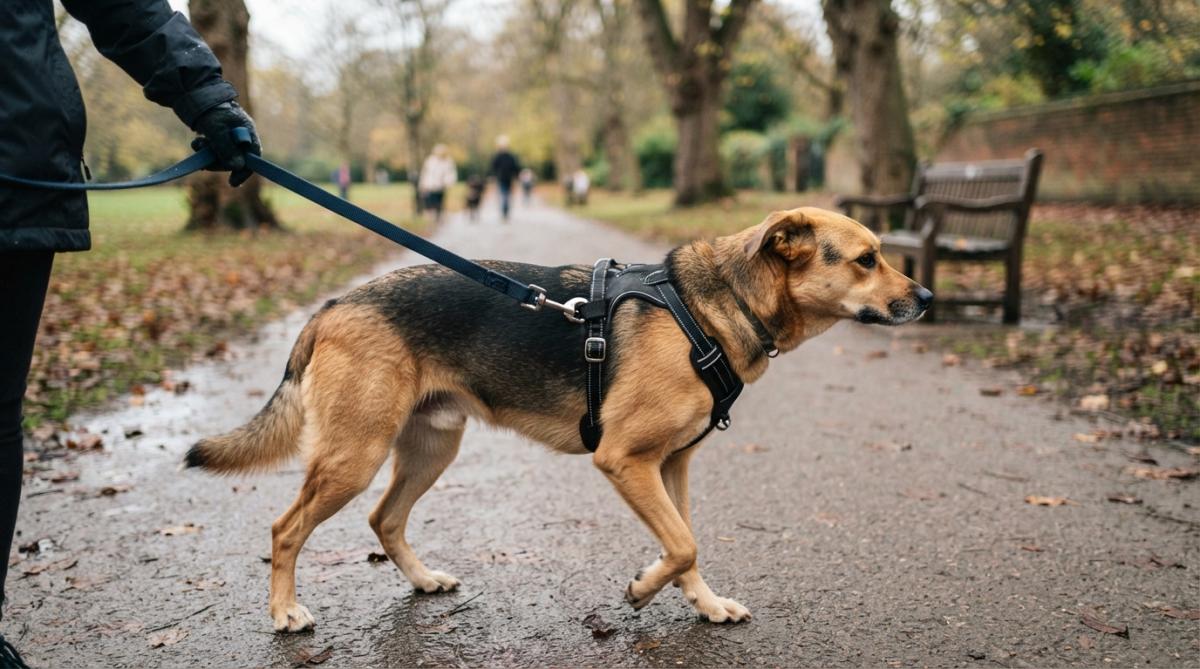
Doggo Shop No Pull Reflective Dog Harness (£19.99) combines front-clip control with visibility features essential for reactive dogs. The breathable polyester construction prevents overheating during intense walks, and the adjustable straps accommodate dogs at different stages of growth. The reflective stitching becomes critical for early-morning or evening walks when you're avoiding peak-activity times.
The front-clip attachment sits on your dog's chest, not their throat. This matters significantly for anxious dogs, a harness that doesn't tighten around the neck feels less restrictive and frightening than a collar, reducing defensive reactivity. Front-clip harnesses work best when combined with consistent training.
Double Ended Dog Lead UK: Dual-Point Control Systems
A double-ended lead clips to two attachment points simultaneously, typically one on a harness and one on a collar, or both on a harness's front and back clips. This redundancy transforms your control options and provides genuine safety backup.
During an explosive lunge, all energy on a single-point lead concentrates through one clip. A double-ended lead distributes force across two connection points, reducing stress on any single attachment. If one clip fails, your dog remains tethered by the second connection.
The Halti Training Lead (£11.00-£15.00) exemplifies the double-ended design with practical versatility. Its dual-clip system accommodates multiple walking scenarios: clip both ends to your dog's harness for maximum control on reactive days, or clip one end to a harness and one to a collar for lighter walks. The lead adjusts to three different lengths, and reflective stitching keeps your dog visible during low-light walks.
Biothane Leash UK: Waterproof and Durable Materials
Biothane is a synthetic material, essentially PVC or TPU-coated webbing, that offers genuine advantages over traditional fabric for reactive dogs. It's waterproof, completely rot-proof, and resists odour absorption. The material's tensile strength exceeds standard nylon webbing, making it ideal for dogs who create constant tension on the lead.
Collared Creatures Biothane Leads (from £16.50) are handmade in the UK using high-tensile Biothane material. The company offers multiple styles, clip leads, slip leads, training leads, and long lines, so you can match the lead to your specific needs. The welded D-rings provide secure attachment points without the stress concentration of stitched loops.
The waterproof property becomes invaluable for UK owners. A Biothane lead remains lightweight whether you're walking in rain, through rivers, or across muddy fields. Traditional webbing absorbs water and becomes heavy; Biothane stays the same weight regardless of weather.
Heavy-Duty Leashes for Reactive Dogs: Shock Absorption and Tensile Strength
Some reactive dogs create such explosive force that standard leads transmit jarring shock through your arm with every lunge. Shock-absorbing leads incorporate bungee sections that stretch slightly, absorbing energy gradually rather than transmitting it as a sudden jolt.
Doggo Shop Heavy Duty Dog Leash with Double Bungee (£19.99) uses premium climbing-grade rope with integrated bungee sections on both sides. This dual-bungee design provides shock absorption regardless of which direction your dog pulls. The reinforced carabiner clips are rated for extreme tension, and the lead's tensile strength exceeds the pulling force of most dogs up to 50kg.
The double-bungee construction also reduces repetitive strain on your joints during extended walks. Instead of absorbing dozens of sudden shocks per walk, the bungee smooths each lunge into a gentler deceleration.
Long Line for Reactive Dogs UK: Extended Control at Distance
A long line, typically 5-10 metres, gives your dog distance while maintaining your ability to intervene. This proves invaluable during training when you're teaching your dog to respond to triggers without reacting.
Long lines work best for fear-based reactivity. A dog who's terrified of other dogs benefits from having space to retreat while remaining tethered. You can allow them to move away from the trigger, rewarding their calm behaviour rather than forcing them closer.
Julius-K9 IDC Tubular Webbing Lead (from £17.99) comes in adjustable lengths, making it suitable for both standard walks and extended training work. The tubular webbing construction offers durability while remaining comfortable to hold. The fluorescent lines woven into the material increase visibility, other people need to see that your dog is tethered, not loose.
Warning Leashes and Colour-Coded Systems for Anxious Dogs
A warning lead communicates your dog's status to other walkers before they approach. The bright colour and printed warning text, "Reactive," "Nervous," or "Anxious", create a visual signal that your dog needs space. This prevents well-meaning strangers from approaching to pet your dog, which often triggers the very reaction you're managing.
Dottie's Pet Boutique Reactive Dog Lead (from £22.00) combines high-visibility design with durable construction. The bright red cushioned webbing with yellow "Reactive" text is visible from a distance. The handmade UK construction ensures quality stitching, and the lead is machine washable.
Head Collars vs. Body Harnesses: Control Without Restraint
Head collars work by controlling the dog's head position, which naturally controls their body direction. When you apply gentle pressure, your dog's head turns and their body follows. This requires minimal force, even for powerful dogs.
However, head collars feel restrictive to dogs, and many resist them initially. A dog who's already anxious may perceive a head collar as more threatening than a body harness.
Dogmatic Padded Cushioned Webbing Headcollar (£34.99) addresses comfort concerns through its three-layer padded construction. The fixed noseband prevents the collar from riding up into the eyes, and the side-fitting design distributes pressure across the dog's muzzle rather than concentrating it in one spot.
Body harnesses distribute control across the dog's chest and back rather than concentrating it on the head. This feels less restrictive to anxious dogs, and many accept harnesses more readily than head collars. A front-clip body harness provides directional control without a head collar, making it suitable for dogs who resist more restrictive equipment.
Equipment Maintenance and Safety Checks
Durable leash options for reactive dogs demand regular inspection. Check your lead weekly for signs of wear: fraying stitching, cracks in the material, and corrosion on metal components. Replace any lead showing significant damage rather than continuing to use it.
Test carabiners and D-rings by pulling hard during a deliberate safety check, not during a walk. Wash your lead monthly or after muddy walks using lukewarm water and mild soap, then air dry completely. Store leads away from direct sunlight and extreme heat, which degrade synthetic materials over time.
Budget-Friendly DIY Safety Modifications
Quality durable leash options for reactive dogs don't require premium pricing. Add a second carabiner to any single-clip lead, creating a backup attachment point. Purchase a heavy-duty carabiner from a climbing supply shop (typically £5-10) and attach it using reinforced webbing.
Wrap the handle area with athletic tape to improve grip during wet conditions. This costs under £2 and significantly improves control when your hands are wet. Sew reinforced webbing patches onto high-stress areas of fabric leads to extend the lead's lifespan by months or years.
Integration with Hands-Free Walking Systems
For owners managing reactive dogs while maintaining an active lifestyle, hands-free leash systems offer genuine convenience and improved safety.
A hands-free lead attaches to a belt worn around your waist, freeing both hands for balance, communication, or managing multiple dogs. This becomes valuable when your reactive dog lunges unpredictably, your hands remain free to steady yourself rather than being yanked by the lead.
Doggo Shop Hands-Free Dog Leash with Belt, Pocket & Bottle Holder (£24.99) incorporates shock-absorbing bungee technology into a waist-mounted system. The integrated pockets and bottle holder add practical value for extended walks, and the reflective stitching maintains visibility in low light. The belt distributes the force of lunges across your core rather than concentrating it in your hands and arms.
Summary: Selecting Your Reactive Dog Lead
| Lead Type | Best For | Key Strength | Primary Limitation |
|---|---|---|---|
| Front-clip harness | Frustration-based pullers | Redirects forward momentum | Requires training for full effectiveness |
| Double-ended lead | Safety-conscious owners | Redundant attachment points | More complex to manage initially |
| Biothane lead | Muddy, wet environments | Waterproof durability | Stiffer feel than fabric |
| Shock-absorbing bungee | Joint protection and comfort | Reduces physical strain | Higher cost than standard leads |
| Long line | Training at distance | Allows space while maintaining control | Requires open space |
| Warning lead | Communication with other walkers | Prevents unwanted interactions | Effectiveness depends on others' understanding |
| Head collar | Maximum control with minimal force | Mechanical advantage | May feel restrictive to anxious dogs |
| Hands-free system | Active owners and multiple dogs | Frees hands during walks | Requires adequate dog weight |
Durable leash options for reactive dogs exist across multiple price points and designs. The right choice depends on your dog's specific reactivity type, your physical capability, your walking environment, and your training goals. Most owners benefit from combining multiple tools: a front-clip harness for daily walks, a double-ended lead for safety backup, and a long line for training work.
Quality equipment won't cure reactivity, but it creates the safety and control foundation that allows training to work. A dog who's managed safely during walks learns that lunging doesn't achieve their goal, which gradually reduces the behaviour.
Doggo Shop offers durable, tested options designed specifically for dogs requiring more than standard equipment. The No Pull Reflective Dog Harness provides front-clip control at accessible pricing, while the Heavy Duty Dog Leash with Double Bungee combines shock absorption with genuine durability. Every purchase supports rescue dogs through Doggo Shop's commitment to donate profits to dogs in need worldwide. Doggo Shop's guide to reactive dog management provides additional resources for training approaches that complement your equipment choices.
For owners committed to managing reactive dogs safely and humanely, investing in durable, purpose-built equipment becomes one of the most effective decisions you'll make. Your dog's safety, your physical wellbeing, and your confidence on walks all depend on gear that performs reliably under stress.
Frequently Asked Questions
What type of leash is best for a reactive dog in the UK?
The best leash for a reactive dog depends on the type of reactivity. For fear-based reactivity, a double-ended lead with a front-clip harness provides dual-point control and safety. For frustration-based reactivity, bungee leashes with shock absorption (like Doggo Shop's Heavy Duty Dog Leash with Double Bungee) reduce lunging impact. Warning leashes from Dottie's Pet Boutique communicate your dog's needs to other walkers. Many UK owners combine these tools: a durable harness, a quality lead, and environmental management to build confidence.
Are biothane leashes more durable than traditional webbing for reactive dogs?
Yes, biothane leashes offer superior durability for reactive dogs. Made from PVC/TPU-coated material, biothane is waterproof, rot-proof, and odour-resistant, ideal for muddy UK walks. Collared Creatures' handmade UK biothane leads feature high tensile strength, preventing stretching and fraying even under heavy pulling. Traditional webbing can absorb moisture and fray; biothane simply wipes clean. For reactive dogs prone to powerful lunges, biothane's strength and low-maintenance properties make it a worthwhile investment.
How do I check if my durable leash is safe for a reactive dog?
Inspect your leash weekly for wear. Check welded D-rings and trigger hooks for cracks or bent metal, these attachment points bear the most stress during lunging. Run your fingers along reinforced stitching for fraying or loose threads, especially on front-clip harnesses. Test the clip mechanism: it should lock firmly without sticking. For bungee leashes, ensure the elastic isn't cracked or overstretched. If any hardware is damaged, replace the leash immediately. Doggo Shop's tactical and heavy-duty options include durable construction specifically designed to withstand reactive dogs' pulling forces.
What's the difference between a front-clip harness and a head collar for reactive dogs?
Front-clip harnesses (like Doggo Shop's No Pull Reflective Dog Harness) redirect pulling force to the dog's chest, reducing forward momentum without restricting breathing. They're comfortable for long walks and suit most reactive dogs. Head collars (like Dogmatic Padded Headcollar) give direct control via the dog's nose, making them powerful for strong pullers but requiring training and a double-ended lead. Head collars can feel restrictive to dogs initially. Choose a front-clip harness for comfort and ease; use a head collar only if your dog is extremely strong or your trainer recommends it specifically.
Can I use a long line safely with a reactive dog in the UK?
Yes, long lines are valuable for reactive dogs during training, especially to manage trigger distance. A long line (like Julius-K9's IDC Tubular Webbing Lead) allows your dog freedom while maintaining control during exposure therapy. Always use a long line in secure, enclosed spaces or quiet areas, never in busy parks where entanglement risk is high. Pair it with a front-clip harness or head collar for added control. Ensure the line is lightweight but durable, with visible fluorescent markings for safety. Professional trainers often recommend long lines for building confidence in anxious or nervous dogs.
This article was written using GrandRanker


Leave a comment