


DIY Puppy Teething Toys for Heavy Chewers
Table of Contents
- Why Puppies Need Teething Toys and DIY Options
- Materials to Avoid: Puppy Teething Toy Safety
- 1. Braided T-Shirt Tug Toy
- 2. Frozen Puppy Teething Toys for Sore Gums
- 3. Tennis Ball Treat Dispenser
- DIY Dog Toys for Aggressive Chewers: Rope and Cotton Knots
- 4. Muffin-Tin Puzzle Toy with Treats
- Safe Homemade Toys for Dogs: Supervision and Durability
- Frequently Asked Questions
Last Updated: October 4, 2026
Why Puppies Need Teething Toys and DIY Options
Puppies chew to relieve sore gums during teething and to explore their world. Without proper outlets, they'll chew your shoes, furniture, and hands instead.
Heavy chewers destroy standard toys within hours. DIY puppy teething toys solve this by using household materials at a fraction of the cost, while letting you control exactly what goes into them, no mystery chemicals or poorly-made seams.
This guide helps you make effective DIY puppy teething toys that last, designed for puppies with aggressive chewing habits that quickly destroy standard commercial toys.
Below are seven proven DIY designs with step-by-step instructions and safety guidance, covering gum relief, enrichment, and durability for serious chewers.
Materials to Avoid: Puppy Teething Toy Safety
Before you start making toys, know what to keep away from your puppy. Some household materials that seem safe are actually dangerous.
Small objects that can be swallowed are a choking risk. Avoid buttons, beads, bells, and plastic pieces smaller than your puppy's fist, as well as anything with sharp edges, broken plastic, exposed wires, or rough metal.
Avoid materials that shed or fray easily. Loose threads and fibres can wrap around your puppy's intestines if swallowed, causing a blockage requiring surgery. This rules out frayed fabrics, old blankets, and anything that comes apart when tugged.
Toxic materials must be avoided. Never use paint, glue, or varnish unless explicitly pet-safe and fully cured. Avoid treated wood, mould, and pesticide-treated materials. When in doubt, don't use it.
Always supervise playtime with young puppies. Even safe DIY toys become dangerous if torn apart and swallowed.
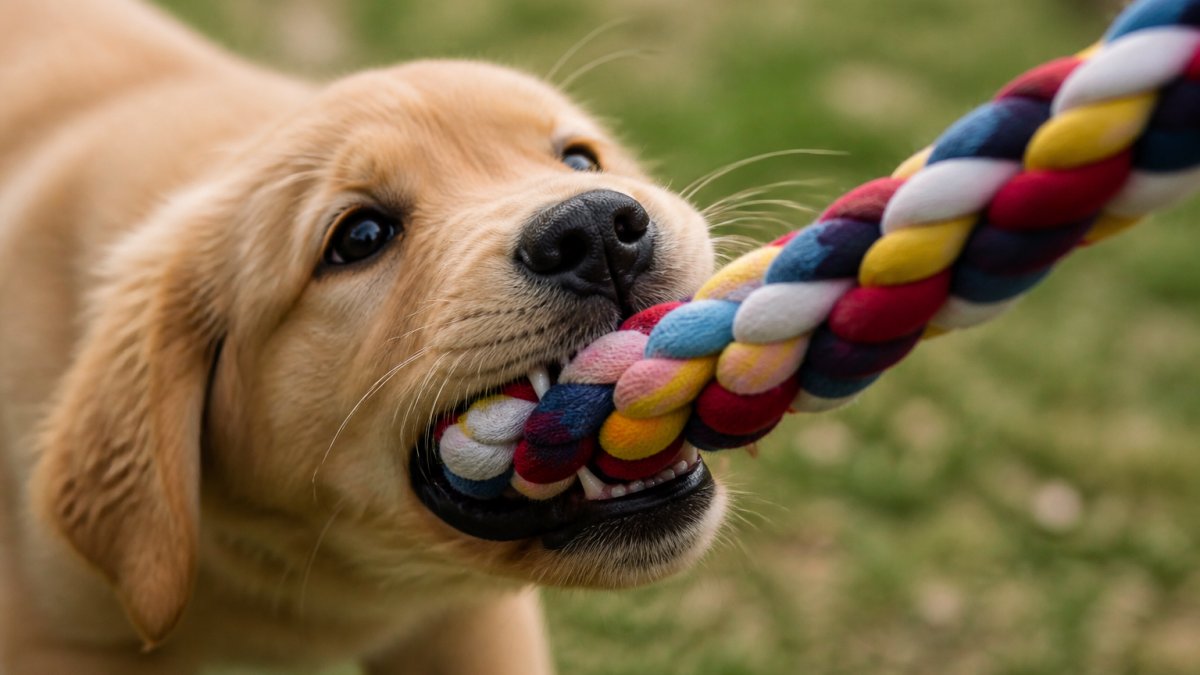
1. Braided T-Shirt Tug Toy
This is the simplest DIY puppy teething toy to make, and it's surprisingly durable for heavy chewers when constructed properly.
What you'll need:
- 3 old cotton T-shirts (different colours help your puppy see the toy clearly)
- Scissors
- A ruler or measuring tape
Step-by-step instructions:
-
Cut each T-shirt into three long strips, roughly 5 centimetres wide and running the full length of the shirt. You'll have nine strips total.
-
Lay three strips flat and tie them together at one end with a tight knot. This is your anchor point.
-
Braid the three strips together, keeping the tension even. A loose braid falls apart; a tight braid creates a toy that resists shredding.
-
When you reach the end, tie another tight knot to lock the braid in place.
-
Trim any loose threads with scissors. This step is crucial, loose threads are a choking hazard.
-
For extra durability, you can make a second braid and tie the two braids together at their midpoints, creating a four-way tug toy.
Why this works for heavy chewers: The braided structure distributes force across multiple strands, resisting quick tearing. Cotton is soft on developing teeth yet provides chewing resistance.
Prep time: 10-15 minutes per toy
Safety note: Check regularly for loose threads or fraying and remove immediately if it starts to come apart. Best for supervised play only.
2. Frozen Puppy Teething Toys for Sore Gums
Frozen toys numb sore gums and provide substantial chewing texture.
What you'll need:
- Old socks or tea towels
- Water
- A freezer
- Optional: low-sodium broth or mashed sweet potato (unsweetened)
Step-by-step instructions:
-
Fill a sock or tea towel with water (or add unsweetened mashed sweet potato or low-sodium broth for flavour).
-
Tie the sock or towel closed at the top with a secure knot.
-
Place it in the freezer for at least 4 hours, ideally overnight.
-
Remove from the freezer and let it thaw slightly for 2-3 minutes before giving it to your puppy. A completely solid frozen toy can be too hard on developing teeth.
Why this works: Cold numbs sore gums and reduces inflammation. Soft fabric is gentle on delicate teeth while satisfying the chewing urge.
Prep time: 5 minutes active time; 4+ hours freezing
Safety note: Always supervise frozen toy play. Remove once mostly thawed to prevent choking hazards. Never give completely frozen toys, as they can damage developing teeth.
3. Tennis Ball Treat Dispenser
Tennis balls are ideal for puppies, textured, bouncy, and the right size. Converting one into a treat dispenser adds enrichment and engagement.
What you'll need:
- One used tennis ball (new ones have a fuzzy coating that can shed; used balls are safer)
- A small knife or box cutter
- Treats (small training treats or kibble)
Step-by-step instructions:
-
Make a small 2-centimetre slit in the tennis ball using a knife or box cutter, large enough for treats to fall through, but not so large the ball falls apart.
-
Squeeze the ball gently to open the slit wider.
-
Insert small treats or kibble through the opening.
-
Close the slit by releasing the ball's pressure. The treats will stay inside because of the friction.
-
Give the ball to your puppy. As they chew and roll it, treats will occasionally fall out, rewarding their effort.
Interactive Suction Cup Tug Toy – Dog Chew & Teething Ball →
Why this works for heavy chewers: The fuzzy texture satisfies chewing urges. Unpredictable treat rewards keep puppies engaged longer and stimulate problem-solving.
Prep time: 5 minutes
Safety note: Check regularly for damage. Remove if the fuzzy coating tears or large holes form, as swallowing rubber chunks can cause intestinal blockages.
DIY Dog Toys for Aggressive Chewers: Rope and Cotton Knots
Rope toys are durable classics that satisfy the tug instinct. For aggressive chewers, use thick rope and secure knots properly.
What you'll need:
- Thick cotton rope (at least 1 centimetre diameter; thinner rope frays too easily)
- Scissors
- Optional: sisal or jute rope for extra texture
Step-by-step instructions:
-
Cut a length of rope approximately 30 centimetres long.
-
Tie a large knot at each end. Make the knots tight and substantial, loose knots unravel under heavy chewing.
-
For extra durability, tie a knot in the middle of the rope as well, creating a toy with knots at both ends and the centre.
-
Trim any loose fibres with scissors.
-
Optional: Braid two or three lengths of rope together before knotting for added strength.
Why this works: Thick rope distributes chewing force across many fibres. The knots give puppies something to grip and work at without immediately falling apart. Cotton rope is natural and safe if swallowed in small amounts, though you want to minimise this.
Prep time: 5 minutes per toy
Safety note: Rope toys shed fibres, especially under heavy chewing. Supervise play and remove the toy if it's starting to fray significantly. Never leave a rope toy unattended with a puppy who's likely to tear it apart and swallow pieces.
4. Muffin-Tin Puzzle Toy with Treats
Puzzle toys engage puppies mentally while rewarding them with treats. A muffin tin is the perfect foundation for this enrichment toy, and it costs nothing if you have one at home.
What you'll need:
- A muffin tin (metal or silicone)
- Treats or kibble
- Optional: tennis balls, socks, or cardboard to cover the tin
Step-by-step instructions:
-
Place the muffin tin on a flat surface.
-
Put a small treat or a few pieces of kibble in each cup.
-
Cover each cup with a tennis ball, a rolled-up sock, or a piece of crumpled cardboard. The covering should be easy for your puppy to move but not so loose that it falls off immediately.
-
Give the toy to your puppy. They'll have to remove the covering from each cup to access the treats.
-
Start with easy coverings (a light tennis ball) and progress to harder ones (tightly rolled socks) as your puppy gets the idea.
Why this works: Muffin-tin puzzles slow down eating and engage problem-solving. Puppies have to work for each treat, which provides mental stimulation and keeps them occupied longer than simply eating treats from a bowl. This is especially valuable for puppies left alone during the day.
Prep time: 5 minutes
Safety note: Always supervise puzzle play. If your puppy tries to swallow the covering (tennis ball, sock, etc.), remove it immediately. The goal is to make the puppy work for treats, not to create a choking hazard.
Safe Homemade Toys for Dogs: Supervision and Durability
Making DIY puppy teething toys is cost-effective and safe when you follow basic guidelines. The real safety comes from supervision and knowing when to replace a toy.
Supervision essentials: Young puppies, especially heavy chewers, should never be left alone with toys they can destroy. Supervision means being in the same room, not just in the same house.
Durability testing: Check each toy regularly. Squeeze it, pull it, and look for weak points. If a toy shows signs of tearing or fraying after just a few days, it's not durable enough for your puppy's chewing power.
Rotation strategy: Don't leave all toys out at once. Rotate them every few days. This keeps puppies interested (novelty matters) and gives you time to inspect toys for damage before they're used again.
When to replace: If a toy is torn, frayed, or has pieces missing, it's time to make a new one. A toy that's starting to come apart is a choking hazard, no matter how much your puppy enjoys it.
Cleaning: Wash fabric toys regularly in hot water to remove bacteria and saliva buildup. Rope toys can be rinsed under running water and air-dried. Tennis balls can be wiped down with a damp cloth.
For puppies who destroy toys within days despite your best efforts, consider complementing DIY toys with durable commercial options.
The reality is that some puppies simply need toys built to withstand extreme chewing. DIY toys are excellent for enrichment and cost savings, but they work best alongside a rotation of durable commercial options.
Making DIY puppy teething toys is one of the most practical ways to support your puppy through this challenging phase.
Frequently Asked Questions
What homemade toys are safe for a teething puppy?
Safe homemade toys include braided cotton T-shirts, frozen socks, and rope toys made from 100% natural cotton. Always supervise your puppy during play and remove any toy that shows signs of unravelling, fraying, or small pieces coming loose. Avoid toys with plastic parts, buttons, or anything your puppy could swallow. Check toys regularly for wear, especially with aggressive chewers, and replace them immediately if damaged. Frozen toys offer sore gum relief but should only be offered for short periods to avoid mouth numbness.
Can puppies chew on frozen toys safely?
Yes, frozen puppy teething toys are safe when used correctly. Frozen socks, tea towels, or rubber toys provide natural relief for sore gums during teething. Limit frozen toy sessions to 10-15 minutes at a time to prevent mouth numbness and potential damage to emerging teeth. Never freeze toys solid in a way that could crack delicate puppy teeth. Thaw toys slightly before offering them to very young puppies (under 8 weeks). Always supervise frozen toy play and remove the toy once it begins to thaw or show signs of degradation.
What materials should I avoid in homemade dog toys?
Avoid plastic, foam, elastic bands, buttons, zips, and synthetic materials that can splinter or be swallowed. Don't use toys with small decorative parts, glue, or dyes that aren't pet-safe. Steer clear of anything with loose threads, wire, or sharp edges. Never offer toys made from materials like leather scraps, foam rubber, or anything treated with chemicals. Avoid toys filled with beans, beads, or other choking hazards. Always choose 100% natural materials like untreated cotton, jute, sisal, or natural rubber when making DIY toys for puppies.
How do I know if my DIY toy is durable enough for a heavy chewer?
Test your DIY toy before giving it to your puppy by pulling, tugging, and applying pressure yourself. Look for loose threads, unravelling edges, or pieces that separate easily. Heavy chewers need toys with tight knots, thick braiding, and materials that don't fray quickly. Supervise all play sessions and check the toy every few minutes for damage. Replace toys immediately if your puppy tears off pieces or if the toy becomes thin, frayed, or compromised. Consider alternating toys to extend their life, and always have a backup ready for aggressive chewers who destroy toys quickly.


Leave a comment