


Choosing the Right Size Dog Bed: A Complete Guide
Table of Contents
- Why Dog Bed Size Matters for Comfort and Health
- How to Measure Your Dog for a Bed in the UK
- Understanding Dog Sleeping Positions and Bed Selection
- Dog Bed Size Chart UK: Breed and Weight Guidelines
- Orthopaedic Dog Bed UK: Supporting Joint Health and Arthritis
- Types of Dog Beds and Which Suit Different Sizes and Styles
- Climate and Temperature Considerations When Choosing the Right Size Dog Bed
- Budget-Friendly and Sustainable Dog Bed Solutions
Last Updated: July 30, 2026
Why Dog Bed Size Matters for Comfort and Health
A properly sized bed provides the support your dog needs for better sleep, joint health, and overall wellbeing. When a bed is too small, your dog can't stretch out comfortably. When it's too large, they lose the sense of security that comes from a cosy, defined sleeping space. Poor sleep weakens immunity, reduces cognitive function, and increases behavioural problems. The wrong size can contribute to pressure sores, joint strain, and long-term health issues that cost hundreds in veterinary bills.
How to Measure Your Dog for a Bed in the UK
Step-by-Step Measuring Instructions
You'll need a soft measuring tape, your dog in a relaxed position, and about five minutes.
Step 1: Measure nose to tail (Total Length) Have your dog lie down in their natural sleeping position. Measure from the tip of their nose to the tip of their tail. This tells you the minimum length your bed should be.
Step 2: Measure shoulder to hip (Body Length) Measure from your dog's shoulder blade to their hip bone. This shows how much space their torso truly needs.
Step 3: Measure the width (Height) Have your dog stand up and measure from the floor to the top of their shoulder. This tells you their overall size category.
Step 4: Measure side-to-side (Curled Position) Have your dog curl up as if nesting. Measure across their body at the widest point. This shows how much width they need when sleeping.
Adding Extra Space for Comfort
Add at least 20-30 centimetres to your dog's nose-to-tail measurement. If your dog is 60 centimetres from nose to tail, aim for a bed that's at least 80-90 centimetres long. For width, add 15-20 centimetres to their widest point when curled.
Understanding Dog Sleeping Positions and Bed Selection
Sprawlers, Curlers, Cuddlers, and Nesters
Your dog's sleeping position reveals what type of bed they'll actually use.
Sprawlers stretch out completely with legs extended and need rectangular beds with plenty of length and width. They often overheat, so they prefer cooler materials and thinner padding.
Curlers coil up tightly into a ball and appreciate beds with defined edges or bolsters they can nestle against. They often feel anxious and benefit from the security of a smaller, more enclosed space.
Cuddlers like to sleep against something and benefit from donut beds and bolster beds because the raised edge gives them something to lean against.
Nesters burrow and dig at their bed before settling down. Raised beds or those with removable, pliable covers appeal to nesters because they can manipulate the fabric.
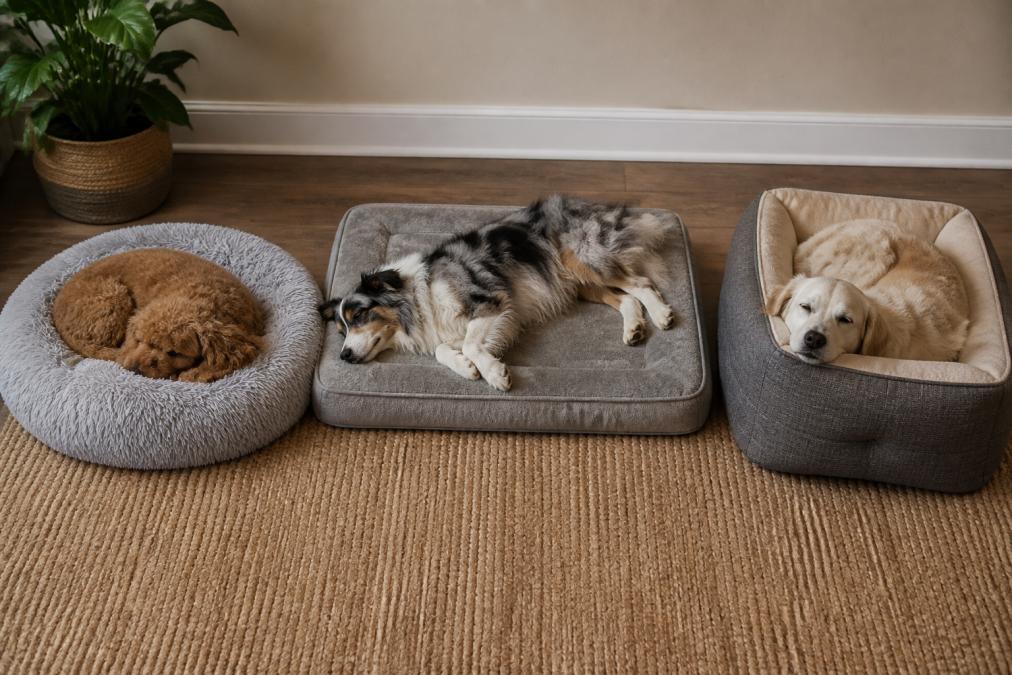
Matching Sleeping Style to Bed Type
Sprawlers need rectangular beds at least 100-120 centimetres long and 70-80 centimetres wide. The Waterproof Dog Bed works well for sprawlers because it offers a flat, open surface without restrictive edges.
Curlers thrive in donut beds or round beds with raised edges. A 60-70 centimetre diameter is usually sufficient for small to medium curlers.

Cuddlers benefit from bolster beds with raised sides on at least two edges. Medium to large cuddlers need beds at least 80-100 centimetres long.
Nesters appreciate beds with removable, machine-washable covers they can adjust. The Cozy Dog Sofa Bed combines softness with defined edges, giving nesters something to work with while maintaining structure.
Dog Bed Size Chart UK: Breed and Weight Guidelines
Small Breeds and Puppies
Small breed adults (under 10 kg) typically need beds 60-75 centimetres long and 45-60 centimetres wide. Puppies grow rapidly, so buy a bed sized for their expected adult weight. For small breed puppies, aim for 70-80 centimetres long and 50-65 centimetres wide.
| Breed | Adult Weight | Recommended Bed Length | Recommended Bed Width |
|---|---|---|---|
| Dachshund | 4-9 kg | 60-70 cm | 45-55 cm |
| French Bulldog | 8-14 kg | 70-80 cm | 50-60 cm |
| Cavalier King Charles | 10-18 kg | 75-85 cm | 55-65 cm |
| Pug | 6-8 kg | 60-70 cm | 45-55 cm |
| Chihuahua | 1-3 kg | 50-60 cm | 40-50 cm |
Medium and Large Breeds
Medium breeds (10-25 kg) need beds 80-100 centimetres long and 60-75 centimetres wide. Large breeds (25-45 kg) require beds 100-120 centimetres long and 75-90 centimetres wide. Large breed dogs often have joint concerns, so orthopedic support becomes increasingly important. Memory foam or high-density fill helps distribute their weight evenly and reduces pressure on hips and elbows.
| Breed | Adult Weight | Recommended Bed Length | Recommended Bed Width |
|---|---|---|---|
| Beagle | 10-15 kg | 80-90 cm | 60-70 cm |
| Cocker Spaniel | 12-15 kg | 85-95 cm | 65-75 cm |
| Boxer | 25-32 kg | 100-110 cm | 75-85 cm |
| Labrador Retriever | 25-36 kg | 110-120 cm | 80-90 cm |
| German Shepherd | 22-40 kg | 110-120 cm | 80-90 cm |
Giant Breeds and Senior Dogs
Giant breeds (over 45 kg) like Great Danes, Mastiffs, and Saint Bernards need beds 120-150 centimetres long and 90-110 centimetres wide. Senior dogs of any size benefit from orthopedic beds regardless of weight. Choose a bed with easy access, low sides they can step over without struggling, and materials that support their joints. Consider breathable materials for warm months and insulated options for winter.
Orthopaedic Dog Bed UK: Supporting Joint Health and Arthritis
Memory Foam and Fill Density for Pressure Points
When your dog has joint issues, arthritis, or hip dysplasia, an undersized bed forces uncomfortable positions while an oversized bed without proper support leaves them unsupported. Memory foam conforms to your dog's body shape, supporting the spine and taking pressure off hips, elbows, and shoulders.
Fill density matters significantly. A bed with 40+ kg/m³ density provides firm support without being rock-hard. At least 7-10 centimetres of quality memory foam provides genuine orthopaedic benefit.
When Your Dog Needs Extra Support
Signs your dog needs an orthopaedic bed include difficulty rising from rest, limping after sleep, reluctance to climb stairs, or a veterinary diagnosis of arthritis, hip dysplasia, or elbow dysplasia. Senior dogs over 7-8 years old benefit from orthopaedic support even without diagnosed joint disease.
When choosing an orthopaedic bed, size still follows the same rules: add 20-30 centimetres to your dog's nose-to-tail measurement. Waterproof covers are particularly valuable for senior dogs and those with incontinence issues. The Waterproof Dog Bed combines practical protection with supportive materials.
Types of Dog Beds and Which Suit Different Sizes and Styles
Rectangular Beds, Bolster Beds, and Donut Beds
Rectangular beds are the most versatile option and work for almost every dog and sleeping style. For small dogs, rectangular beds 60-75 centimetres long work well. For medium dogs, 85-100 centimetres is standard. For large and giant breeds, 110-150 centimetres ensures adequate space.

Bolster beds have raised edges on one, two, or four sides and are ideal for cuddlers who want something to lean against. For cuddlers, match the rectangular dimensions to your dog's size, then choose a bolster height of 15-25 centimetres.
Donut beds are round or oval with a raised edge all the way around, creating a nest-like space. They're perfect for curlers and anxious dogs. A 60-centimetre diameter donut bed suits small to medium curlers. An 80-centimetre diameter works for large curlers.
Flat Mats and Sofa-Style Beds
Flat mats are the simplest option, just a cushioned layer with no edges. They're lightweight, easy to move, and great for sprawlers. Ensure the mat is thick enough (at least 5-7 centimetres) to provide cushioning and support.
Sofa-style beds mimic furniture, with a cushioned base and back support. They're excellent for cuddlers and dogs who like to rest their head on something. Measure your dog's length from nose to tail, add 20 centimetres, and ensure the bed's base is at least that long. The height of the back should be 20-30 centimetres so your dog can rest their head comfortably. The Cozy Dog Sofa Bed combines the security of defined edges with comfortable cushioning.
Climate and Temperature Considerations When Choosing the Right Size Dog Bed
Breathable Materials for Warm Weather
In warm months, your dog needs breathable materials that allow heat to dissipate. Look for beds with cotton, linen, or mesh covers. Cooling gel-infused memory foam is an excellent option if you want orthopaedic support without heat retention. Elevated beds or those with airflow underneath work particularly well in warm weather. The Waterproof Dog Bed works well for warm weather because its materials don't trap heat excessively.
Insulated and Plush Options for Winter
Winter requires insulation and warmth. Choose beds with thick, insulating materials like wool, fleece, and high-density foam. Beds with raised edges or bolsters create enclosed spaces that trap your dog's body heat more effectively than open rectangular beds. The Cozy Dog Sofa Bed is specifically designed for winter warmth.
Budget-Friendly and Sustainable Dog Bed Solutions
DIY Dog Bed Ideas and Affordable Options
Quality dog beds don't have to be expensive. An old duvet or quilt folded into a rectangular shape creates a functional dog bed. You can place it inside a large cardboard box for bolster-like edges. Old blankets layered and sewn together create a cushioned mat. A basic foam mattress topper (often available for £15-25) placed in a wooden frame or large cardboard box produces a bed comparable to commercial options costing £50-80. The Waterproof Dog Bed at Doggo Shop (£19.99) provides washable, durable construction at an accessible price point.

Eco-Friendly Materials and Durability
A bed that lasts five years has far less environmental impact than one needing replacement every year. Organic cotton covers are more sustainable than synthetic fabrics and typically more durable. Recycled foam or recycled plastic materials use materials that would otherwise end up in landfills. Natural rubber or latex foam is more sustainable than petroleum-based memory foam and often more durable. Wool is an excellent sustainable material that's renewable, biodegradable, naturally temperature-regulating, and incredibly durable, a wool-filled bed can last 10+ years.
| Material | Durability | Sustainability | Cost | Best For | | --- | --- | --- | --- | | Organic Cotton | 3-4 years | High | Medium | Warm climates, allergic dogs | | Recycled Foam | 4-5 years | High | Medium | Budget-conscious eco-minded owners | | Natural Wool | 7-10 years | Very High | High | Long-term investment, temperature control | | Synthetic Polyester | 1-2 years | Low | Low | Temporary solutions only | | Natural Rubber Latex | 5-7 years | High | High | Hypoallergenic, durable option |
Choosing the right size dog bed requires measuring your dog accurately, understanding their sleeping position, and matching them to a bed style that suits their needs. At Doggo Shop, we offer a range of sizes and styles, from the Plush Donut Dog Bed for anxious curlers to the Waterproof Warm Dog Sofa Bed for large dogs needing support. Every purchase supports rescue dogs worldwide, so you're investing in your pet's comfort while making a difference for animals in need. Shop now and give your furry friend the restful sleep they deserve.
Frequently Asked Questions
How do I measure my dog for a bed in the UK?
Measure your dog from nose to tail while they're lying in their natural sleeping position, then add 15-20 cm for comfort. Measure width from paw to paw when stretched sideways. Use a soft measuring tape and note measurements in centimetres. Add extra space if your dog sprawls, sprawlers need rectangular beds that accommodate their full length and width. This ensures adequate room for stretching without feeling cramped.
What size dog bed do I need for a large dog?
Large dogs (typically 25-40 kg) generally need beds measuring 100-120 cm long and 70-90 cm wide. However, individual dogs vary, measure your specific dog from nose to tail and add 15-20 cm. Consider your dog's sleeping style: sprawlers need the extra length, whilst curlers may be comfortable in slightly smaller beds. Orthopaedic options with memory foam support are recommended for large breeds prone to joint issues.
What happens if a dog bed is too small?
A bed that's too small forces your dog into uncomfortable positions, limiting natural stretching and causing pressure on joints, particularly the hips and shoulders. This can lead to arthritis, anxiety, and poor sleep quality. Dogs may also avoid the bed entirely, choosing harder floors instead. Over time, inadequate support increases risk of musculoskeletal problems. Senior dogs and those with existing joint conditions are especially vulnerable to health issues from undersized beds.
Should a dog bed be bigger than the dog, and why?
Yes, a bed should be 15-20 cm larger than your dog's nose-to-tail measurement to allow comfortable stretching and position changes during sleep. Extra space reduces anxiety and pressure on joints, particularly important for senior dogs and those with arthritis or hip dysplasia. Dogs also appreciate room to adjust their sleeping position throughout the night for temperature regulation. Proper sizing improves sleep quality and long-term joint health.
This article was written using GrandRanker


Leave a comment