


Best Durable Toys for Power Chewers: 2026 Guide
Table of Contents
- What Makes a Toy Durable Enough for a Power Chewer?
- How to Choose Safe Dog Toys: Materials and Safety Standards
- Top Durable Toys for Power Chewers: Comparison Table
- Product Breakdown: Three Tough Toys That Hold Up
- Mental Stimulation for Power Chewers: Beyond Chewing
- Signs of a Worn-Out Dog Toy: When to Replace
- Verdict: Matching the Right Toy to Your Dog
- Frequently Asked Questions
Last Updated: September 15, 2026
What Makes a Toy Durable Enough for a Power Chewer?
A power chewer is a dog that applies sustained, high-pressure bites to toys, often destroying standard products within minutes. The best durable toys for power chewers are built from high-density rubber or tough nylon with reinforced construction that resists puncture and tear forces.
If you have ever handed your dog a "tough" toy only to find shredded fragments twenty minutes later, you already know the frustration.
Understanding Jaw Strength and Bite Force
Bite force varies enormously between breeds. A Labrador generates far more crushing power than a Shih Tzu, and a German Shepherd can apply sustained pressure that splits cheap rubber seams in seconds.
What most guides miss is that destruction is not purely about force. It is about repetition. A dog that chews for two hours daily will wear through a toy far faster than one that chews for ten minutes.
Signs your dog is a genuine power chewer:
- Toys develop cracks or holes within days
- Your dog removes squeakers almost immediately
- Standard rope toys fray into strands quickly
- Your dog loses interest once a toy stops resisting
If that sounds familiar, you need toys rated for aggressive chewers, not just "tough" marketing labels.
How to Choose Safe Dog Toys: Materials and Safety Standards
Choosing safe dog toys means matching material density to your dog's jaw strength while avoiding toxic additives. High-density rubber and food-grade tough nylon are the two most reliable options for heavy chewers.
Rubber vs Nylon: Which Material Lasts Longer?
Natural rubber flexes under pressure, which makes it excellent for treat-dispensing toys and dental chews. It absorbs bite force rather than shattering. Nylon is harder and lasts longer against determined gnawing, but it offers less give, so some dogs lose interest.
| Material | Durability | Best For | Watch Out For |
|---|---|---|---|
| Natural rubber | High | Treat dispensers, teething | Can be punctured by sharp molars |
| TPR | Medium-high | Dental chews, gum massage | Softer than pure rubber |
| Tough nylon | Very high | Persistent gnawers | Less flexible, harder on enamel |
| Reinforced rope | Medium | Tug and fetch play | Frays; supervise closely |
Non-Toxic Materials and UK Safety Considerations
Under Regulation (EC) No 1907/2006 on chemical safety, retained in UK law, toy materials must not contain harmful substances at levels that pose a risk to animals. Reputable manufacturers use non-toxic, food-grade compounds.
Look for toys described as non-toxic and free from BPA and phthalates. Avoid anything with a strong chemical smell, which often signals low-grade plasticisers.
Top Durable Toys for Power Chewers: Comparison Table
The three toys below are built specifically for aggressive chewers, using materials that resist puncture, tearing, and daily wear.
| Toy | Price | Material | Best For | Key Feature |
|---|---|---|---|---|
| Thick Tire-Inspired Treat Dispenser | £19.99 | Natural rubber | Medium to large breeds | Treat-dispensing + rope tug |
| Indestructible TPR Chew Bone | £16.99 | TPR | All breeds | Puzzle shape, dental cleaning |
| Interactive Suction Cup Tug Toy | £19.99 | Durable rubber | High-energy dogs | Hands-free solo play |
Each one targets a different chewing need. The sections below explain which suits your dog best.
Product Breakdown: Three Tough Toys That Hold Up
Each of these Doggo Shop toys addresses a specific chewing behaviour, from boredom-driven gnawing to anxiety relief and interactive play.
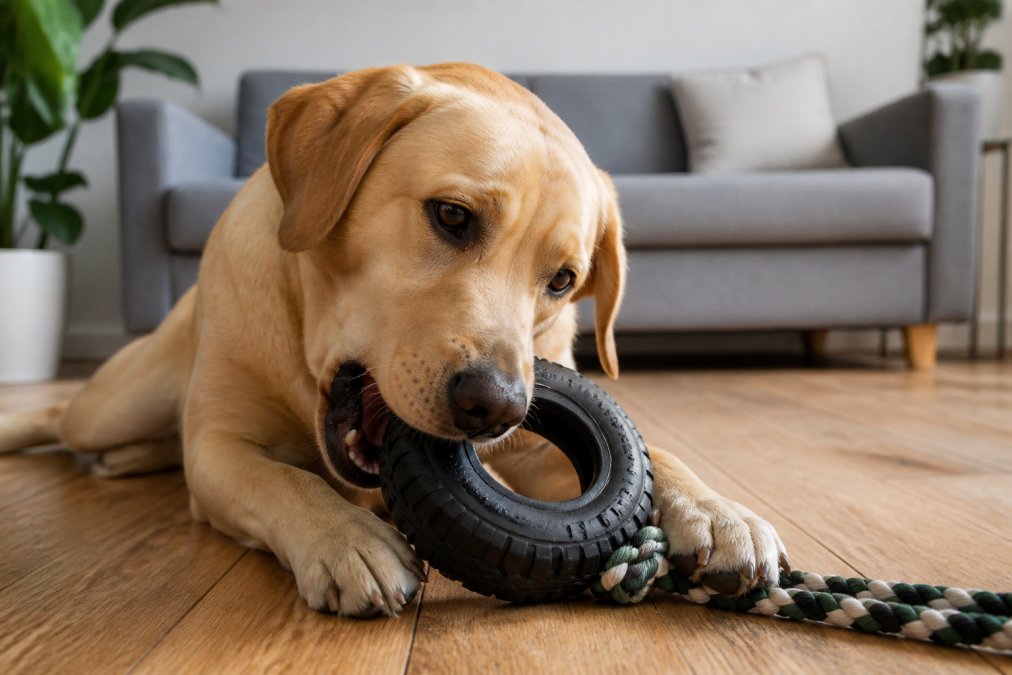
Thick Tire-Inspired Treat Dispenser (£19.99)
This one is our top pick for medium to large power chewers. The thick tire-inspired design is made from high-quality natural rubber, and it withstands the kind of sustained pressure that destroys cheaper toys.
You can stuff treats inside to turn chewing into a rewarding puzzle. The textured surface massages gums and helps clean teeth as your dog works at it. The rope feature adds a tug element for interactive play.
At 35 × 16 cm and 292 g, it suits German Shepherds, Labradors, and similar strong breeds. The trade-off: it is not indestructible, and a determined chewer will eventually wear the rubber down.
Indestructible TPR Chew Bone for Teeth Cleaning (£16.99)
If your dog ignores flexible toys and wants something solid, this TPR bone is the answer. Its puzzle-like shape stimulates the mind while the textured surface cleans teeth, massages gums, and reduces tartar buildup.
It comes in three colours and suits small, medium, and large breeds, including Huskies, Shepherds, Samoyeds, Shiba Inus, and Labradors. The compact design makes it easy to take on walks or trips.
Where it falls short: some dogs find TPR less satisfying than natural rubber, and very determined chewers may still make dents over time. For anxiety relief and boredom-busting between meals, though, it earns its place.
Interactive Suction Cup Tug Toy (£19.99)
For dogs that need mental stimulation as much as physical chewing, this suction cup tug toy is the cleverest option here. It sticks firmly to smooth surfaces and lets your dog enjoy solo tug-of-war, freeing your hands while keeping them busy.
The chew ball has textured grooves that clean teeth and freshen breath as your dog bites. It also dispenses treats, which adds a puzzle element that relieves stress and boredom.
Mental Stimulation for Power Chewers: Beyond Chewing
Mental stimulation for power chewers matters as much as physical toughness. A bored dog chews destructively; a stimulated dog chews appropriately. The mechanism is straightforward: chewing is a self-reinforcing behaviour, and if the only outlet is a toy that gives way quickly, the dog learns that destruction is the reward. Enrichment redirects that drive into a task the toy can survive.
Breed Chewing Profiles: Match the Toy to the Jaw
Most guides treat "power chewer" as one category. In practice, chewing style varies by breed group, and matching the toy to the profile prevents both boredom and dental damage.
- Terrier types (Staffordshire Bull Terrier, Jack Russell Terrier, Border Terrier): short, rapid, repetitive bites with a strong grip-and-shake instinct. They favour smaller, denser toys they can worry at. Flexible rubber that compresses under a quick bite suits them better than a large rigid block.
- Mastiff and guarding types (Bullmastiff, Rottweiler, Cane Corso): slow, sustained crushing pressure. They need thick-walled natural rubber with no thin seams, and larger diameters so the toy cannot be swallowed or wedged.
- Working and herding types (German Shepherd, Belgian Malinois, Labrador Retriever): prolonged gnawing combined with high energy. Treat-dispensing rubber and reinforced rope work well because the chewing is tied to a task.
- Scent hounds and sighthounds (Beagle, Greyhound): often less destructive but prone to boredom-chewing. Puzzle and dispenser formats hold attention longer than a plain solid chew.
If you are unsure which profile fits, watch how your dog attacks a new toy for the first five minutes: quick repeated nips point to terrier-style, slow crushing to mastiff-style, and steady grinding to working-style.
Using Chew Toys for Impulse Control Training
A durable toy is also a training tool. Two techniques are worth building into your routine:
- Chew-and-wait. Offer the toy, let your dog chew for a set period, then ask for a sit or a drop before returning it.
Rotation and Novelty
Signs of a Worn-Out Dog Toy: When to Replace
Weekly Inspection Checklist
How Chewing Affects Dental Health
Material Safety and What to Avoid
Never give your dog a toy with loose squeakers, glued-on eyes, or thin plastic parts. These detach under pressure and become choking hazards. If a toy has any removable component smaller than your dog's throat, it is not safe for unsupervised chewing.
When to Retire a Toy Immediately
Verdict: Matching the Right Toy to Your Dog
Frequently Asked Questions
What is the toughest dog toy for aggressive chewers?
The toughest toys are typically made from high-density natural rubber or tough nylon. Look for thick, solid designs without small parts that can break off. A tire-inspired rubber toy with a treat dispenser is a strong option because it combines durability with mental engagement. Always check for a toy that is size-appropriate and free from sharp edges after chewing.
How can I tell if a dog toy is safe for a power chewer?
Check for non-toxic materials, reinforced stitching, and a solid construction with no loose pieces. Avoid toys with squeakers or plastic parts that can be swallowed. The toy should be larger than your dog's throat to prevent choking. Inspect regularly for wear and tear, and replace it at the first sign of deep cracks or tears.
How do I keep a power chewer mentally stimulated without them destroying toys?
Use interactive toys that dispense treats or require problem-solving, like suction cup tug toys or puzzle bones. Rotate toys every few days to keep them novel. Combine chewing with training sessions and food-dispensing toys to provide mental stimulation for power chewers. This reduces boredom and destructive behaviour.
Are there truly indestructible dog toys?
No toy is completely indestructible, but some come close. High-density rubber and tough nylon toys are the most durable. Even the strongest toys will show wear over time, so supervision is essential. Choose toys labelled for aggressive chewers and check them regularly for damage. Replace any toy that develops sharp edges or loose pieces.


Leave a comment