


Best Durable Chew Toys for Puppies: 2026 Guide
Table of Contents
- Quick Comparison: Top Durable Chew Toys for Puppies
- Best Chew Toys for Aggressive Chewers
- Puppy Teething Toy Safety Standards and Material Selection
- How to Stop Puppy Chewing Furniture: Redirection and Toy Strategy
- How to Choose the Right Durable Chew Toy for Your Puppy
- Conclusion
Last Updated: August 19, 2026
Quick Comparison: Top Durable Chew Toys for Puppies
Finding durable chew toys for puppies protects your furniture while supporting healthy oral development. Most standard toys fall apart within days under determined jaws, leaving you frustrated and your pup unsatisfied.
At Doggo Shop, we've identified resilient options that withstand aggressive chewing while delivering real benefits like gum massage, tartar reduction, and mental stimulation.
| Toy | Price | Best For | Key Benefit |
|---|---|---|---|
| Thick Tire-Inspired Durable Dog Chew Toy | £19.99 | Medium to large aggressive chewers | Treat dispenser |
| Indestructible Dog Chew Bone Toy | £16.99 | All sizes, dental care focus | Teeth cleaning + stress relief |
| Interactive Suction Cup Tug Toy | £19.99 | High-energy, solo play needs | Hands-free engagement + dental support |
Each addresses a different chewing need while sharing one critical quality: durability beyond the first week.

Best Chew Toys for Aggressive Chewers
Aggressive chewers need toys engineered for serious jaw pressure. Standard rubber toys compress, splinter, or bore dogs within hours.
1. Thick Tire-Inspired Durable Dog Chew Toy - Treat Dispenser
The tire-inspired design distributes bite force across a larger surface area, making it significantly harder to puncture than traditional ball-shaped toys. Made from natural rubber, this toy combines chewing, treat dispensing, and interactive play.
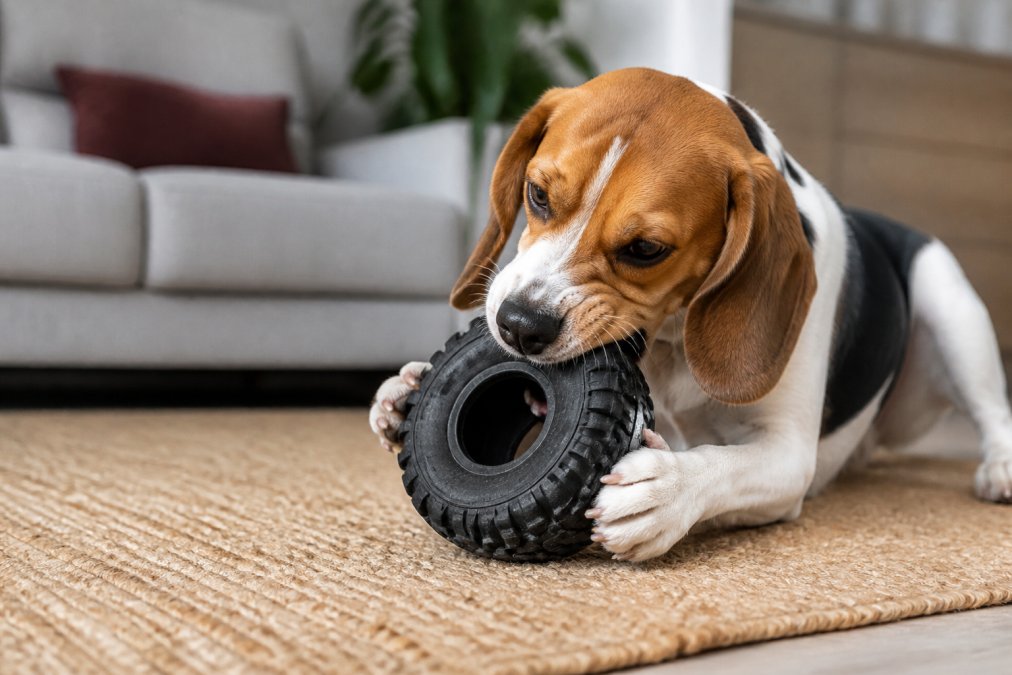
The textured surface massages gums and scrapes away plaque buildup. You can apply pet-safe toothpaste to the surface for deeper cleaning. For medium to large breeds like German Shepherds, Labradors, and Huskies, the 35cm length and 292g weight prevent choking hazards.
The treat-dispensing function redirects destructive chewing toward productive behaviour. Stuff it with kibble or training treats to create a puzzle that rewards patience.
Best for: Medium to large dogs with serious chewing habits.
Price: £19.99
2. Indestructible Dog Chew Bone Toy for Teeth Cleaning
TPR (thermoplastic rubber) is engineered for durability, resisting tearing far better than standard rubber and avoiding splinters. The puzzle-like shape with multiple textures means different mouth parts encounter different resistance levels, softer grooves massage gums while firmer ridges remove tartar.
Chewing releases calming endorphins, reducing anxiety and boredom. Puppies with appropriate chewing outlets are significantly less likely to develop destructive behaviours when left alone. Available in three colours, this toy works across small, medium, and large breeds, eliminating the need for breed-specific replacements as your puppy grows.
Best for: Puppies where dental health is the priority.
Price: £16.99
3. Interactive Suction Cup Tug Toy - Dog Chew & Teething Ball
The strong suction cup anchors to smooth surfaces, tile, hardwood, or glass, allowing solo tug-of-war sessions. This solves a real problem for busy professionals: keeping puppies entertained without active participation.
The textured chew ball features grooves for tartar removal and breath freshening. The treat-dispensing design extends play sessions through problem-solving. This toy works across energy levels, high-energy puppies get genuine challenge while anxious puppies get solo play without pressure. For urban apartments with limited space, it provides full engagement without requiring floor space.
The suction cup requires smooth surfaces; carpet won't hold it. But kitchens, bathrooms, and tiled areas make it an easy deployment option.
Best for: Busy owners and high-energy puppies needing solo play.
Price: £19.99
Puppy Teething Toy Safety Standards and Material Selection
Safety involves understanding material composition your puppy will mouth daily for months. Budget toys often fail here.
Understanding Material Toxicity: What Actually Matters
When puppies chew toys 20-30 minutes daily, they create micro-abrasions increasing material absorption through mouth membranes. Material selection directly impacts long-term health.
BPA (Bisphenol A) is an endocrine disruptor used in some plastics and rubbers. When stressed during aggressive chewing, BPA leaches into saliva. Puppies are particularly vulnerable due to developing systems. Quality toys use BPA-free formulations.
Phthalates are plasticisers softening rubber and PVC. Though banned in children's toys under EU Toy Safety Directive (2009/48/EC), some pet toy manufacturers still use them because pet products fall under different regulations. They accumulate in fatty tissues. Natural rubber and TPR formulations avoid this entirely.
Heavy metals (lead, cadmium) can be present in cheap dyes and pigments. Darker colours sometimes contain higher concentrations. Premium toys use lighter, naturally derived pigments for safety. Always check for third-party heavy metal testing documentation.
Material Standards and Certifications to Look For
Responsible manufacturers voluntarily comply with standards designed for similar products:
- EN 71-3 (Migration of Certain Elements): Limits lead, cadmium, chromium, and other heavy metals.
- Toy Safety Regulations (e.g., The Toys (Safety) Regulations 2011): These regulations set out essential safety requirements for toys, including chemical properties and physical/mechanical properties, ensuring non-toxic material verification.
- Natural Rubber Certification: Look for sustainably harvested natural rubber (FSC certification). Natural rubber is inherently free from synthetic additives.
Ask manufacturers for Certificate of Analysis or third-party testing reports. Reputable brands provide these upon request.
Why Durability and Safety Are Inseparable
A toy degrading quickly creates hazards: loose pieces become choking risks, sharp edges cut gums, and breakdown releases chemicals. A durable toy maintaining structural integrity for 6-12 months is inherently safer because it doesn't fragment.
Natural rubber and TPR toys (£15-25) are genuinely safer than £3-5 alternatives, which often use recycled rubber or lower-grade synthetics that break down faster and may contain undisclosed fillers.
Size-Appropriate Selection and Choking Risk
Material safety means nothing if the toy poses a choking hazard:
- Small breeds (under 5 kg): Toys should be at least 5 cm in diameter, 50-100g.
- Medium breeds (5-25 kg): Toys should be 7-10 cm in diameter, 150-300g.
- Large breeds (over 25 kg): Toys should exceed 10 cm in diameter, 300g+.
Always request specific measurements in centimetres and weight in grams.
Supervision Protocol for New Toys
Supervision during the first 3-5 sessions is essential:
- Watch for tearing vs. chewing: Puppies attempting to tear pieces off show the toy isn't appropriate for their jaw strength.
- Monitor for mouth irritation: Inflamed gums or dramatically increased drooling indicate sensitivities. Discontinue use.
- Check for material degradation: Inspect for cracks, soft spots, or peeling after each session. Replace immediately if structural integrity compromises.
How to Stop Puppy Chewing Furniture: Redirection and Toy Strategy
Destructive chewing signals your puppy needs an appropriate outlet. The solution is redirection combined with the right toys.
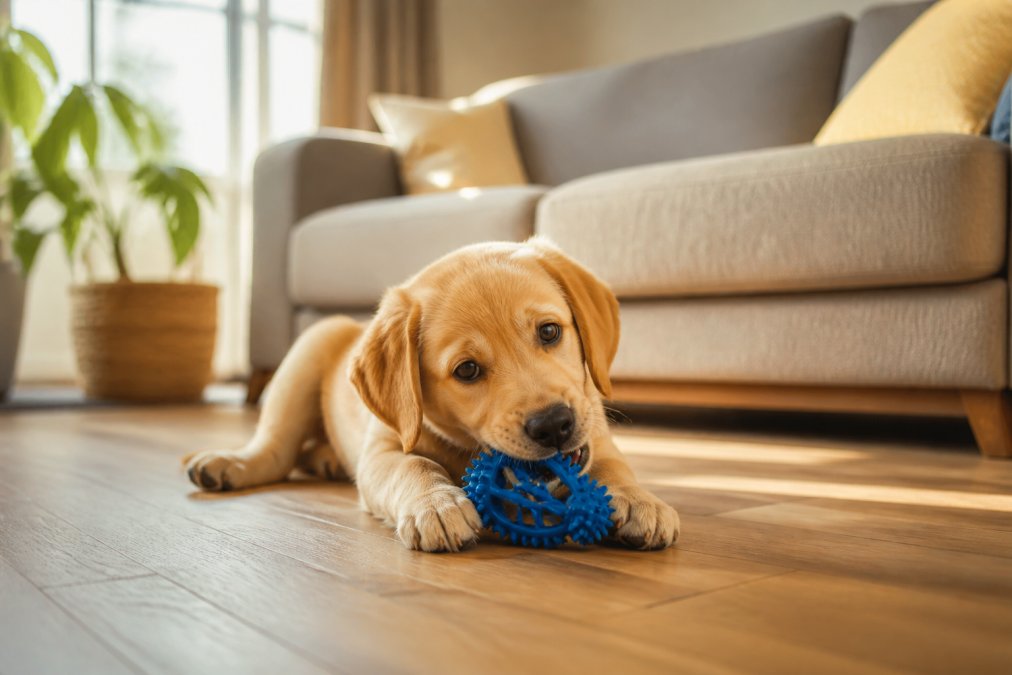
When you catch your puppy chewing furniture, calmly redirect them to a durable chew toy and immediately reward engagement with praise, treats, or play. Puppies learn fast and will seek out the toy instead of the sofa.
Rotation is underrated. Puppies get bored with the same toy. Rotating between three or four toys makes each feel "new" when it reappears, extending engagement and preventing abandonment.
Timing matters. Puppies chew most when tired, teething, or understimulated. Offer appropriate toys during these windows. If your puppy destructively chews late afternoon, they likely need more mental or physical exercise earlier in the day.
Treat-dispensing toys become your secret weapon, keeping puppies occupied for 20-30 minutes, enough time to break destructive cycles and establish new habits. Never leave unsupervised puppies with unproven toys. Watch for wear, loose pieces, cracks, or missing chunks, replacing toys before they become hazards.
How to Choose the Right Durable Chew Toy for Your Puppy
Selecting the right toy is half the challenge. The other half is understanding rotation, maintenance, and replacement as your puppy grows.
Initial Selection: Matching Toy to Puppy
Assess chewing intensity first. Watch behaviour during the first week:
- Gentle chewers (mouthing, light gnawing): Can use a wider range of toys, including softer rubber options.
- Moderate chewers (sustained gnawing, occasional aggressive bursts): Need moderate durability. The bone toy (TPR) is ideal.
- Aggressive chewers (intense jaw pressure, attempting to tear): Require the most durable options. The tire-inspired toy is engineered for this intensity.
Honest assessment prevents wasted money and ensures safety.

Consider your lifestyle. If you work long hours, a suction cup toy provides hands-free engagement. If dental health is primary, the bone toy's tartar-removal focus wins.

Think about breed and size. Larger breeds need toys that won't disappear in their mouths. Always verify dimensions in centimetres and weight in grams. Generic size labels are meaningless without specifics.
Evaluate material priorities. Natural rubber toys are eco-friendly and safe but may soften in warm conditions (above 25°C). TPR toys resist damage better but are synthetic. Both are non-toxic.
Test initial engagement. Some puppies love rope toys immediately; others ignore them. Start with one toy, observe for 3-5 sessions, then expand your collection based on what motivates your individual dog.
The Rotation Strategy: Why It Works and How to Implement It
A puppy with the same toy available 24/7 loses interest within 1-2 weeks. Rotation solves this by making each toy feel novel when it reappears.
How to rotate effectively:
- Acquire 3-4 toys with different textures and functions: treat-dispensing toy, dental-focused toy, interactive toy.
- Offer one toy for 2-3 days, then swap it out. Store "off-rotation" toys where your puppy can't see them.
- Reintroduce toys in sequence. After 5-7 days away, your puppy treats it as "new" again.
- Adjust rotation frequency based on intensity: aggressive chewers need faster rotation (every 2 days); gentle chewers can go longer (4-5 days).
Continuous chewing causes material stress and micro-fractures. Rotation allows rubber to rest and recover slightly. A toy rotated every 3 days lasts 40-50% longer than one available constantly.
Recognising Toy Fatigue: When to Replace
Visual inspection checklist (perform weekly):
- Surface cracks or splits: Any visible crack indicates compromised integrity. Cracks expand rapidly under continued chewing.
- Soft spots or indentations: If areas don't spring back, material is degrading.
- Loose or peeling material: Any separating rubber is an immediate replacement trigger.
- Flattening or deformation: Permanently dented toys indicate advanced material fatigue.
- Odour changes: Sour or chemical smells indicate bacterial growth or breakdown. Remove immediately.
Tactile inspection: Run your fingers over the entire surface. Feel for rough patches, sticky residue, or areas your fingernail can puncture. If you can damage it with your fingernail, your puppy's teeth will damage it faster.
Replacement timeline:
- Gentle chewers: 12-18 months per toy
- Moderate chewers: 6-12 months per toy
- Aggressive chewers: 3-6 months per toy
These timelines assume rotation and proper storage away from direct sunlight and heat.
Breed-Specific Considerations
Retrievers and Labradors: Powerful jaws and love carrying toys. They need toys that won't splinter if dropped. The tire toy's durability is ideal. Treat-dispensing functions suit their high food-motivation.
Terriers and smaller aggressive chewers: Despite smaller size, many have intense, focused chewing. They need toys rewarding precision chewing. The bone toy's textured surface provides varied resistance.
Spaniels and gentle-mouthed breeds: Often prefer softer toys and interactive play. Rotation becomes more important because they're less likely to destroy toys and more likely to abandon them from boredom.
Giant breeds (Great Danes, Mastiffs): Size matters enormously. Always size up. A toy appropriate for 20 kg is a choking hazard for 50 kg.
Maintenance and Storage
- Store in cool, dry conditions: Avoid cars, conservatories, or direct sunlight. Heat and humidity accelerate breakdown.
- Wash toys weekly: Use warm water and mild soap. Remove saliva and bacteria. Dry thoroughly.
- Inspect after washing: Wet toys reveal cracks and soft spots more clearly.
- Separate toys by material: Store rubber toys separately from rope toys to prevent fibre transfer.
Planning for Growth and Changing Needs
Your puppy's chewing needs change as they grow:
- 8-12 weeks: Teething is intense. Puppies need softer, smaller toys. The bone toy works well.
- 12-24 weeks: Teething peaks. Larger toys become appropriate. The tire toy shines.
- 6+ months: Adult teeth arrive. Chewing intensity increases. Aggressive chewers really test durability.
- 12+ months: Chewing may decrease slightly, but habits are established. Rotation and maintenance become routine.
As your puppy grows, retire smaller toys and introduce larger ones. Plan for toy replacement as part of your puppy budget, expect £15-25 per toy, with 3-4 toys in rotation, replaced every 6-12 months depending on chewing intensity.
Frequently Asked Questions
What are the toughest durable chew toys for puppies?
The toughest options combine natural rubber with textured designs that withstand aggressive chewing. Look for toys made from TPR (thermoplastic rubber) or high-quality natural rubber, as these materials resist puncturing and tearing. Toys with multilayered construction and rope elements offer extra durability. The Thick Tire-Inspired Durable Dog Chew Toy (£19.99) and Indestructible Dog Chew Bone Toy (£16.99) are engineered specifically for power chewers, with reinforced designs that last through intense play sessions.
How do I know if a chew toy meets puppy teething toy safety standards?
Safe teething toys should be non-toxic, free from harmful chemicals, and designed without small parts that could become choking hazards. Check that toys are made from food-grade materials and don't contain BPA, phthalates, or lead. Look for products tested against durability standards to ensure they won't splinter or break apart. Reputable brands clearly state material composition and safety certifications. Textured surfaces that massage gums are beneficial, and toys should be appropriately sized for your puppy's breed to prevent swallowing risks.
How can durable chew toys help stop puppy chewing furniture?
Redirecting your puppy's chewing instinct to appropriate toys prevents furniture damage. Offer interactive, treat-dispensing toys like the Interactive Suction Cup Tug Toy (£19.99) to keep your puppy engaged during the day. Rotate toys regularly to maintain novelty and interest. When you catch your puppy chewing furniture, calmly redirect them to an approved toy and reward the behaviour. Puppies naturally explore with their mouths, so providing engaging alternatives satisfies this need while protecting your home. Long-lasting toys reduce boredom, a primary cause of destructive chewing.
Are rubber toys better than nylon for puppies?
Natural rubber toys generally offer better safety and durability for puppies than nylon. Rubber is softer on developing teeth and gums, making it ideal for teething. It's also less likely to splinter or create sharp fragments if chewed aggressively. Nylon toys can wear down into small pieces that pose choking risks. However, quality matters in both materials. High-grade natural rubber toys like those offered at Doggo Shop provide superior longevity, are easier to clean, and support dental health through textured massage surfaces.
This article was written using GrandRanker


Leave a comment