


Best Dog Car Seat Cover for Travel: 2026 Buying Guide
Table of Contents
- What the Best Dog Car Seat Cover for Travel Actually Needs to Do
- Waterproof Dog Car Seat Cover: What Water-Resistant Really Means
- Hammock, Bench or Boot Liner: Matching the Cover to Your Car
- Fit, Measurements and Vehicle Compatibility
- Dog Car Seat Cover With Seat Belt Access: Safety and Restraint
- How to Clean a Dog Car Seat Cover Without Damaging It
- Common Buying Mistakes and What to Ignore
- Frequently Asked Questions
Last Updated: October 19, 2026
What the Best Dog Car Seat Cover for Travel Actually Needs to Do
A dog car seat cover for travel is a protective layer fitted over your vehicle's seats to shield upholstery from mud, water, hair and scratches while keeping your dog comfortable.
Here is the honest starting point. The Highway Code guidance on securing animals in vehicles is clear that dogs must be suitably restrained so they cannot distract you or injure themselves in a crash.
Look for four things, in this order:
- A waterproof backing layer, not just a water-resistant face fabric
- A non-slip base that grips the seat rather than sliding on leather
- Gaps or slits for seat belt access, so a harness can still be clipped in
Get those four right and most covers will serve you well. Get them wrong and you have bought a slippery blanket with a dog on top.
Waterproof Dog Car Seat Cover: What Water-Resistant Really Means
Waterproof and water-resistant are not the same claim, and the gap matters most on a wet January walk. A waterproof dog car seat cover has a sealed or laminated backing that stops liquid reaching the seat beneath. A water-resistant cover only slows absorption, so a soaked dog lying down will eventually push moisture through.
Assess three specific construction details:
- A separate backing layer. Quilted fabric on its own absorbs. The waterproofing lives in the membrane behind it.
- Welded or bound seams. Stitched seams without sealing are the usual leak point.
- Raised side flaps. These catch drips running off the dog and protect the door cards.
The practical test is simple: pour a little water onto the reverse of the cover and leave it a few minutes. If it beads and sits, the backing is doing its job. If it darkens and spreads, it is not.
Hammock, Bench or Boot Liner: Matching the Cover to Your Car
There are three main formats, and the right one depends less on your car than on how your dog travels: size, number of dogs, journey length, and whether they ride on a seat or in the boot.
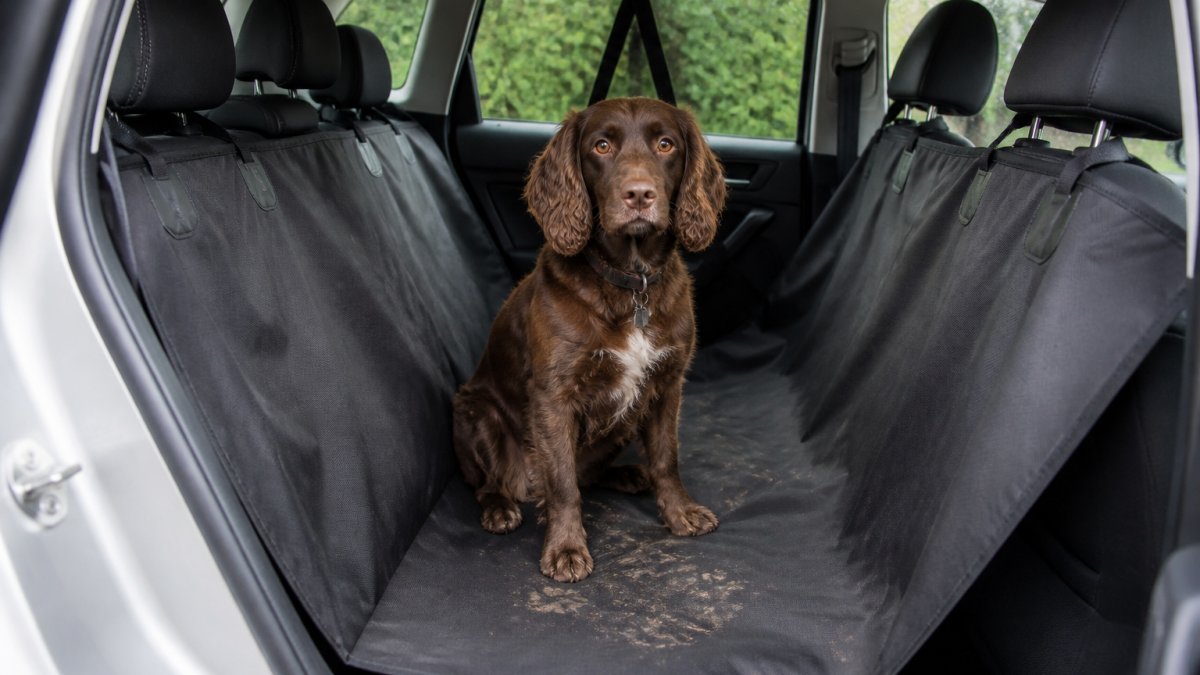
A hammock cover suspends between the front and rear headrests, creating a cradle that stops your dog sliding into the footwell. A boot liner protects the load area and suits larger dogs or owners who prefer the dog behind a guard.
Match the format to the dog and the journey
Medium dogs (roughly 10-25 kg). A hammock suits regular solo-dog travel and longer journeys where the dog needs to lie down.
More than one dog. Two dogs on one hammock slide into each other on corners.
Journey length. For short urban trips, a bench cover is quick to fit and remove.
Seat or boot. A dog on the seat is usually better in a hammock or bench cover, paired with a harness clipped to a seat belt.
The trade-offs in plain terms
Hammock covers win for most travelling owners because they solve two problems at once: they protect the seat and stop the dog dropping into the gap.
Bench covers are easier to fold away and let passengers sit alongside the dog.
If you travel regularly with one dog and no rear passengers, a hammock is the best dog car seat cover for travel in most cases.
| Format | Best For | Protection Level | Main Trade-off |
|---|---|---|---|
| Hammock | Regular solo-dog travel, small to medium dogs, long journeys | High, covers seat and footwell gap | Blocks rear passenger seating; can interfere with child seat anchors |
| Bench | Dogs travelling alongside passengers, calm dogs, short trips | Medium, seat surface only | Dog can still slip into footwell; door cards exposed |
| Boot liner | Large dogs, multiple dogs, load-area travel, families carrying passengers | High, full boot coverage | Needs a boot guard for restraint; dog must travel happily in the boot |
Fit, Measurements and Vehicle Compatibility
Universal fit is a marketing phrase, not a guarantee. Dimensions vary enormously between a small hatchback and an estate: too large and the cover bunches under the dog, too small and the seat edges are exposed.
Measure before you buy. You need four numbers, not one:
- Rear bench width between the door cards, measured at the widest point of the seat cushion
- Seat depth from the backrest to the front edge of the cushion
- Backrest height from the cushion to the top of the headrests
Write those down and compare them with the cover's stated dimensions, not with the vehicle class. A cover listed as fitting "medium SUVs" may be 140 cm wide, which is too wide for a compact crossover and too narrow for a full-size estate.
Fit checks that catch problems before they happen
Compatibility comes down to features that are easy to overlook until the cover is on the seat:
- Split-fold rear seats. If your rear bench splits 60/40 or 40/20/40, a one-piece bench cover will stop you folding either side independently. Look for covers with a split seam or buy two narrower covers if you regularly fold one side for cargo.
- Removable versus fixed headrests. Hammock covers need headrests to anchor around. If your rear headrests are fixed or integrated into the seatback, you need a cover that anchors via the seat base or uses strap loops around the seat frame instead.
- Headrest post spacing. Straps adjust, but only within a range. Measure the gap between the posts and check the cover's strap length; a strap that is too short will not reach around a wide bench.
- Door-card clearance. Side flaps need to hang over the door cards without fouling the door seal or the window glass. If your doors have deep armrests or storage bins, a flap that is too short will leave the top of the door card exposed to wet paws.
A practical fit test
Before you commit to a long journey, fit the cover and do three checks:
- The tug test. Grab the cover at the front edge and pull firmly. It should resist rather than slide. If it moves more than a few centimetres on leather, the non-slip base is not gripping and the cover will shift every time the dog turns around.
- The fold test. Fold one side of the rear bench down, if your car allows it. If the cover prevents the fold or bunches badly, it is the wrong design for your vehicle.
- The buckle reach test. Clip a harness to the seat belt with the cover in place. If you have to lift or unclip the cover to reach the buckle, the access points are in the wrong place for your car.
A common mistake is buying on seat width alone. Depth matters just as much, and it is the measurement most buyers forget. The second is assuming a cover that fits one car will fit another of the same size class; seat shapes, headrest positions and door-card profiles vary far more than exterior dimensions suggest.
Dog Car Seat Cover With Seat Belt Access: Safety and Restraint
A dog car seat cover with seat belt access includes openings or Velcro slits that let you clip a harness to the seat belt buckle without lifting the cover, so restraint and protection work together rather than against each other.
Here is the distinction we keep coming back to. The PDSA advice on travelling safely with dogs recommends securing dogs with a harness attached to a seat belt or a suitable carrier, and a cover with well-placed access points makes that possible without removing the protection.
A booster seat or a rigid car restraint is a separate purchase again. If your dog is small, a booster raises them so a harness sits correctly. If your dog is large, a crash-tested harness paired with a cover that has clear belt access is the combination we would choose.
How to Clean a Dog Car Seat Cover Without Damaging It
Knowing how to clean a dog car seat cover properly keeps the waterproof layer intact. Most covers are machine washable on a cool, gentle cycle, but heat is the enemy of the membrane and the non-slip backing.
Follow this routine:
- Shake out loose hair and grit outdoors before washing
- Brush or vacuum the quilted surface to lift embedded hair
- Close all straps and buckles so they do not snag the drum
- Wash on a cool, gentle cycle with a mild detergent, no fabric conditioner
Fabric conditioner is the quiet killer: it coats the fibres and reduces both the water repellency of the face fabric and the grip of the anti-slip base. Skip it.
Common Buying Mistakes and What to Ignore
The most expensive mistake is buying a cover as a substitute for restraint. It protects your seats, not your dog, and no amount of padding changes that.
Other traps we see regularly:
- Trusting "universal fit" without measuring your own seats
- Ignoring the non-slip backing, then wondering why the cover slides on leather every time the dog turns around
- Buying on price alone, when a cheap cover with a thin backing fails within a season
- Overlooking side flaps, which are what protect your door cards from wet, muddy paws
What can you safely ignore? Marketing language about "premium" or "luxury" materials tells you nothing measurable. Focus on construction instead: backing layer, seam sealing, base grip and dimensions.
At Doggo Shop, we stock durable leashes, cosy beds and travel-friendly essentials for owners who take their dogs everywhere, and every order supports rescue dogs and cats in need worldwide. If you are kitting out for longer journeys, browse our range and travel with a dog that is comfortable, protected and properly restrained.
Travelling with a dog should be one of the good parts of owning one, not a chore you dread because of what the back seat will look like afterwards.
Frequently Asked Questions
What is the safest way for a dog to travel in a car?
A seat cover protects your upholstery, but it does not restrain your dog. For safety, pair a dog car seat cover with a crash-tested harness attached to a seat belt, or use a secured crate or carrier. Under the Highway Code, dogs must be suitably restrained so they cannot distract you while driving or injure you if you brake sharply. A cover alone does not meet that requirement, so treat it as protection for the car, not a safety device for the dog.
How do I measure my car seat for a dog cover?
Measure the width of the rear bench between the door panels, the depth from the seat back to the front edge, and the height of the seat back to the top of the headrests. Check whether your rear seats fold or slide, because that changes the depth. A hammock-style cover also needs the distance between the front and rear headrests. Compare your figures with the cover's stated dimensions rather than relying on 'universal fit' claims, and allow a few centimetres of slack for adjustable straps.
Are hammock-style dog car seat covers safer than bench covers?
A dog hammock car seat cover stops your dog falling into the footwell and keeps them away from the front seats, which reduces distraction. It is not a crash-tested restraint, though. Neither a hammock nor a bench cover protects your dog in a collision on its own. Use a hammock for containment and cleanliness, then add a harness and seat belt tether or a secured crate for actual restraint. Look for reinforced headrest straps and a non-slip backing so the hammock stays put.
Will a seat cover work with a dog harness and seat belt?
Yes, if you choose a dog car seat cover with seat belt access. Look for Velcro or zip openings that let the seat belt buckle pass through, so you can clip a harness tether without lifting the whole cover. Check that the openings line up with your car's buckle positions, since these vary between models. Test the fit before a long journey, and make sure the harness is crash-tested and correctly sized rather than relying on the cover's straps to hold your dog.


Leave a comment