


Best Bitter Sprays for Dog Chewing Furniture: 2026 Guide
Table of Contents
- Why Dogs Chew Furniture and How Bitter Sprays Help
- What to Look for in a Bitter Spray for Dog Chewing Furniture
- Does Bitter Spray Work for Dogs? Effectiveness and Limitations
- How to Use Anti-Chew Spray on Furniture Safely
- How to Stop a Dog Chewing Furniture: Training Alongside Deterrent Spray
- Common Mistakes When Using Chewing Deterrent Spray
- Conclusion: Choosing the Right Bitter Spray for Your Dog
- Frequently Asked Questions
Last Updated: October 8, 2026
Why Dogs Chew Furniture and How Bitter Sprays Help
Chewing is normal dog behaviour, but when it targets your settee legs and favourite shoes it becomes destructive.
Bitter spray is simple, but it only works when you understand why your dog chews.
Puppies chew to relieve teething discomfort; adult dogs chew from boredom, stress or rewarded attention.
The RSPCA's advice on dog behaviour and enrichment makes clear that chewing is a natural canine need, not naughtiness.
What to Look for in a Bitter Spray for Dog Chewing Furniture
The right chewing deterrent balances three things: a taste dogs genuinely dislike, a pet-safe formula, and one that will not stain your furniture.
The criteria that separate a good spray from a wasted bottle
| What to Check | Why It Matters | What to Avoid |
|---|---|---|
| Active bittering agent | Determines whether your dog actually cares | Vague "bittering agent" with no detail |
| Ingredient transparency | Lets you check for allergens and irritants | Undisclosed "proprietary blend" |
| Pet-safe ingredients | Dogs lick treated surfaces | Harsh chemicals or unknown additives |
| Fabric and wood suitability | Prevents staining and damage | Formulas that mark upholstery |
| Carrier and drying time | Affects how long the deterrent lasts | Alcohol-heavy sprays that dry out wood |
| Scent strength | Strong smells can put owners off | Overpowering artificial fragrances |
| Reapplication guidance | Tells you how often to top up | Products with no clear instructions |
| Volume and cost per application | Reveals real value, not headline price | Tiny bottles that vanish in a week |
Comparing the main formula families
Bitter sprays fall into a few families, each behaving differently on furniture and on dogs.
Bitter apple formulas. The best-known family, usually built on plant-derived bittering compounds and a water or alcohol carrier.
Citrus-based formulas. Built around citrus extracts or oils.
Herbal and capsaicin-adjacent formulas. Some use stronger irritants derived from chilli.
Synthetic bittering agents. Denatonium-based formulas are among the most bitter substances known.
Ingredient transparency and scent
A label that lists its bittering agent, carrier and preservatives is doing you a favour. A label that says only "natural bittering agents" tells you almost nothing, "natural" is neither a safety claim nor a fabric-safety claim.
Scent is the criterion owners most often buy on, and the least reliable predictor of whether a spray will work. A pleasant-smelling spray your dog ignores is a waste of money.
Value: cost per application, not cost per bottle
A cheap 250ml bottle reapplied every two days can cost more over a month than a larger bottle that holds its bitterness for a week. Work out how many applications a bottle gives you across the surfaces your dog targets, then compare. A fabric-safe, pet-safe, long-lasting spray beats a bargain bottle you replace twice as often.
Bitter Apple Spray for Dogs: The Classic Taste Deterrent
Bitter apple spray for dogs is the best-known taste deterrent on the market and remains a sensible starting point for most owners.
Most bitter apple formulas rely on plant-derived bittering agents rather than anything toxic, making them suitable for household items, though always read the label before applying anything to fabric your dog sleeps on.
What most guides miss is that bitterness fades. A treated skirting board may deter your dog on day one and be ignored by day four. Reapply regularly, especially on high-contact surfaces.
Pet-Safe and Fabric-Safe Formulas
Pet-safe means the formula can be licked in small amounts without harm. Fabric-safe means it will not leave marks, stiffen upholstery or discolour wood.
These are not the same thing, and plenty of products manage one without the other.
Before buying, check that the label mentions both. A product that only claims to be "natural" tells you nothing about how it behaves on your furniture.
Does Bitter Spray Work for Dogs? Effectiveness and Limitations
Bitter spray works for many dogs, but it is not universal.
Owners often report a spray worked brilliantly for one dog and did nothing for another, taste sensitivity and motivation vary between dogs.
Where bitter spray performs well:
- Discouraging casual mouthing of furniture legs and skirting boards
- Protecting shoes and household items during the teething phase
- Interrupting a habit early, before it becomes entrenched
Where it falls short:
- Dogs who chew from separation anxiety, which needs a behaviour plan
- Power chewers who ignore taste entirely
- Surfaces you cannot treat, such as electrical cables in constant use
If your dog continues destructive chewing despite consistent use, the cause is likely emotional or medical rather than habit. Speak to your vet before assuming a spray will solve it.
How to Use Anti-Chew Spray on Furniture Safely
Knowing how to use anti-chew spray on furniture correctly matters as much as which bottle you buy. Applied badly, even a good product fails and can damage your furniture.
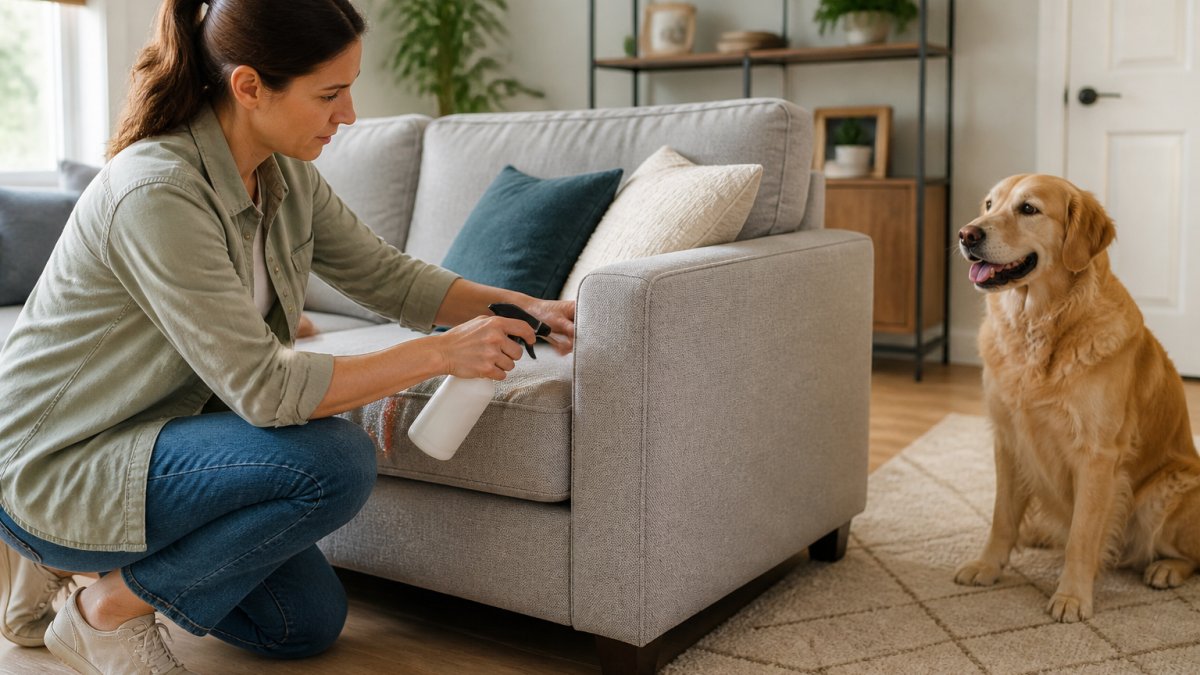
Start by cleaning the surface, dust and polish stop the spray bonding, shortening how long it lasts.
Let the surface dry completely before your dog goes near it. Most formulas need a few minutes.
Patch Testing on Upholstery and Wood Furniture
Patch testing takes two minutes and can save you a ruined sofa.
Wait at least an hour. Check for discolouration, stiffening or lingering marks. If the patch looks and feels unchanged, treat the visible surfaces.
Wood furniture needs the same care. Some finishes react badly to liquid sprays, so test an inconspicuous spot such as the underside of a table before treating the legs your dog chews.
How to Stop a Dog Chewing Furniture: Training Alongside Deterrent Spray
Spray alone rarely solves chewing. Owners who succeed combine a taste deterrent with clear training and better management of the environment. A bitter spray punishes a behaviour but does not teach your dog what to do instead, without an alternative, the chewing urge redirects to the next untreated object.
The redirection principle
Chewing is a need, not a whim. Block one outlet without providing another and you create frustration rather than a solution. Make the furniture boring and the chew toy rewarding, so your dog chooses the toy because it pays off, not because the settee tastes bad.
The spray and the training have to run together. The spray buys a few seconds of hesitation, in those seconds, offer something better and reward the choice.
A step-by-step routine
- Manage the space. Close doors or use a pen when you cannot supervise, so your dog cannot rehearse the habit. Every unsupervised chewing session strengthens the behaviour you are trying to break.
- Treat the targets. Apply bitter spray to the furniture and items your dog chews most, and reapply every few days until the habit fades.
- Offer a better option. Keep appropriate chew toys within reach and rotate them so they stay interesting, a toy on the floor for a fortnight is no longer novel.
- Reward the right choice. Praise or treat your dog the moment they pick up a toy instead of a chair leg. Timing matters, the reward must land within a second or two of the correct behaviour.
- Interrupt, then redirect. If you catch your dog mid-chew, a calm interruption followed immediately by offering a toy teaches the swap. Shouting alone teaches the dog to chew when you are not looking.
- Stay consistent. Every lapse undoes progress, so keep the routine steady for several weeks rather than a few days.
The Dogs Trust guidance on preventing destructive behaviour stresses that bored dogs chew more. Daily walks, sniffing time and puzzle feeders reduce the urge before it starts.
Matching the fix to the cause
The routine above works for habit-based chewing, but not for every dog, recognising the difference saves months of frustration.
- Teething puppies. Chewing relieves gum discomfort. Cold chew toys and patience matter as much as any spray.
- Boredom chewers. Usually young, active dogs left alone for long stretches. More exercise, sniffing and puzzle feeders reduce the behaviour at source.
- Attention-seeking chewers. The dog has learned chewing brings you running. Reward quiet, appropriate behaviour and avoid turning the chew into a game.
How to tell whether it is working
Effectiveness is not "the dog stopped chewing overnight". Look for these signals over two to three weeks:
- Your dog approaches a treated surface, sniffs, and walks away.
- Chewing attempts become shorter and less intense.
- Your dog starts choosing the chew toy without being prompted.
If damage migrates to new objects, the spray is working but the training is not, you removed one outlet without providing a satisfying alternative. If your dog chews straight through a freshly treated surface, the formula or the cause is wrong, not the routine.
Interactive toys and puzzle feeders are among the most effective tools here, giving your dog a legal outlet for chewing and mental work. Doggo Shop stocks a range of interactive toys designed for precisely this purpose, and every order donates 10% to rescue dogs in need worldwide.
Common Mistakes When Using Chewing Deterrent Spray
Most failures with chewing deterrent spray come down to a handful of avoidable errors. Fix these and results improve quickly.
- Spraying only once. Bitterness fades. Reapply every few days until the habit breaks.
- Skipping the patch test. One untreated cushion can cost more than the spray itself.
- Treating the furniture but not the shoes. Dogs move between targets. Treat everything they chew.
A common mistake is treating the symptom and calling it solved. If your dog chews the skirting board at 2pm every day, the question is not "how do I stop the chewing" but "what is happening at 2pm". Answer that and the spray becomes a small part of a working plan.
Conclusion: Choosing the Right Bitter Spray for Your Dog
Every dog owner faces the same challenge: a beloved dog, a damaged settee, and no obvious way to break the cycle.
At Doggo Shop, we focus on products that support that whole routine, from durable chew toys to interactive feeders that keep busy dogs occupied while you are out.
Browse our range of interactive toys and chew-friendly essentials, and build a routine that protects your furniture and keeps your dog happy.
SHOP NOW
Frequently Asked Questions
What is the best spray to stop dogs from chewing on furniture?
There is no single best spray for every dog. Look for a bitter spray made with pet-safe ingredients that is suitable for the surface you need to protect. Bitter apple spray is a common starting point, but some dogs ignore it. Check the label for fabric-safe and wood-safe claims, and always patch test first. The most effective approach combines a deterrent spray with training and appropriate chew toys.
Do bitter sprays work for every dog?
No. Bitter sprays rely on taste aversion, and some dogs simply are not bothered by the bitter flavour. Puppies and persistent chewers may lick the spray off or ignore it entirely. If your dog keeps chewing after you apply a bitter spray, the spray is not the problem. Your dog needs more appropriate chewing outlets, closer supervision, and possibly a vet check to rule out underlying causes.
Can bitter spray damage furniture or fabric?
Some formulas can stain or discolour upholstery, wood, or leather. Always patch test on a hidden area first and wait 24 hours before applying to visible surfaces. Avoid alcohol-based sprays on wood furniture because they can strip the finish. Fabric-safe and pet-safe formulas are available, but no spray is universally safe for every material, so read the label carefully.
How often should you reapply anti-chew spray?
Most anti-chew sprays need reapplying every 24 to 48 hours, or sooner if your dog licks the surface. Effectiveness fades as the spray dries or gets wiped off. For furniture your dog targets daily, reapply once a day until the chewing habit reduces. Pair reapplying with training so your dog learns the furniture is off-limits even without the spray.


Leave a comment