


Are Dog Hiking Boots Worth It for Rocky Terrain?
Table of Contents
- Are Dog Hiking Boots Worth It for Rocky Terrain? The Honest Answer
- Signs of Dog Paw Pad Injury You Should Never Ignore
- What Boots Actually Do That Paws Cannot on Sharp Shale and Igneous Rock
- How to Protect Dog Paws on Rocky Terrain (With or Without Boots)
- How to Measure Dog Paws for Boots: A Simple Sizing Method
- The Doggo Shop Pick: Waterproof Non-Slip Shoes for Big Dogs Reviewed
- Verdict: When Dog Hiking Boots Are Worth It and When They Are Not
- Frequently Asked Questions
Last Updated: September 11, 2026
Are Dog Hiking Boots Worth It for Rocky Terrain? The Honest Answer
For most dogs walking regularly on sharp shale or igneous rock, dog hiking boots are worth it, but only if the fit is right. A poorly fitted boot causes more harm than bare paws. This guide from Doggo Shop breaks down when boots help, when they don't, and how to choose correctly.
Scree slopes and volcanic rock abrade paw pads, wedge into the spaces between toes, and heat up fast in direct sun. Boots solve those three problems at once, but introduce new risks: rubbing at the dewclaw, sweat buildup, and a changed gait the dog must relearn.
Below, we'll show you how to decide whether your dog needs boots, how to measure for a secure fit, and what to do if your dog refuses to wear them. Most guides get this wrong: they treat boots as a universal upgrade. They aren't. On soft forest trails, boots add friction and heat for no benefit. On sharp rock, they're close to essential.
Signs of Dog Paw Pad Injury You Should Never Ignore
Limping after a walk is the most obvious sign of paw pad injury, but rarely the first. Early damage is quiet, and owners usually miss it until the pad has already split.
Watch for these signs, especially after rocky routes:
- Licking or chewing at one specific paw, often in the evening
- Reluctance to walk on gravel, hot pavement, or frozen ground
- Visible flattening or shiny patches on the pad surface
- Small cuts, flaps of skin, or dark specks lodged between toes
- A single paw held up briefly, then put down again
- Reluctance to jump into the car after a hike
Abrasions from sharp shale appear on the thickest part of the pad, not the edges, which is why they're easy to miss. Interdigital irritation shows up as redness and licking between the toes, often caused by grit working into the fur.
What Boots Actually Do That Paws Cannot on Sharp Shale and Igneous Rock
Boots replace the pad's contact surface with a rubber or synthetic sole, changing how force spreads across the foot. The mechanism matters more than the marketing.
On sharp shale, the risk isn't just cutting but repeated micro-abrasion: every step grinds the pad against a rough edge, wearing it thin in one spot. A sole spreads that load across more square centimetres, so the pad stops being the sacrificial layer.
On igneous rock, heat and grip matter most. Dark volcanic rock absorbs solar radiation and can burn pads within seconds of contact on still summer afternoons. Smooth, polished rock offers almost no purchase for claws, especially on descents where the dog brakes every stride; a rubber sole with a tread pattern gives the foot something to bite into.
Boots also handle hazards paws can't:
- Ice buildup between the toes in winter
- Trail debris, thorns, and small stones
- Hot pavement on the walk to the trailhead
- Chemical de-icers and salt on winter paths
The biomechanics angle most gear reviews skip
Any change to the foot's contact surface alters how force travels up the leg. A well-fitted boot with a flexible sole keeps the gait close to normal; a stiff or loose boot forces compensation, showing up as a shortened stride and altered weight distribution. Over one hike that's trivial, but over a season of constant booting it's the repetitive loading pattern practitioners associate with soft-tissue strain in the carpus and shoulder.
That's not a reason to avoid boots. It's a reason to fit them properly and to use them selectively rather than constantly. The goal is to keep the dog's natural gait as close to barefoot as possible while removing the terrain hazard.
Temperature regulation and sweat management
Dogs don't sweat through their paw pads the way humans sweat through skin, but the pads do have sweat glands and contribute to thermoregulation (PubMed). A boot that traps heat and moisture softens the pad and makes it more vulnerable to abrasion, not less, the most under-discussed trade-off in boot reviews.
What to look for:
- A breathable upper rather than a fully sealed membrane for warm-weather hiking
- A sole that's thick enough to insulate from hot rock but not so thick it blocks ground feel entirely
- A fit that allows a small amount of air movement without letting grit in
- Regular removal at rest stops so paws can cool and dry
Owners who boot for every walk often end up with a dog whose pads are softer, not tougher, because the pads never get the controlled abrasion that builds callus. Build tolerance on easy terrain and save boots for routes that genuinely need them.
How to Protect Dog Paws on Rocky Terrain (With or Without Boots)
Protecting paws on rocky terrain comes down to four things: conditioning, coverage, acclimatisation, and aftercare. You don't need boots for all four, but you need all four.
Conditioning. Start with five to ten minute sessions on gravel or packed dirt and build up over several weeks. This is how paw pad toughening happens; skip it and pads stay soft no matter how many hikes you do. Add no more than about ten minutes of rough-ground walking per week, and back off if the dog starts licking paws in the evening.
Coverage. Use boots on routes that need them: scree, volcanic rock, hot pavement, ice, and long-distance hiking days. For mixed terrain, many owners boot the front paws only, since dogs carry roughly 60% of their weight forward, a practical compromise, since the back paws still take the braking load on descents (PubMed).
Acclimatisation. This is where most owners fail. Put the boots on indoors for two or three minutes with treats, then a short walk on soft grass, then pavement, and only then a hike. Expect a comical high-stepping gait for the first few sessions; it usually fades within a week. If the dog refuses to move at all, the fit is probably wrong, not the concept.
Aftercare. Check paws after every rocky walk. Look between the toes, at the dewclaw, and along the pad edges. Rinse off grit and salt with plain water. A PDSA guide to paw care is a useful reference for what normal paw tissue should look like.
Structured vs soft boots: which style suits which terrain
Structured boots have a moulded sole and rigid heel cup, suiting jagged scree and long descents where grip and lateral stability matter most. The trade-off is weight and a longer break-in period.
Soft boots are essentially a reinforced sock with a rubberised sole, suiting mixed terrain, hot weather, and dogs that won't tolerate a stiff boot. The trade-off is less protection against sharp edges and faster wear on abrasive rock.
For most owners hiking a mix of forest track and rocky sections, a soft boot on the front paws and a structured boot on the back paws is a reasonable compromise. For pure scree or volcanic rock, structured on all four is the safer choice.
DIY emergency paw protection vs commercial boots
If you're hiking with no boots and no time to condition, wrap the paw in a self-adhesive bandage, secure with tape, and check every 20 minutes. It works for a short emergency stretch but won't survive a full day and traps moisture badly.
A thick wool sock held with vet wrap is more durable but has the same moisture problem and wears through on sharp rock within an hour or two. Neither substitutes for a fitted boot on a multi-day route; they're a bridge back to the car.
Boot failure points on jagged rock
On volcanic rock, failure points are predictable. The sole edge delaminates first, usually where rubber meets upper. The closure system is next, as grit works into hook-and-loop straps and reduces grip. The upper abrades last, usually only on the outer edge of the paw taking the most contact.
That's why replaceable soles and simple, cleanable closures matter more than fancy features on rocky terrain: a single wide strap is easier to clear of grit than three narrow ones.
How to Measure Dog Paws for Boots: A Simple Sizing Method
Measuring a dog's paw for boots takes about two minutes per foot and one tool: a soft tape measure or paper and a ruler. Measure while your dog is standing, because the paw spreads under load.
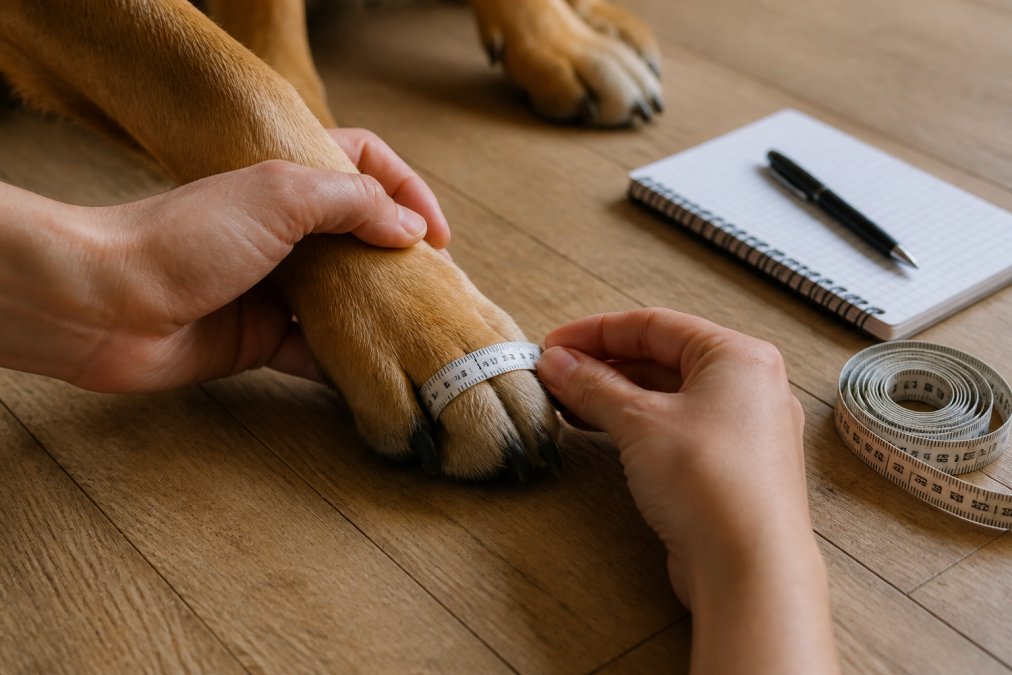
Follow this order:
- Place the tape around the widest part of the paw, just behind the toes. This is the paw circumference.
- Note the measurement in centimetres. Do not add extra room. A boot that's too loose rubs more than one that's snug.
- Measure the length from the back of the pad to the tip of the longest claw.
- Repeat for all four paws. Front and back paws are often different sizes.
- Measure in the evening, after a walk, when the paw is at its most expanded.
Match your measurements to the boot's own size chart, not to a generic size. Brands size differently, and a "large" from one maker can match a "medium" from another. Doggo Shop's Waterproof Non-Slip Shoes for Big Dogs run from size 1 at 5.8 cm long and 3.5 cm wide up to size 8 at 8.5 cm long and 7.5 cm wide, which gives a clear target for most large and medium breeds.
| Paw length | Paw width | Doggo Shop size | Typical fit |
|---|---|---|---|
| 5.8 cm | 3.5 cm | 1 | Small-medium breeds |
| 6.5 cm | 5.0 cm | 4 | Mid-size, e.g. collie |
| 7.5 cm | 6.4 cm | 6 | Large, e.g. Labrador |
| 8.5 cm | 7.5 cm | 8 | Extra-large, e.g. German Shepherd |
The Doggo Shop Pick: Waterproof Non-Slip Shoes for Big Dogs Reviewed
The Waterproof Non-Slip Shoes for Big Dogs at £24.99 for a set of four feature a double hook and loop closure that lets you adjust each boot independently, which can help prevent slipping and twisting on uneven ground.
The non-slip rubber sole provides excellent traction on wet, snowy, or rough terrain. The waterproof cloth upper keeps the paw dry through shallow streams and damp grass, and the reflective trim helps on early morning or evening walks when visibility drops.
Where it falls short: the cloth upper is breathable but not fully sealed, so a long wade through deep water will eventually soak through. And like any boot, it needs a break-in period before a long hike.
What works:
- Eight sizes cover most large and medium breeds
- Double closure gives a genuinely secure, adjustable fit
- Reflective design for low-light walks
- Easy to put on and remove
What doesn't:
- Not fully submersible
- Needs gradual acclimatisation before long distances
Pair them with a Heavy Duty Dog Leash with Double Bungee at £19.99 if your dog pulls on descents, and a 2-in-1 Pet Water Bottle at £24.99 for hydration stops on the trail.
Verdict: When Dog Hiking Boots Are Worth It and When They Are Not
Boots are worth it when terrain is abrasive, hot, frozen, or chemically treated, for long-distance hiking where cumulative pad wear becomes the limiting factor, and for dogs with existing pad damage or a history of interdigital irritation.
They're not worth it on soft forest trails, cool grass, or short suburban walks, where boots add weight, trap heat, and interfere with the natural gait adjustment a dog makes on varied ground. Constant booting can also reduce the pad's natural conditioning.
There's also a joint-health angle most gear reviews skip: any change to the foot's contact surface alters how force travels up the leg. A well-fitted boot with a flexible sole keeps the gait close to normal; a stiff or loose boot forces compensation, showing up as shortened stride and altered weight distribution. That's not a reason to avoid boots, but to fit them properly and use them selectively.
A useful rule: if you'd wince walking it barefoot, boot your dog.
Frequently Asked Questions
Do vets recommend dog boots for long-distance walking on rocky terrain?
Many vets suggest boots for long-distance walks over sharp shale or igneous rock because repeated impact can cause paw pad abrasions and bruising. Boots with abrasion resistance and traction control reduce that risk. However, vets also stress proper fit: a loose boot can cause dewclaw irritation, while a too-tight one restricts circulation. Always introduce boots gradually and check paws after each walk.
How do I know if my dog needs paw protection on a hike?
Look for signs of paw sensitivity: stopping frequently, licking paws, limping, or refusing to walk on rough ground. If the trail has hot pavement, sharp rocks, or ice buildup, protection helps. Breeds with thin pads or previous pad injuries benefit most. A simple test: after a short rocky walk, inspect pads for redness or small cuts. If you see any, dog hiking boots are likely worth it.
Are dog boots effective at preventing pad injuries on sharp rocks?
Yes, when they fit well and have durable soles. Boots with abrasion resistance and non-slip rubber outsoles shield pads from sharp shale and igneous rock. They also prevent cuts from trail debris. But no boot is indestructible: check for wear at the toe and sole after each hike. Combining boots with paw pad toughening and regular paw checks gives the best protection.
How do I measure my dog for hiking boots to ensure a secure fit?
Measure paw width and length while your dog stands on a firm surface. Place a tape measure across the widest part of the paw (paw circumference) and from the back of the pad to the tip of the longest claw. Compare to the boot's size chart. A secure fit allows slight movement but no slipping. Recheck before each hike as paws can change.
Can my dog wear boots all day on a thru-hike?
Boots are designed for protection during rough sections, not constant wear. On long-distance hiking or thru-hiking, take boots off during breaks and on smooth ground to let paws breathe. Temperature regulation matters: boots can trap heat, so choose breathable mesh where possible. Monitor for interdigital irritation and remove boots if you see rubbing. Rotate with paw wax or toughening routines to maintain pad health.
Rocky terrain punishes soft paws, and the difference between a great hike and a painful one often comes down to preparation. Doggo Shop stocks paw protection and trail gear built for exactly this, including waterproof non-slip shoes, shock-absorbing leads, and portable hydration bottles. Every order also supports rescue dogs and cats in need. Get started with Doggo Shop and head out on the trail with gear that holds up.


Leave a comment