


5 Best Durable Dog Leashes for Heavy Chewers (2026)
Table of Contents
- Quick Comparison: 5 Durable Dog Leashes for Heavy Chewers
- Heavy Duty Dog Leash with Double Bungee: Best Overall
- Hands-Free Dog Leash with Belt and Bottle Holder: Best for Runners
- Durable 4.5M Dog Leash for Daily Walks: Best Long Line
- Best Material for Chew-Resistant Dog Leads
- How to Stop a Dog from Chewing the Leash
- Toy Pairings That Redirect Chewing on Walks
- Conclusion
- Frequently Asked Questions
Last Updated: October 1, 2026
Quick Comparison: 5 Durable Dog Leashes for Heavy Chewers
Finding durable dog leashes for heavy chewers starts with one hard truth: no lead survives a determined chewer if the behaviour goes unmanaged. This guide from Doggo Shop pairs five tough, tested leads with the training tactics that actually protect them. Below, we break down what holds up, what fails, and how to stop the chewing at its source.
| Leash |
|---|
| Price |
| Key Feature |
| Best For |
| --- |
| --- |
| --- |
| --- |
| Heavy Duty Dog Leash with Double Bungee |
| £19.99 |
| Shock-absorbing double bungee |
| Best overall |
| Hands-Free Dog Leash with Belt & Bottle Holder |
| £24.99 |
| Hands-free waist belt |
| Runners and hikers |
| Durable 4.5M Dog Leash for Daily Walks |
| £19.99 |
| 4.5m training length |
| Long-line training |
| Durable Dog Chew Toy for Aggressive Chewers |
| £19.99 |
| Natural rubber, treat dispenser |
| Redirecting chewers |
| Indestructible Dog Chew Bone Toy |
| £16.99 |
| TPR dental texture |
| Teething puppies |
Heavy Duty Dog Leash with Double Bungee: Best Overall
The Heavy Duty Dog Leash with Double Bungee is the best all-round pick for heavy chewers because its climbing rope core and tightly woven nylon resist abrasion far better than flat webbing. The double bungee stretches from 20 to 35 inches, absorbing the jolt when a strong dog lunges.


Hands-Free Dog Leash with Belt and Bottle Holder: Best for Runners
Runners get the most from the Hands-Free Dog Leash with Belt, Pocket & Bottle Holder. The adjustable waist belt fits 28 to 48 inches and supports dogs up to 180 lbs, so you keep both hands free on the towpath or trail.

Durable 4.5M Dog Leash for Daily Walks: Best Long Line
Training a leash-biter often means giving them more room, not less. The Durable 4.5M Dog Leash for Daily Walks offers 4.5 metres of lightweight cloth lead, ideal for recall practice and sniff-heavy walks where a short lead causes frustration.
Best Material for Chew-Resistant Dog Leads
The best material for chew-resistant dog leads is tightly woven nylon over a rope or cable core, because dense weaves resist abrasion and give a chewer less purchase than flat webbing.
- Braided climbing rope: excellent tensile strength, comfortable grip and weather-resistant. A tight braid gives teeth very little to grip, which is why rope cores outperform flat webbing against determined chewers.
- Heavy-duty nylon webbing: lightweight and affordable, but flat webbing frays faster under teeth and a single chewed strand can run the length of the lead.
Where leads actually fail
Generic 'durable' claims hide the fact that most lead failures happen at three predictable points, not in the middle of the material:
- The clasp-to-lead junction. This is the highest-stress point on any lead. A swivel clasp that is stitched rather than bar-tacked, or a crimped cable end with no protective sleeve, will fail long before the body of the lead does. Look for a bar-tacked or riveted join and a covered cable end.
- The handle loop. Chewing usually starts here because the loop dangles near the dog's mouth on a slack lead. A padded, double-stitched handle survives far longer than a single-layer webbing loop.
- The bungee or elastic section. Shock-absorbing leads concentrate force at the point where the elastic meets the fixed rope. If that join is only glued or lightly stitched, it is the first thing to go.
Clasp and hardware strength
A lead is only as strong as its weakest metal component. Trigger clasps are convenient but can be popped open by a strong dog twisting against them; a locking carabiner or a screw-gate clasp removes that risk entirely. Zinc-alloy clasps are common on budget leads and are the first component to bend under a hard lunge, while stainless steel hardware resists both bending and rust.
Weather resistance and maintenance
Rope and cable leads handle rain well but should be rinsed in fresh water and dried after muddy walks, because grit trapped in a braid acts like sandpaper against the core. Nylon webbing absorbs water, stiffens when it dries and weakens with prolonged UV exposure, so store it out of direct sun. Vinyl-coated cable should be wiped down and checked for cracks in the coating; once water gets inside, rust follows.
How to Stop a Dog from Chewing the Leash
Stopping leash chewing is a training problem first and a hardware problem second. Dogs bite leads during teething, out of boredom, or because tugging has become a game. Fix the cause and most leads last far longer.
Thick Tire-inspired Durable Dog Chew →
Why dogs chew the lead in the first place
Before you change any gear, work out which of these four drivers is behind the behaviour, because each one needs a different response:
- Teething. Puppies between roughly four and seven months chew to relieve gum discomfort. The lead is simply the nearest textured object. This is a life-stage problem, not a discipline problem.
- Boredom and under-stimulation. A dog that has had no sniffing, no training and no mental work will find its own entertainment, and a lead that swings at mouth height is an easy target.
- Attention-seeking. If chewing the lead has ever made you stop, look down or start talking, the dog has learned that the lead is a remote control for your attention.
- Over-arousal. A dog that is already excited, before a walk, near other dogs, on a busy pavement, redirects that arousal onto whatever is closest, which is often the lead.
The training sequence that actually works
The aim is to make the lead boring and the alternative rewarding. Work through these steps in order:
- Never let the lead become a tug toy. The moment your dog grabs it, stop walking and hold the handle still. A lead that goes dead in the mouth teaches faster than any correction.
- Redirect immediately, not eventually. Offer a chew toy the instant your dog's mouth heads for the lead, and praise the swap. Timing is the whole skill here, a redirect two seconds late rewards the bite.
- Reward loose-lead walking. Mark and treat a slack lead every few paces. A dog that is being paid for walking calmly has far less reason to entertain itself with the lead.
- Add mental work before the walk. Five minutes of scent games or a short training session lowers arousal and gives the dog a job, which reduces the redirection behaviour on the walk itself.
- Change the picture. If the lead dangles at mouth height, loop the slack through your hand or use a shorter lead so there is less to grab. Removing the opportunity is not cheating; it is good management while the training takes hold.
- Check for teething and provide appropriate outlets. Puppies need something legal to chew, not punishment for chewing the wrong thing.
Match the approach to the dog
A teething puppy and a powerful adult chewer need different plans. For a puppy, the priority is management and redirection: shorter walks, a light lead, a chew toy in your pocket and patience until the gums settle. For an adolescent or adult dog that has learned to play tug with the lead, the priority is removing the reward, the walk stops the moment teeth touch the lead, and resumes the moment the dog disengages.
Toy Pairings That Redirect Chewing on Walks
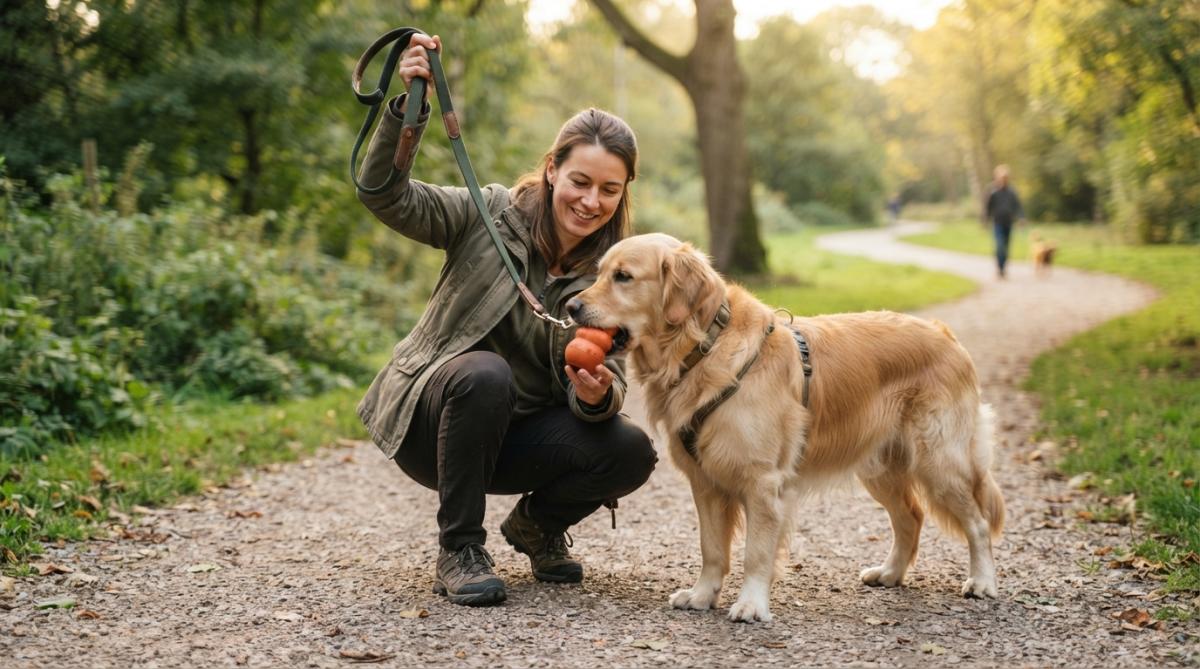
Redirecting a chewer works best when the alternative is more interesting than the lead. Carry a high-value toy on every walk and offer it the second your dog's mouth heads for the leash.
Conclusion
A chewed-through lead is rarely about bad luck; it is usually a behaviour left unmanaged and hardware that was never tough enough. Pair the right training habits with gear built to last and the problem disappears. At Doggo Shop, every lead, toy and essential is chosen to keep your dog happy, healthy and comfortable, and every order supports rescue dogs and cats in need worldwide.
Frequently Asked Questions
What is the best leash that my dog can't chew through?
No leash is completely chew-proof, but climbing rope and tightly woven nylon leashes resist teeth far better than flat webbing. The Heavy Duty Dog Leash with Double Bungee uses climbing rope and woven nylon with 360° swivel metal hardware, which makes it harder for a determined chewer to grab and sever. Pairing a tough leash with training to redirect chewing is the most reliable approach.
Are chain leashes better for dogs that chew?
Chain leashes are very hard to bite through, but they are heavier, colder to hold, and can damage teeth if your dog bites down hard. A climbing rope or tightly woven nylon leash with metal hardware offers similar durability without the weight. If your dog is a determined chewer, a rope leash plus a distraction toy usually works better than chain.
How do I stop my dog from chewing their lead during walks?
Start by teaching a default position by your side with treats and praise, so the leash stays slack. When your dog grabs the lead, stop walking and hold it still until they release, then reward. Bring a chew toy on every walk and offer it the moment your dog looks at the leash. Consistency across every walk matters more than any single tool.
What materials are most resistant to dog chewing?
Climbing rope, tightly woven nylon and biothane resist chewing best because their fibres are dense and hard to separate. Flat webbing with reinforced stitching is a step down but still holds up well. Look for metal hardware such as a bolt snap or swivel clasp, since plastic clips are usually the first part to fail on a heavy chewer.
What is the best leash for heavy dogs?
For dogs over 30 kg, choose a leash rated well above your dog's weight with metal hardware and a padded handle. The Heavy Duty Dog Leash with Double Bungee supports dogs up to 150 lbs and uses a shock-absorbing bungee to reduce strain on your arms. The Hands-Free Dog Leash with Belt supports dogs up to 180 lbs and is a good option for strong pullers.


Leave a comment